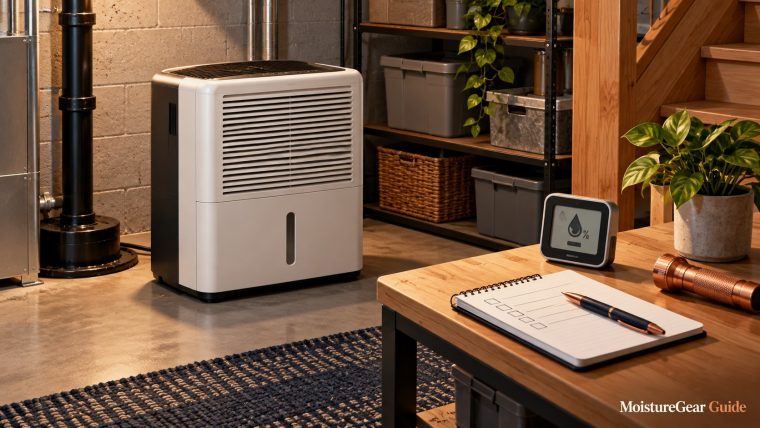
The question “why is my basement humid in summer?” usually needs an explanation of both moisture and temperature. Humid outdoor air can reach a basement whose walls and floor remain cooler than the weather outside. Cooling that air raises its relative humidity, and sufficiently cold surfaces can collect condensation. Rainwater, ground moisture, plumbing, laundry, and other indoor activities can add separate loads at the same time.
The useful next step is to identify the pattern in your house. A wet wall after a storm and condensation on a cold pipe during muggy weather may look related, yet call for different corrections.
This guide explains the building science and a practical observation process. For equipment choices after the source assessment, use the basement dehumidifier hub and basement buying guide.
Warm weather does not mean warm basement surfaces
A below-grade basement can retain cool surfaces even when the outdoor air becomes hot and humid. Foundation walls, slab areas, cold-water pipes, and objects touching those surfaces may be cooler than the room's central air.
When moist air contacts a surface below its dew point, condensation can form. That does not require the entire room to reach 100% relative humidity. The conditions immediately at the cold surface can be different from the reading on a meter across the room.
Building Science Corporation’s explanation of basements describes summer contact between warm moist air and cold below-grade surfaces. That is why an apparently dry warm afternoon can still coincide with basement condensation.
Look at where the water appears. Widespread moisture on cold surfaces suggests one line of inquiry. A concentrated water track, a damp base of a wall, or water entering a window well suggests another.
Avoid deciding the cause from a single photograph. Timing, weather, surface location, and repeated observations make the pattern clearer.
Relative humidity and dew point answer different questions
Relative humidity expresses the air's moisture condition relative to saturation at its temperature. Dew point gives the temperature at which that air would become saturated as it cools under the relevant conditions.
The National Weather Service explains why dew point is more useful than relative humidity alone when comparing moisture in air at different temperatures.
For a basement decision, a lower outdoor humidity percentage does not necessarily mean the outside air is drier in the way that matters. Warm air at a modest percentage can contain more water vapor than cooler basement air at a higher percentage.
That is the mistake behind automatically opening windows because the weather app shows a smaller humidity number outdoors. Temperature and moisture must be considered together.
If your monitoring equipment or local weather information shows dew point, compare it with the conditions indoors and the cold surfaces of concern. A weather station reading is context rather than an exact measurement at your basement window, but it can help explain the seasonal pattern.
Why opening windows can make summer dampness worse
Ventilation with outside air helps dry a space only when the incoming conditions and complete building plan support that result. During muggy weather, the incoming air can add a moisture load.
University of Minnesota Extension specifically cautions against ventilating a summer-condensation problem directly with warm, humid air.
An open basement window may bring that air toward cool walls and stored objects. A fan can move the air faster without changing whether it contains too much moisture for those surfaces.
Do not interpret this as advice to disable required ventilation or combustion-air provision. Mechanical systems and occupied spaces still need an appropriate ventilation plan.
For routine dehumidifier operation, manage unnecessary exterior openings and use the appliance according to its manual. Assess building ventilation separately if you are unsure which openings are required or how the system is intended to operate.
Rain and groundwater can add a different source
Summer storms can expose drainage problems. Roof runoff, poor grading, blocked gutters, window wells, and changing groundwater conditions can affect the basement independently of air humidity.
Observe the relationship to rainfall. Does the humidity rise after rain while a particular wall becomes damp? Is water visible at a crack or wall-floor joint? Does a window well retain water?
Those observations do not diagnose the exact repair, but they are useful information for a drainage or foundation professional. Photograph the location and note when the change occurred.
A dehumidifier may collect water evaporating from damp materials, yet that collection does not prove the source is corrected. It can reduce air humidity while the wall continues to receive moisture.
The EPA moisture guide emphasizes repairing water problems. Do not let a lower room reading obscure new seepage or damage to finishes.
Indoor activities still matter downstairs
Laundry, bathing, people, and other activities can add water vapor to a basement. Those loads may become more noticeable when summer conditions already make the space difficult to manage.
Check whether a dryer exhausts as intended and whether a bathroom's exhaust arrangement is functioning. Persistent humidity associated with an activity can point toward source control rather than a larger appliance.
Wet clothes left to dry indoors create another load. The amount depends on the activity, but the principle is straightforward: water leaving the clothing enters the surrounding environment.
A finished basement may add more moisture-producing uses than the original storage area had. A new bathroom, bedroom, or kitchenette can change the pattern without any change to the foundation.
Keep those activities in the log. If humidity rises mainly after laundry rather than during muggy weather or rain, that difference should shape the next investigation.
Why air conditioning may not control the basement
Air conditioning can remove moisture during cooling, but temperature control and humidity control are not identical goals. A comfortable basement temperature does not establish adequate drying.
If the space does not call for much cooling, the air conditioner may operate less while the moisture load continues. Air distribution and the larger system's controls also affect the basement.
The Department of Energy’s humidity-control research discusses why lowering the thermostat can leave occupants cold without resolving humidity appropriately.
Do not respond by making random changes to blower speeds, wiring, or control settings. Have an HVAC professional assess the system when its humidity performance is a concern.
A supplemental dehumidifier can be useful for residual loads, particularly when the basement needs drying without additional cooling. Its application still depends on capacity, temperature, airflow, and drainage.
Use timing to narrow the possibilities
| Pattern you observe | What it can suggest | Useful next observation |
|---|---|---|
| Condensation increases during muggy weather | Humid air meeting cold surfaces | Temperature, dew point, exterior openings, surface locations |
| Wetness follows rain at one wall or window well | Water-management issue | Runoff, grading, drainage, photos after storms |
| Humidity rises after laundry or showers | Indoor moisture source | Venting and activity timing |
| One closed room stays elevated | Air-distribution or local-source issue | Door position and readings in adjacent rooms |
| Dehumidifier location is dry but a corner is damp | Local conditions differ | Surface temperature, obstruction, moisture entry |
| High humidity persists through several conditions | Combined load or equipment/application issue | Longer log and professional assessment |
The table is a way to organize evidence. Several rows can apply at once, and none establishes a diagnosis without checking the building and equipment.
Build a short summer observation log
Choose representative monitoring positions. Keep a meter away from direct sunlight, warm appliance discharge, and the immediate effect of a shower or dryer unless you are deliberately studying that local source.
Record temperature and humidity at similar times. Note rain, muggy periods, exterior window use, internal door positions, laundry, and air-conditioner operation.
If there is condensation, identify the surface rather than writing only “basement wet.” A cold pipe, slab edge, wall base, and window each provide different clues.
Photograph visible changes with dates. A comparison before and after rain can be more useful to a contractor than a general statement that the basement feels damp in summer.
The basement hygrometer guide explains accuracy, placement, and logging features. You can begin with a simple meter if its location is sensible and the observations are consistent.
What you can address before changing equipment
Review ordinary source-control items that are accessible and within your ability to inspect safely. Look for blocked gutters, runoff near the foundation, obvious leaks, displaced dryer exhaust, or unnecessary open exterior windows.
Correct repairs should suit the building. Do not improvise foundation drainage, alter structural details, or conceal a damp assembly with a coating because it seems to reduce the visible symptom.
For cold-water pipe condensation, insulation may be relevant, but identify leaks and use an appropriate installation. Water on a pipe is not automatically condensation.
Keep stored items away from areas that remain wet and inspect vulnerable materials. A lower room humidity reading does not restore items already damaged by water or contamination.
If the cause is unclear or the condition persists, use the log to obtain an assessment. Source control and equipment can work together, but one should not be used to hide uncertainty about the other.
Where a dehumidifier fits
A dehumidifier is useful when the basement has a residual water-vapor load that the building's normal systems do not manage. It can maintain a target under suitable operating conditions while source issues are corrected.
Select capacity using more than floor area. The basement sizing guide considers temperature, moisture pattern, connected rooms, and the rating conditions behind equipment labels.
Place the appliance where it can reach useful air, not simply beside the most convenient outlet. A closed utility room may become dry while the area you care about remains elevated.
Drainage must remain reliable during the humid period. Full-bucket interruptions can make a suitable appliance appear inadequate if it stops each time the container fills.
If the machine runs continuously, use our constant-running investigation before buying another model. A very low target, restricted air path, or active moisture source can be mistaken for an undersized appliance.
What a fan can and cannot do
A fan can improve mixing in a suitable arrangement and help you understand whether stagnant local air is part of the problem. It does not itself remove water vapor from the basement.
A fan pointed at a wet surface may increase evaporation into the room. That water still needs to leave through an appropriate drying or ventilation arrangement.
A window fan brings or exhausts outside air; its effect on moisture depends on the complete path and outdoor conditions. During muggy periods, it may increase the load instead of reducing it.
Avoid directing fans at known mold growth or using ordinary airflow to declare contaminated materials restored. Follow appropriate remediation guidance for an existing contamination problem.
Think of air movement as part of distribution, not as a substitute for source correction or actual moisture removal.
Do cold walls need insulation?
Cold surfaces can contribute to condensation, but adding insulation is a building-assembly decision. The order matters: water control and a suitable moisture design come before covering the wall.
Building Science Corporation’s basement-insulation guidance discusses protecting cold foundation surfaces from interior moisture while allowing an appropriate assembly.
Do not assume that a layer of fiberglass, interior plastic, or a decorative panel works in every basement. Materials and drying paths have to suit the location and climate.
If a renovation is planned, ask how the design handles both bulk water and humid indoor air. Also ask how the dehumidifier, drainage, controls, and maintenance access fit the completed layout.
Our finished versus unfinished guide explains why a finished appearance can change the equipment decision without establishing that concealed conditions are dry.
Choose a humidity target with context
EPA recommends keeping indoor relative humidity below 60%, ideally within 30–50% when possible. That reference can guide monitoring and equipment settings.
The room number should be considered alongside cold surfaces. Condensation in one corner may occur under conditions not represented by a meter in the warmer center.
For many basements, starting around 45–50% and watching the trend is reasonable. Avoid running at an exceptionally low setting simply because summer feels damp upstairs.
A practical target should produce stable control and prevent persistent condensation in the intended space while the building issues are addressed. It does not replace inspection of materials that are already wet.
If the desired condition cannot be maintained, review sources, distribution, temperature, maintenance, and capacity together. The solution may be a better application rather than a lower number on the controls.
An odor is a clue, not a humidity measurement
A musty odor can alert you to an area that needs investigation, but it cannot identify the moisture source or replace a room reading. An odor may remain after conditions change, and a comfortable-smelling room can still contain a localized damp area.
Use location and timing to guide the inspection. Does the smell come from a stored item, an enclosed room, or an area beside a wet surface? Record that observation alongside the measurements.
Do not use fragrance, a lower setpoint, or a clean-looking wall as proof that an underlying condition is corrected. If damp or contaminated materials are suspected, address them through appropriate inspection and cleanup.
When to bring in help
Active seepage, recurring standing water, an unexplained plumbing leak, concealed dampness after renovation, or existing mold that you cannot manage appropriately deserves professional attention.
An HVAC assessment can help when temperature is comfortable but humidity remains high throughout the house, or when the basement's air distribution seems inconsistent. A drainage or building-envelope assessment may be more useful when wetness follows storms.
Provide the observations, photographs, and equipment details you have collected. The aim is to make the next decision evidence-based, not to prove a theory before someone visits.
Summer basement humidity often combines humid outdoor air, cool surfaces, and one or more water sources. Once you separate those contributors, you can choose source repairs, a ventilation plan, and dehumidification that work toward the same result.
Selected sources
- National Weather Service: dew point versus relative humidity
- Building Science Corporation: understanding basements
- University of Minnesota Extension: summer condensation and water sources
- EPA: moisture control
- Department of Energy: humidity control and cooling

About the author
Davis Murphy
Davis Murphy writes about dehumidifiers, indoor humidity, and home moisture control at MoistureGear Guide. His articles explain how to compare equipment, understand capacity ratings, and plan for drainage and maintenance. He focuses on clear, practical guidance to help readers choose a dehumidifier suited to their space and needs.