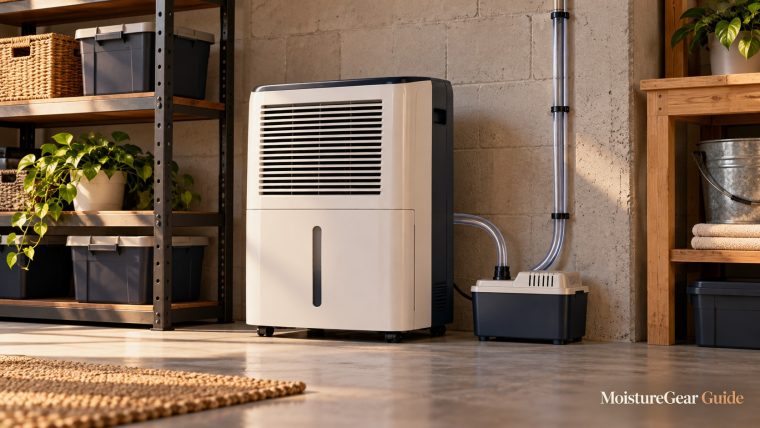
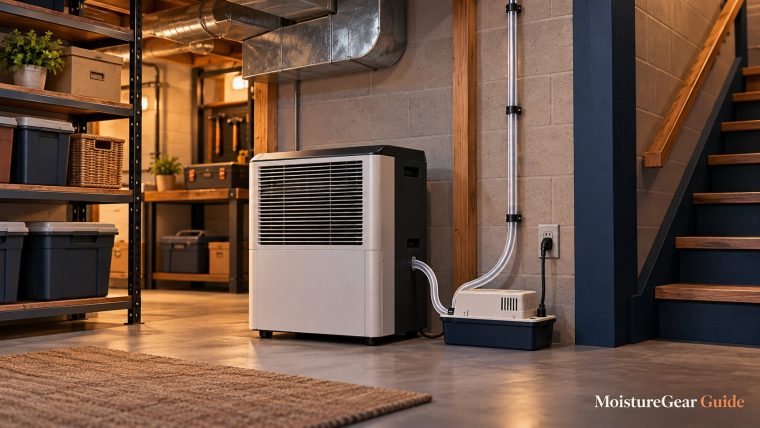
The best basement dehumidifier is the one that keeps the dampest useful part of your basement under control without creating an awkward drainage routine. A portable machine may be enough for a mostly open lower level. A permanent unit can make more sense when several rooms need coordinated treatment, the moisture load persists through the year, or you want the equipment outside your living area. Paying more only helps when the additional capacity, installation options, or service access solve a problem you actually have.
Start with a temperature and humidity log, a sketch of the basement, and a realistic water-disposal route. Those three things reveal more about the right equipment than a large square-footage number printed on a listing.
This guide compares manufacturer-documented features and published specifications. It does not report hands-on tests or rank long-term reliability. Product names refer to the exact versions shown; confirm the nameplate, supplied manual, seller, and accessories before ordering. Our basement dehumidifier hub connects this buying decision with sizing, placement, drainage, and troubleshooting.
Choose the arrangement before choosing the brand
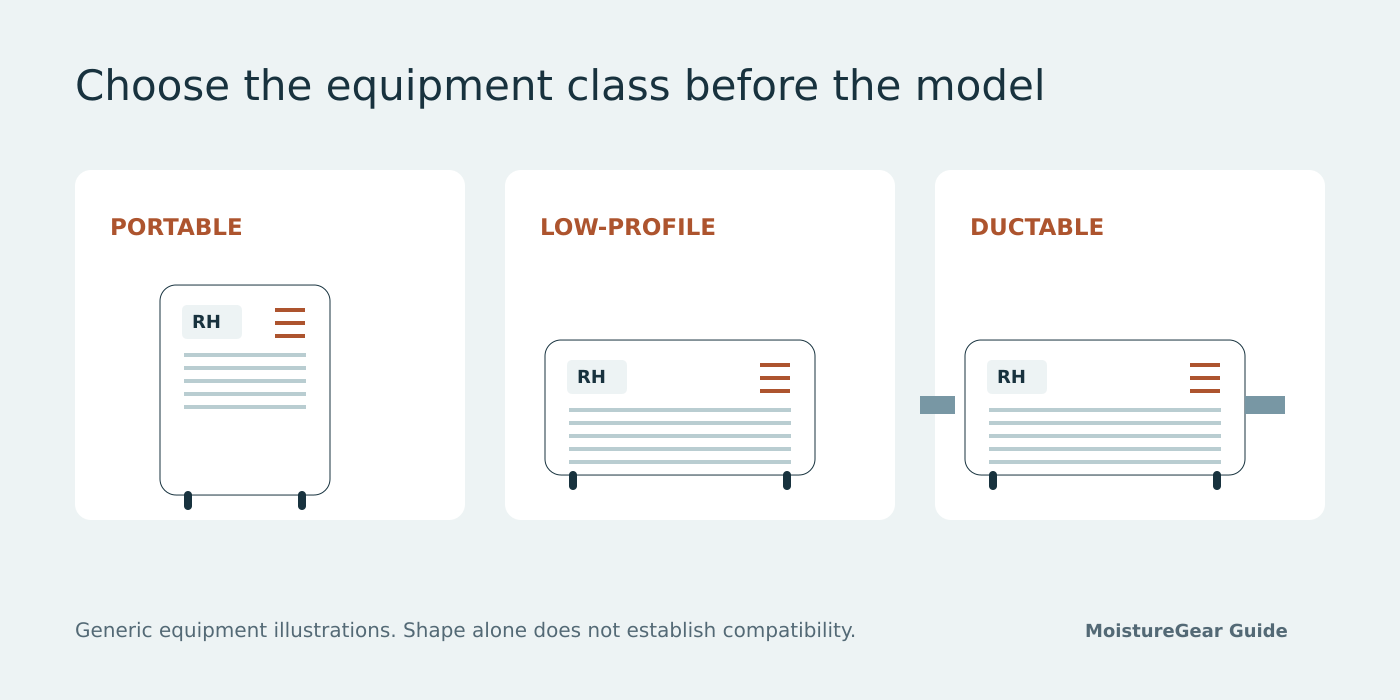
For many owners, the first useful distinction is between a portable room dehumidifier and equipment intended for a permanent installation. Portables combine controls, a collection bucket, and a cabinet you can move. Permanent equipment normally directs condensate to a drain and may support ductwork, a remote control, or a location in a mechanical area.
Neither design fixes incoming groundwater. If the floor gets wet after rain, a wall leaves a fresh water track, or a window well fills, investigate that source alongside humidity control. The EPA’s moisture guidance emphasizes correcting water problems rather than merely treating their effects.
| Basement situation | Arrangement worth considering | Main constraint |
|---|---|---|
| Open storage basement with a convenient lower drain | Portable with gravity drainage | Hose must run downhill throughout |
| Open basement with a utility sink above the appliance | Portable with an integrated pump | Actual hose route must fit the pump’s documented limit |
| Divided finished basement with regularly closed doors | Professionally planned air distribution | A larger machine cannot compensate for isolated rooms |
| Persistent load and space for permanent equipment | Basement-rated permanent unit | Installation, drainage, and service costs |
| Lower level that gets unusually cold | Model with a suitable operating range | Capacity near the minimum remains a separate question |
Think of that table as a way to eliminate unsuitable designs. It is not a floor-area calculator. A small damp room with an active laundry area can ask more of the equipment than a larger, well-sealed space used only for storage.
Four options with different reasons to consider them
Our shortlist includes three portable designs and one permanent option. They are not arranged from universally best to worst. The most sensible choice changes with your drainage route, room layout, and willingness to organize an installation.
| Exact model | Why it belongs on the shortlist | What to verify |
|---|---|---|
| Midea Cube MAD50PS1QWT-A | Lift-and-twist portable design, smart controls, integrated pump | Operating configuration and the matching pump instructions |
| Frigidaire FHDP5033Y1 | Conventional portable arrangement with pump and connected controls | Rear filter access, clearances, and the exact Y1 model |
| Danby DDR050BJP2WDB | Portable pump option with straightforward onboard controls | Manual, drain routing, and local carry-in service |
| AprilAire E080 | Permanent equipment for basement or planned ducted use | Load assessment, complete installation scope, and purchase eligibility |
The three portable machines are marketed in the 50-pint class. The AprilAire belongs to a different equipment category and uses different published rating conditions. Do not interpret that table as evidence that an 80-pint permanent unit removes a fixed percentage more water in your basement.
Midea Cube MAD50PS1QWT-A: consider it for flexible bucket and pump use
The Cube is an interesting option if your basement use changes. You might begin with bucket collection while deciding on a drain route, then use the pump once a utility sink becomes available. The exact manufacturer page identifies the MAD50PS1QWT-A as the pump version with smart controls.
Its cabinet arrangement deserves more attention than a conventional rectangular portable. Storage and operating positions differ, and a compact-looking dimension does not tell you the room required for normal stacked operation. Before fitting it beneath shelving, check the supplied manual and account for lifting the upper assembly when you access the bucket.
The pump should not be treated as a separate attachment you can ignore after installation. In the manufacturer-hosted guide for this version, pump use involves the bucket and pickup arrangement; bucketless operation is a different mode. That distinction matters if a retailer describes several drainage methods in one short bullet list.
Choose the Cube when its form and controls suit your routine. Choose another layout if repeatedly separating assemblies would be inconvenient, you lack room to handle the bucket, or you prefer the familiar front-bucket format. App access can help you see settings, but a connected appliance still needs physical inspection of hoses and water collection.
Frigidaire FHDP5033Y1: consider it for a conventional connected portable
The FHDP5033Y1 manufacturer page describes a pump-equipped portable with app control. It is a distinct model from older FFAP-series equipment and from similarly named versions with other suffixes.
This option suits someone who wants a familiar appliance layout, onboard operation, and a remote view of settings. It is also a useful candidate for a partially finished basement where the equipment will sometimes be visible. The practical issue is where the inlet and filter need space. A tidy-looking recess can make cleaning more difficult if furniture or storage blocks access.
The published specification sheet identifies rear filter access and top discharge. That helps you plan the footprint, but it does not authorize enclosing the appliance in a cabinet. The full owner’s guide remains the installation authority.
A conventional cabinet is worth choosing when it makes the job easier to live with. It does not establish better drying performance than the Cube, nor do remote schedules guarantee lower bills. If you use a schedule to create a quiet evening period, verify that the basement remains under control between those sessions.
Frigidaire has discontinued some much-discussed older units. A review of an older FFAP model can explain the category, but it is not evidence about this Y1 model's noise, controls, warranty, or pump. Match the actual product you are purchasing.
Danby DDR050BJP2WDB: consider it when simple local operation matters
Danby's US product page for DDR050BJP2WDB documents a portable with a vertical pump and two fan speeds. It is a reasonable alternative when you want to make the humidity setting at the appliance rather than build your routine around a phone.
Simple controls can be an advantage in a house shared by several people. Someone checking the basement can see the display, notice a bucket problem, and inspect the hose without knowing an app login. That is a usability preference, not a reliability finding.
Pay particular attention to the floor. The matching Danby manual calls for a stable, level surface and warns against placement on carpeting. A finished basement may therefore need a different location from the one suggested by the nearest outlet.
Service arrangements also affect the purchase. Carry-in coverage means the owner's practical responsibility can differ from a system serviced at home. Before buying, ask where an eligible unit would go if it needed attention. Saving a receipt and retaining the original model information makes that conversation easier.
The right reason to choose this Danby is that its layout, controls, documentation, and support route work for you. Avoid choosing on brand-wide claims about sound or lifespan. Those broad statements cannot substitute for a measurement or a service record for the exact appliance.
AprilAire E080: consider it for a permanent basement plan
The AprilAire E080 is a different proposition. It uses a drain arrangement rather than an ordinary removable collection bucket and can serve a professionally configured basement installation.
Its attraction is not simply its larger nameplate class. A permanent setup can place controls, drainage, and airflow where they fit the building. That may allow treatment of a divided basement while keeping the main cabinet in a utility area. It also introduces decisions about duct routing, return paths, accessory controls, supports, and commissioning.
For an open unfinished basement, a standalone arrangement may be sufficient if the manufacturer's installation requirements and load assessment support it. For a bedroom, office, and storage room separated by doors, investigate whether the installation will move air through all the rooms. A powerful machine in one closed mechanical room is still serving that room first.
Ask for a written scope covering equipment, mounting, drainage, air distribution, control location, electrical requirements, and ongoing access. Compare that total with a portable solution that is actually likely to succeed. An equipment-only price is an incomplete estimate for the permanent option.
The E080 and E080W are separate models. Accessories and control capabilities must match the exact purchase. Our E080 research review examines the permanent-unit decision in more detail, while the whole-house versus portable comparison helps when humidity extends beyond the basement.
How much capacity should you buy?
A basement's floor area is a starting point. The rest of the question is how much water enters the space, how cold the air becomes, and whether the appliance can circulate that air.
ENERGY STAR's dehumidifier buying guidance considers both space size and existing dampness. A coverage claim on a retail listing should therefore be read as a manufacturer’s broad application estimate, not a promise for any basement of that size.
Measure the connected space rather than every room on the floor plan. If one door stays closed most of the day, treat the space behind it as a separate airflow problem. Ceiling height, an open stairwell, indoor activities, and moisture from adjacent areas all change the practical load.
Water-removal ratings also depend on test conditions. ENERGY STAR explains why newer portable ratings differ from older warm-air ratings. The basement sizing guide turns that information into an application-specific worksheet without pretending that one formula knows your foundation, weather, and daily use.
Avoid buying an intentionally undersized unit merely because you can run it continuously. Long operation can be normal, but a machine that cannot reach a reasonable target under ordinary conditions leaves little margin for humid weather. Conversely, a much larger installation will not dry an isolated room until you address the air path.
Temperature can change the shortlist
The temperature near the intended inlet matters more than the reading upstairs. An unheated corner can be several practical steps away from the comfortable family room, even though both are called the basement.
Check measurements during the cooler part of the day and through the seasons you expect to operate. A model advertised for low-temperature use has a lower operating limit; that number does not describe full water removal at the limit.
The Frigidaire and Danby options above have manufacturer-documented low-temperature provisions, but a basement close to freezing requires a different assessment. Pumps, exposed tubing, and receiving drains also need a usable environment. The cold-basement guide explains how to separate permitted operation from useful capacity and when the usual portable shortlist stops being appropriate.
Heating the whole basement solely to improve a dehumidifier's output is not an automatic recommendation. First determine whether the problem is high moisture content, a cold surface, an uncorrected water source, or a measurement that rises because the room cooled.
Water disposal is part of the purchase
A bucket is a workable option when you visit the basement regularly and can handle the water safely. It becomes less attractive for a seldom-used property or a persistent moisture load. Bucket-full shutoff protects the collection system, but the room receives no active drying while the appliance waits.
Gravity drainage is often the cleanest arrangement when an approved receiving point lies below the outlet. Check the entire hose path. A hose can start downhill and still fail because it rises over a threshold or sags behind a shelf.
An integrated pump addresses the need to lift water, not the need to select a legal, practical destination. The height and length limits belong to the exact model and hose arrangement. If the route exceeds those limits, an external condensate pump or a different equipment location may be required.
Use the pump-equipped basement comparison for appliance selection. If there is no floor drain at all, the no-floor-drain guide begins with possible receiving points and avoids buying a pump before the route is known.
Finished rooms need a sound and airflow plan
An appliance that is tolerable in a storage basement may become intrusive beside a home office. Fan airflow, compressor operation, vibration, and intermittent pump discharge create different sounds. A single low-speed decibel claim cannot tell you how the machine will feel during a video call.
Try to preserve distance from desks and seating while keeping a useful air path. Do not hide a portable in an unventilated closet to solve noise. That arrangement can satisfy the machine's local humidistat while the occupied room remains damp.
The quiet-basement guide explains which manufacturer figures are meaningful and where they lack context. For divided spaces, the placement guide helps you plan a location that balances airflow, maintenance, and everyday use.
Compare total cost, not only the checkout amount
For a portable, include the appliance, suitable hose, any permitted fittings, monitoring, and the effort involved in emptying or cleaning it. An unused app feature has little value if the physical setup remains inconvenient.
For permanent equipment, request installation and accessory costs separately. Two quotes for the same model can include different air-distribution work, drain destinations, remote controls, or service arrangements. Write down what each quote actually delivers.
Running cost depends on power use and operating time. A published efficiency number is useful for comparing properly matched equipment, but it does not predict your electric bill by itself. Use the electricity-cost guide with measured or explicitly estimated values rather than assuming a universal monthly charge.
Warranty length deserves similar care. Find out who qualifies to service the equipment, what the seller must provide, and whether transport, labor, or installation work is covered. A headline warranty period is not a complete ownership comparison.
A practical first-week evaluation
Once the appliance is set up according to its manual, keep the initial evaluation simple. Record the target, room temperature, and humidity at the same locations. Note weather, laundry use, and whether internal doors were open. Inspect the drain during actual discharge.
A target around 45–50% can be a reasonable starting experiment for many occupied basements, provided conditions and the building support it. EPA recommends keeping humidity below 60%, ideally within 30–50% when possible. The goal is stable control and dry surfaces, not chasing the lowest number the controls permit.
Use an independent meter away from the warm discharge to compare areas. Look for a downward trend in the troublesome room and whether surfaces stop collecting condensation. If one area remains elevated while the appliance location is dry, investigate distribution before replacing the machine with a larger one.
Long initial operation can reflect moisture coming out of stored materials. Persistent operation without progress calls for a separate investigation. Our constant-running checklist helps distinguish settings, blocked airflow, ongoing moisture, and a need for professional service.
Keep the model label, invoice, installed hose information, and a photograph of the completed arrangement. Those details are useful if you need support or want to change the setup later. The strongest purchase is the one whose capacity, location, drainage, and service plan work together.
What to write on your purchase shortlist
Before comparing checkout totals, make a one-page note for each candidate. Record the exact model, the room it will serve, the lowest measured inlet temperature, the drainage method, and the clearance you can actually provide. Leave a blank beside any detail you have not confirmed. A missing pump limit or unavailable installation manual is a reason to investigate, even if the listing looks attractive.
Add the seller name and the support route to that note. If two offers use the same product photograph but different suffixes, treat them as different products until the documentation proves otherwise. If an installer proposes a permanent system, ask them to mark the equipment location and air paths on your basement sketch. This small amount of preparation makes the comparison specific to your house and prevents an appealing feature from hiding an unsuitable layout.
Selected sources
- ENERGY STAR: dehumidifier buying guidance
- EPA: moisture control and indoor humidity
- Frigidaire FHDP5033Y1 specifications
- Midea Cube MAD50PS1QWT-A manufacturer documentation
- Danby DDR050BJP2WDB owner’s manual
About the author
Davis Murphy
Davis Murphy writes about dehumidifiers, indoor humidity, and home moisture control at MoistureGear Guide. His articles explain how to compare equipment, understand capacity ratings, and plan for drainage and maintenance. He focuses on clear, practical guidance to help readers choose a dehumidifier suited to their space and needs.