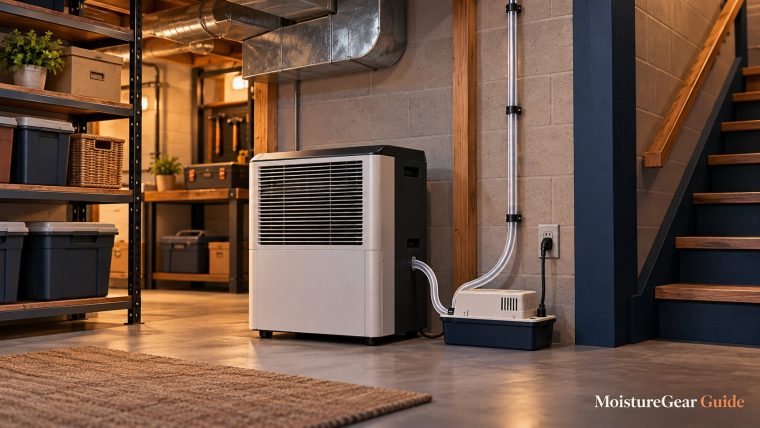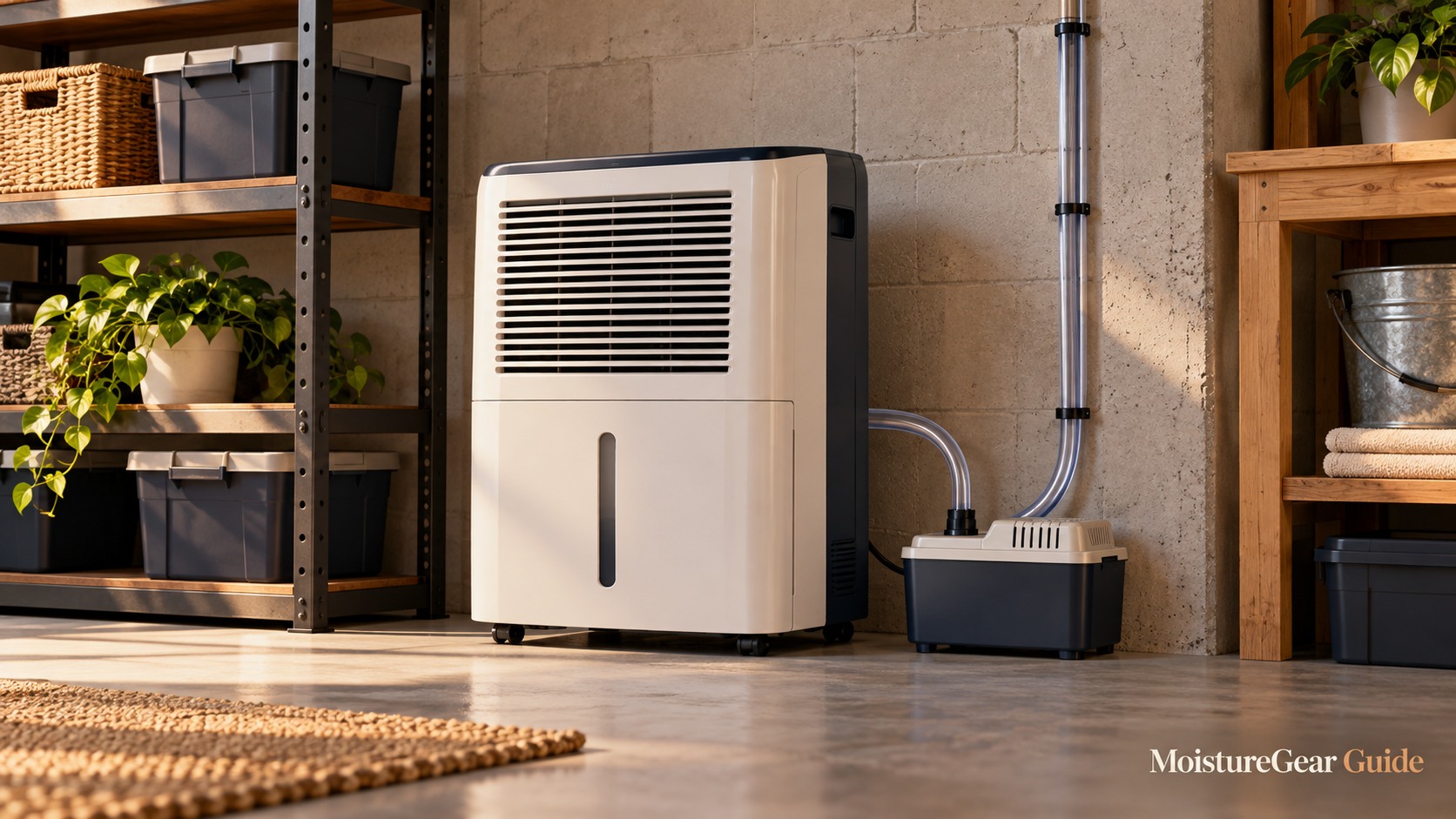
The best basement dehumidifier with pump should lift condensate through your actual hose route, remain easy to inspect, and remove enough moisture under the conditions downstairs. The pump is a convenience feature attached to a drying appliance. It does not enlarge the appliance's water-removal capacity, make every drain connection acceptable, or eliminate maintenance.
If you already know where the water will go, this guide helps compare integrated-pump models. If the destination is still uncertain, start with our basement without a floor drain guide. Buying the pump first can leave you with equipment that cannot reach the available sink or discharge point.
Our selections use manufacturer pages and manuals rather than laboratory measurements. We consider exact variants, handling, operating arrangements, and documented pump instructions. We have not tested their sound, long-term durability, or performance in a particular basement.
What an integrated pump changes
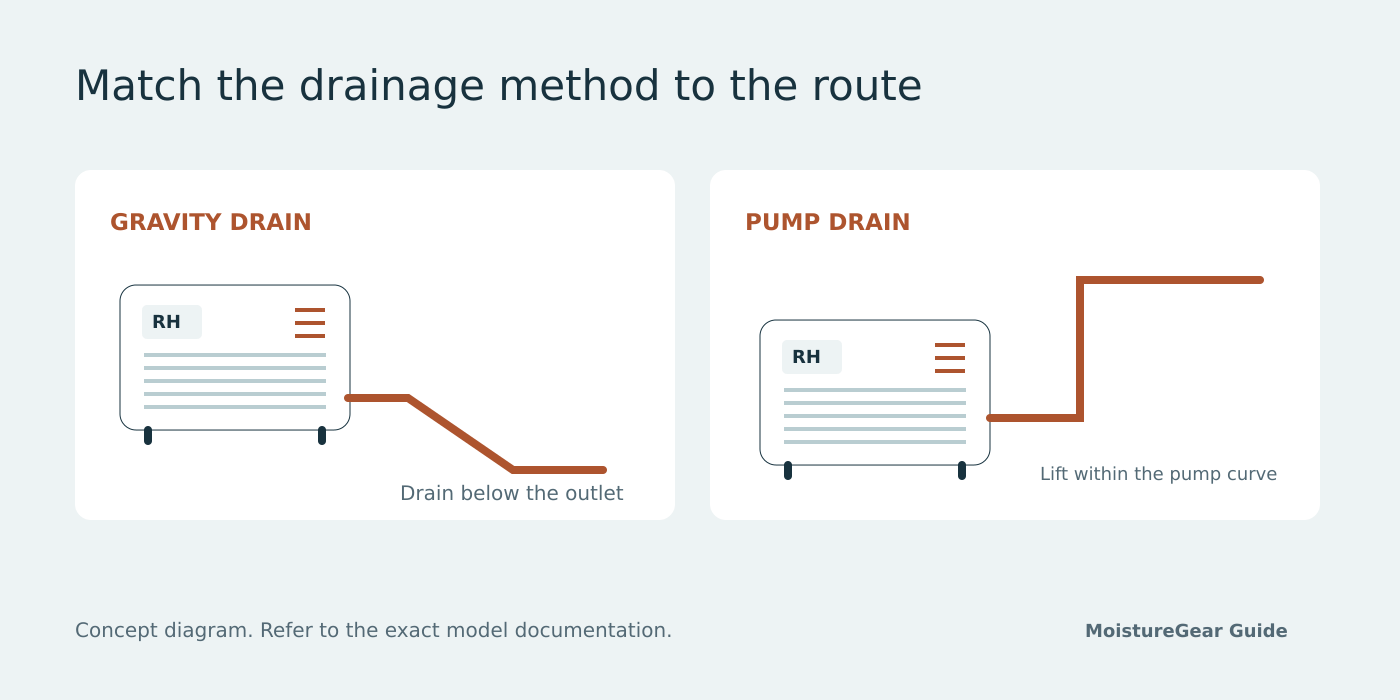
A gravity outlet needs an uninterrupted downhill path. An integrated pump can move collected water upward, usually through a smaller discharge hose, to a suitable receiving point above the appliance. That can remove the daily bucket-emptying job when the route stays inside the manufacturer's limits.
The appliance may still collect water internally before pumping. Some designs use the bucket as part of that collection arrangement; others have an internal condensate reservoir. Pump cycles therefore do not necessarily begin the moment the compressor starts.
A pump also adds items to check: the pickup or reservoir, hose connection, tubing route, outlet destination, and any fault or full-water indication. That is a sensible trade when the alternative is a bucket that regularly fills before you return home.
Our basement dehumidifier hub covers the rest of the application. Keep capacity selection and drainage selection as two related decisions rather than assuming that a pump-equipped version automatically suits a wetter basement.
A shortlist for four different ownership preferences
| Exact model | Best reason to investigate it | Main buying question |
|---|---|---|
| Midea Cube MAD50PS1QWT-A | Cube arrangement with smart operation and a documented pump mode | Can you use and maintain the required bucket arrangement? |
| Frigidaire FHDP5033Y1 | Conventional portable with connected controls | Does its exact manual permit your complete discharge route? |
| Danby DDR050BJP2WDB | Portable pump option with onboard controls | Is the appliance and pump area easy to reach for inspection? |
| AlorAir Sentinel HDi90, built-in-pump version | Equipment for a dedicated basement location | Does a permanent-style setup suit the load, access, and budget? |
These are use-case candidates, not a claim that one pump is independently proven more reliable. The three portables are marketed as 50-pint models. The Sentinel's published capacity uses a different test condition, so compare the installation and application before treating the capacity labels as directly interchangeable.
Midea Cube MAD50PS1QWT-A: for owners comfortable with its operating arrangement
The MAD50PS1QWT-A official page confirms a pump-equipped Cube with smart control. The exact suffix is significant because Cube listings and older reviews can describe other pump and non-pump versions.

This model deserves consideration when you want connected operation and its bucket format fits the available floor space. It deserves a pause when you expect to tuck the entire assembly below a low shelf. The form shown in storage photographs does not establish normal operating clearance.
The manual at the manufacturer’s model-specific URL gives a maximum pump height of 14 feet. Treat that as a limit in the illustrated setup, not as a guarantee for any combination of long tubing, restrictive fittings, and bends.
It also distinguishes pump mode from bucketless mode. The pump uses a pickup in the bucket; removing the bucket to create a lower-profile arrangement changes what drainage method is available. A buyer planning to use the pump should understand that before measuring the installation space.
The appeal is flexibility, with a clear responsibility to follow the setup sequence. Read the pump instructions before ordering replacement tubing or deciding to use the bucketless configuration. A short official diagram is more valuable here than a retailer's broad statement that the machine offers several drainage methods.
Frigidaire FHDP5033Y1: for a familiar portable layout with remote controls
Frigidaire's current FHDP5033Y1 page describes built-in pumping and app operation. That combination is useful when you want to change settings remotely but keep a conventional portable appliance downstairs.

The practical advantage is how the product fits your routine. If several household members inspect the basement, a recognizable appliance format and local controls can be easier to manage. Remote access can supplement those visits, especially when you want to see whether someone changed the humidity setting.
Choose it only after checking the actual hose route in the supplied owner's guide. Do not assume the pump lift of an older Frigidaire model carries over. Similarly named machines may differ in controls, cabinet, tubing, and instructions.
Allow space behind the cabinet for filter maintenance and hose inspection. A pump-equipped portable is particularly awkward when placed so close to shelving that the water connections disappear from view. Inspectability is part of the choice, even if no brochure calls it a premium feature.
The FHDP5033Y1 should also be distinguished from the discontinued FFAP5034W1. If a marketplace combines photographs, customer reviews, or selectable versions, check what the order will actually contain. Features documented for this Y1 unit do not establish the features of another suffix.
Danby DDR050BJP2WDB: for a direct, locally controlled pump setup
The Danby DDR050BJP2WDB US page identifies an integrated vertical pump, electronic controls, and two fan settings. It is worth considering if your main requirement is a portable you can operate at the cabinet.

The decision is partly about simplicity. Not every basement needs a connected appliance. A reachable display, visible hose, and regular inspection can be more useful than a remote feature you rarely use.
The matching owner’s manual shows separate continuous-drain and pump-drain connections. That means a hose on the gravity outlet should not be mistaken for a pump installation. Confirm the connection you intend to use before routing water toward an elevated destination.
Consider where the equipment would go for service as well. Danby describes carry-in coverage for this model, so ask about the local process and seller eligibility. The practical inconvenience of transporting a damp appliance is part of an ownership comparison, even though it is not part of its advertised capacity.
This Danby can be a sensible choice when its controls and support route match the household. We do not infer superior pump life from the warranty period, nor apply general brand noise statements as an exact model measurement.
AlorAir Sentinel HDi90: for a dedicated equipment location
The built-in-pump Sentinel HDi90 page identifies equipment intended for basement and crawl-space applications. It may be more appropriate than a room portable when you are organizing a dedicated long-term location and want the condensate system included.

The differences extend beyond the pump. Think about moving the cabinet downstairs, preserving access around it, placing the controls, and obtaining the exact manual for the current version. A utility-space installation can be easier to live with than a portable beside the recreation area, but only if it circulates useful air.
HDi90 listings can describe different generations and separate ductable or connected variants. Do not use the built-in-pump page as permission to assume that every listing has Wi-Fi, every duct accessory, or the same refrigerant and warranty arrangement.
Its published 90-pint figure is at 80°F and 60% relative humidity. That explains the label; it is not a promise of 90 pints a day in a cooler basement. The HDi90 research review examines the exact-model considerations, and the broad basement guide explains when a permanent plan is worth the added cost.
A dedicated unit is most attractive when ordinary portable placement or capacity is a real constraint. It is less persuasive when a smaller portable already maintains the space and your only problem is reaching a drain.
Measure lift before comparing pump claims
Draw the route from the pump outlet to the highest point the water must reach. Record the vertical rise and the approximate hose length separately. They answer different questions.
The vertical rise is not necessarily the height of the final sink. If tubing goes up to the ceiling and then down to the receiving point, the pump first has to overcome that higher route. A nearby sink can therefore require less lift than an apparently shorter path routed overhead.
Total tubing length and bends introduce additional resistance. A maximum-height statement usually describes the pump's limit under specified conditions. It does not mean you should design a route exactly at that limit and assume every remaining variable is irrelevant.
Use the manufacturer's approved tubing, connections, and instructions. If the required route is near a limit, unclear, or involves a building alteration, ask the manufacturer or a qualified installer before purchase. Do not solve uncertainty by adding another hose section because its outside diameter looks similar.
The gravity-drain versus pump guide explains the two drainage principles. An external condensate pump may offer a different arrangement, but that alternative requires its own compatibility and discharge assessment.
Decide where the water is allowed to go
A utility sink may be a convenient destination if the connection and discharge method are accepted locally. Secure the tubing so water reaches the intended drain rather than falling behind it or being displaced during cleaning.
A sump arrangement must be assessed as part of the existing drainage system. A sealed cover, radon control, pump servicing, and permitted discharge can all matter. Do not leave a cover open merely to make a dehumidifier hose convenient.
An exterior route needs special thought. It should not return collected water to the foundation, damage the building envelope, freeze, or create an uncontrolled opening. A manufacturer illustration showing a hose near a window is not a complete installation design for every climate and house.
Avoid using a larger open bucket as an unofficial intermediate reservoir. That recreates the overflow risk without the appliance's intended full-bucket control. An approved condensate pump has a designed reservoir and operating instructions; a household container does not.
If none of the receiving points is suitable, resolve that first. There is no benefit in buying the appliance with the strongest-sounding pump claim when you still lack an acceptable place to discharge the water.
How to compare the appliance behind the pump
Keep the moisture-removal decision separate. An integrated pump can make a modestly sized appliance easier to manage, but it cannot correct insufficient capacity or blocked circulation.
For portables, compare ratings under the same procedure. ENERGY STAR’s explanation of testing describes why capacity figures from different eras and equipment categories should not be read as equivalent.
Check the coldest conditions at the proposed location. A machine may be permitted to run there while producing less water than its headline rating. If the basement becomes particularly cold, consult the cold-basement comparison before deciding that pump convenience is the most important feature.
Consider the doors normally kept closed. A dehumidifier near the sink can drain beautifully and still miss a damp room at the opposite end. Placement should satisfy both the air path and water route. If those needs conflict, a different pump arrangement or installation may be more useful than a bigger portable.
Setup details that prevent misleading first impressions
At first use, verify that the intended pump mode is active and the collection arrangement is complete. A connected hose alone does not establish that the pump is enabled. Some controls combine fill-level and pump functions, so follow the exact button sequence rather than a video for a similar model.
Keep the unit level and allow its required clearances. A tilted cabinet, badly fitted bucket, or interrupted pickup can produce a water problem that has nothing to do with the nominal pump height.
Do not expect immediate discharge as proof of correct installation. A pump may wait until water reaches its operating level. Observe a real pumping cycle once the machine collects enough moisture, then inspect the hose connections and receiving point.
Check the tubing along its whole length. Small tubing can be pinched behind furniture, trapped under a door, or compressed by a storage box without looking obviously damaged from the appliance end. Secure the route without creating kinks.
Retain the supplied drain plugs and any unused fitting. If you later change to bucket or gravity operation, the manual may require a different outlet to be capped. The original parts are preferable to improvising a seal.
Living with the pump after installation
Build inspection into a routine that already exists, such as checking the laundry area or replacing a nearby filter. Look for water where it should not be, a hose that moved, a full-water message, or debris near the pickup.
Follow the cleaning procedure for the exact model. Some pump arrangements include a user-accessible filter or bucket-cleaning requirement; others direct internal work to service personnel. Do not pour drain chemicals into the system merely because a household sink is slow.
An app can show that the dehumidifier is connected or report certain appliance states. It may not confirm that the receiving drain is clear or the tubing remains secured. Physical inspection still answers those questions.
A small water alarm near a vulnerable receiving area can complement the setup if placed according to its instructions. It should not be used to justify an uncertain connection or ignored pump fault. Its role is an additional indication, not permission to leave an improvised installation unattended.
If the pump stops discharging, compare the symptoms with our pump-not-draining checklist. Persistent faults, damaged electrical parts, or water near an outlet call for the manufacturer’s service route rather than a homemade internal repair.
Match the pump to your inspection routine
Consider who will notice a problem after installation. An owner who visits the laundry area daily can inspect a visible hose easily. In a seldom-used basement, a similarly hidden route may go unnoticed for much longer. That difference should influence the arrangement and any additional monitoring.
Make the normal pumping behavior understandable to another household member. Show them the intended discharge point, where water should collect before a cycle, and which displayed warning means the appliance needs attention. Leave the manual available rather than relying on one person's memory of the setup.
If remote control is part of your plan, ask exactly which faults or water conditions the appliance reports. An online status showing that the machine is connected should not be read as confirmation that the sink is clear or the outlet hose is secured. Plan a physical check appropriate to the property.
Cost questions beyond the pump upgrade
Compare the full arrangement you need. A built-in-pump version may avoid buying a separate pump, reservoir, fittings, and additional power connection. An external pump may give you better service access or let you keep an appliance that already handles the moisture load.
Do not assume either option is automatically cheaper over its life. Hose compatibility, installation labor, service transport, and replacement availability can change the practical result. There is also value in a setup you understand and can inspect.
If you already own a working gravity-drain dehumidifier, replacing the entire machine solely for pumping should be weighed against an approved external arrangement. If you are buying new and a modest upward lift is unavoidable, an integrated pump may be simpler.
Choose the appliance whose documented setup fits your route with comfortable practical margin. The best pump feature is the one that makes water disposal predictable while preserving the dehumidifier's useful placement.
Questions to settle before checkout
Does a pump-equipped machine still have a bucket? Many portable models do. The bucket may remain part of the intended collection and pumping system. Check the specific instructions rather than assuming that pump operation removes it.
Can I use any longer hose? Only if the manufacturer permits that hose, connection, length, and lift. Additional resistance changes the job the pump must perform.
Will the pump make the basement dry faster? Not by increasing refrigeration capacity. Its contribution is avoiding downtime caused by a full bucket, provided drainage functions correctly.
Can I place the unit farther away to reduce sound? Sometimes, but evaluate the new air path and complete hose route. Moving it into an isolated room may reduce what you hear while leaving the damp area untreated.
What should I keep for future service? Save the invoice, exact model and serial information, manual, accessory details, and a photograph of the installed hose route. Those are more helpful than saying only that you own a 50-pint pump model.
Selected sources
- Midea Cube pump-version guide
- Frigidaire FHDP5033Y1 product page
- Danby DDR050BJP2WDB product and support page
- AlorAir Sentinel HDi90 built-in-pump model
- ENERGY STAR: testing and capacity

About the author
Davis Murphy
Davis Murphy writes about dehumidifiers, indoor humidity, and home moisture control at MoistureGear Guide. His articles explain how to compare equipment, understand capacity ratings, and plan for drainage and maintenance. He focuses on clear, practical guidance to help readers choose a dehumidifier suited to their space and needs.