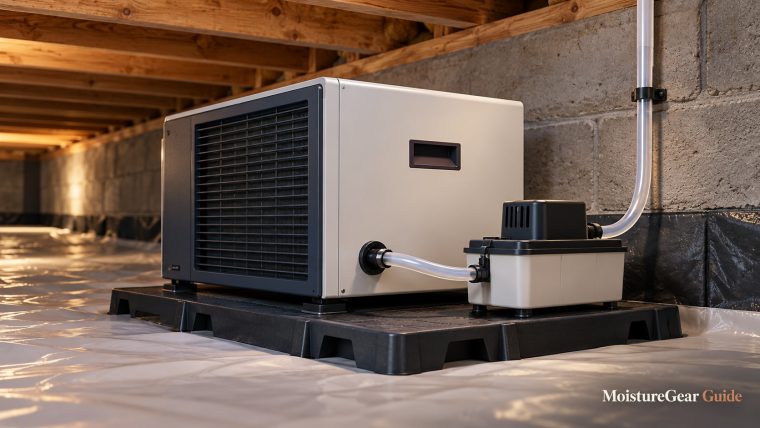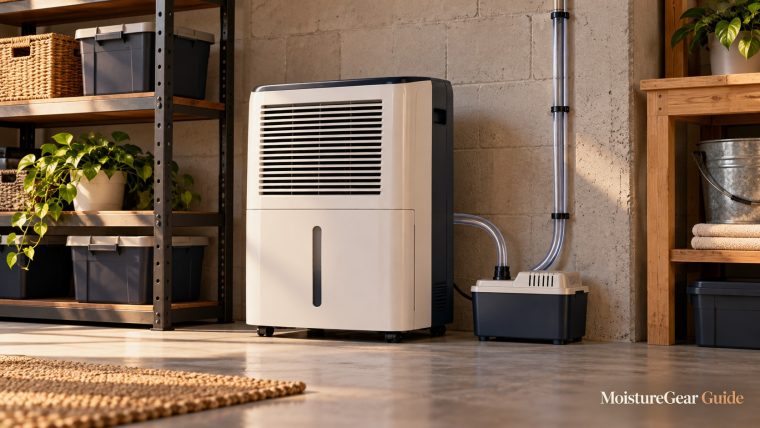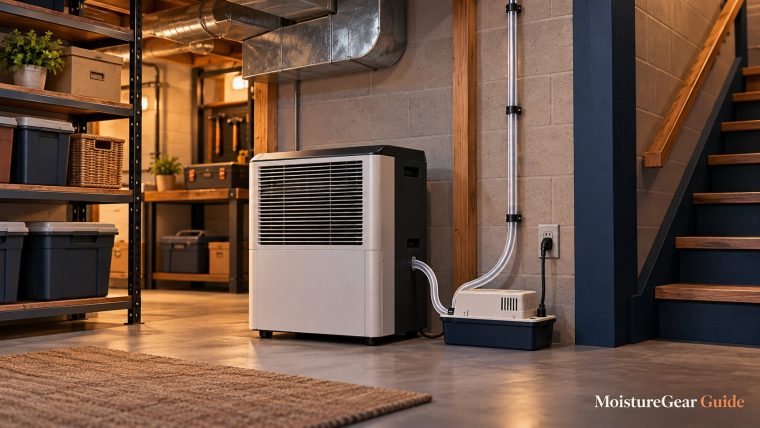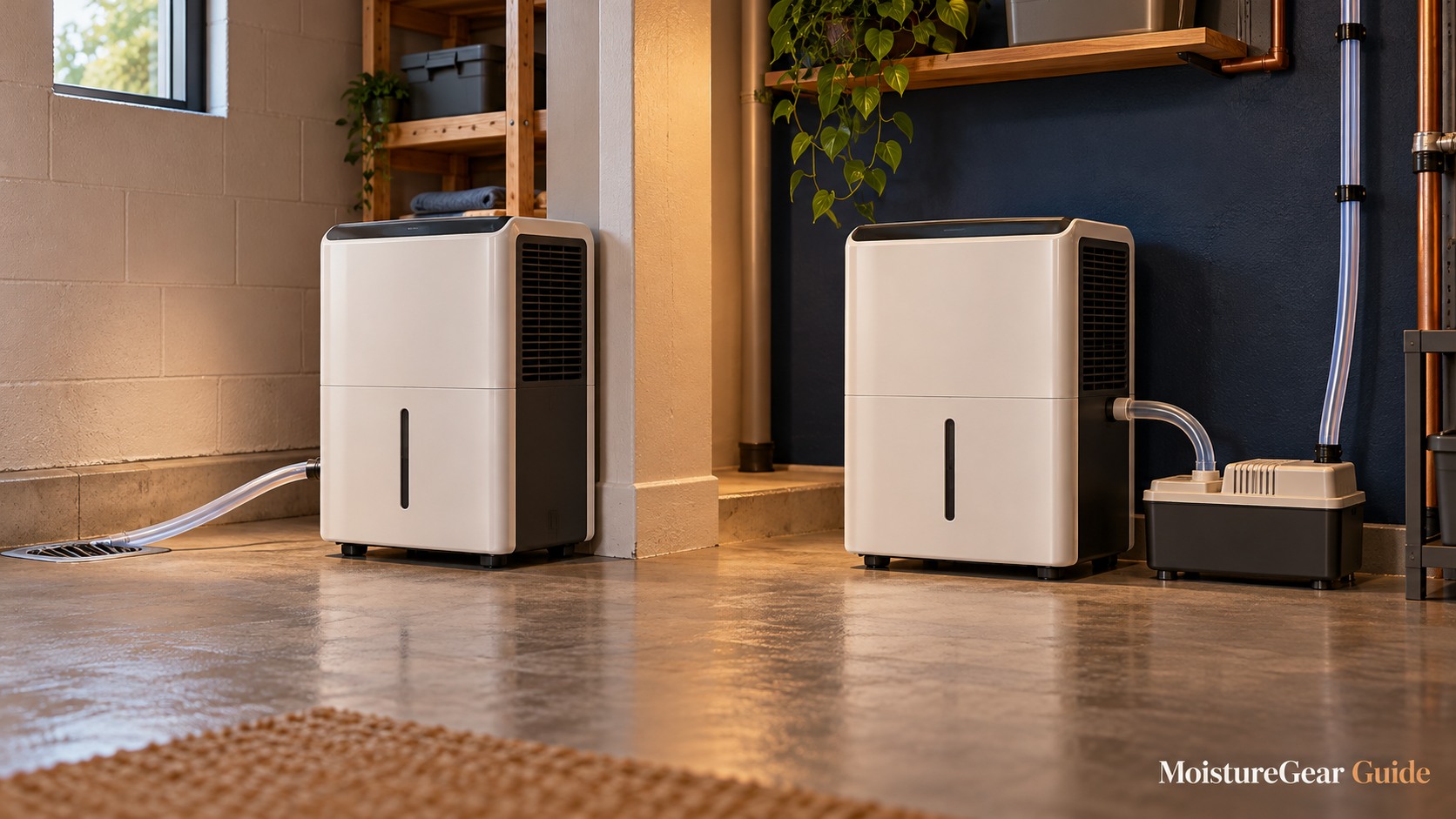
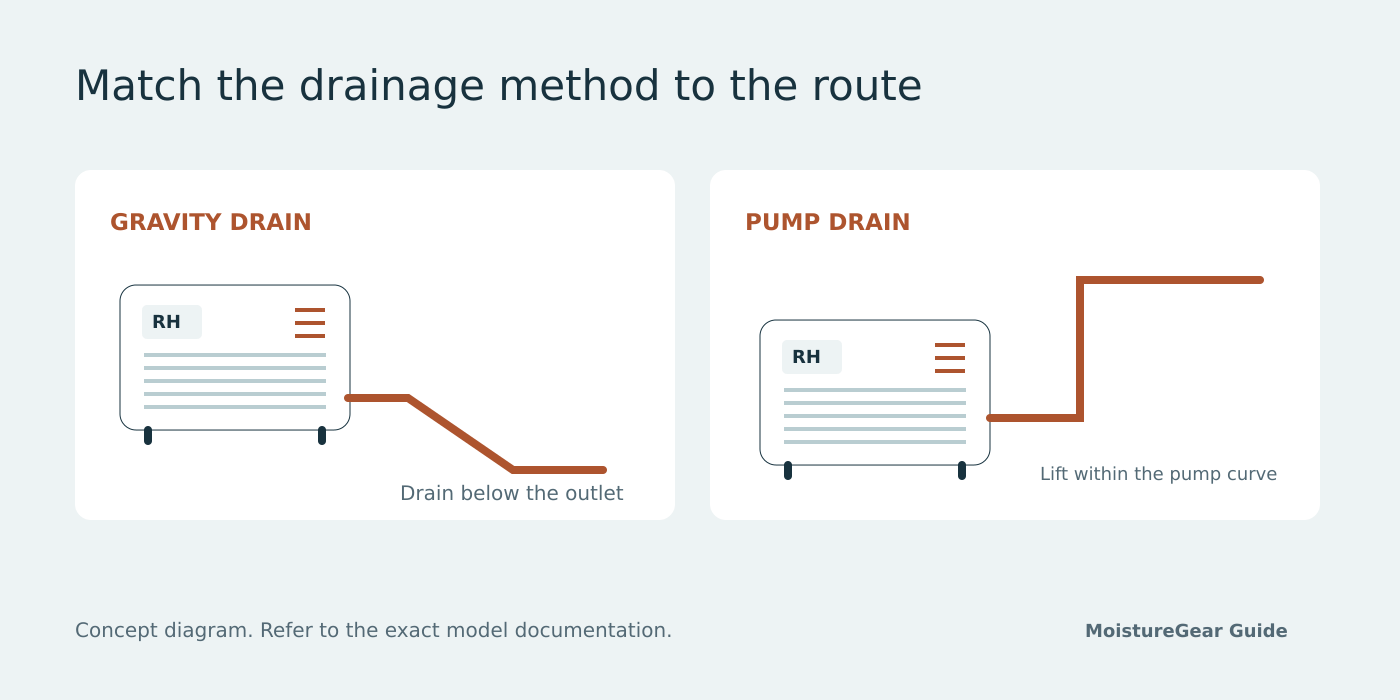
The dehumidifier gravity drain vs pump decision comes down to where the water must go. Gravity drainage works when the entire permitted route falls toward a suitable destination. A pump is useful when water must rise, cross a route that cannot maintain that fall, or reach a drain above the appliance. Choose the drainage arrangement before buying the dehumidifier, because a powerful machine is ineffective when its collected water has nowhere appropriate to leave.
This guide connects the equipment choice with a practical drain plan. Visit our sizing and ownership hub for the wider purchase process, or use the condensate-pump buying guide if you already know an external pump is needed.
Follow the water from coil to destination
Water first collects inside the dehumidifier. From there it may enter a removable tank, flow out of a gravity fitting, or collect in an internal pump reservoir. Those are different arrangements. A hose connection does not automatically mean the appliance can lift water.
On a gravity model, the drain outlet normally needs an appropriate falling route. On a pump model, the pumped outlet uses the manufacturer's specified tube and connection. Some portable units provide both arrangements, but the two outlets are not interchangeable. Read the manual for the exact selected model.
The same distinction applies to external pumps. The appliance's gravity hose carries water into the pump's reservoir; the pump's discharge tube then carries water onward under pressure. Installing the external pump above the appliance's outlet does not magically pull water uphill through the gravity section.
Gravity drainage: fewer moving parts, more routing discipline
A properly installed gravity line needs no separate water-lifting motor. This can simplify ownership when a suitable lower drain is nearby. There is still a drain fitting, hose or pipe, route, termination, and maintenance responsibility. Gravity is not a guarantee against leaks or blockage.

Trace the entire route, rather than comparing only the start and finish heights. A hose that drops initially, dips along the floor, and rises over a doorway can retain water or prevent dependable drainage. A drain at a lower final height does not remove the problem created by the intermediate rise.
Follow the model's instructions for slope, hose diameter, traps if required, and maximum recommended route. Avoid improvising a trap because another brand uses one. A ducted unit's drain arrangement can have requirements that differ from those of a portable freestanding appliance.
The AlorAir HD55S manual identifies normal gravity drainage for that model. Its shared control discussion also describes a pump feature only for Sentinel models with built-in pumps. A button description in a family manual therefore does not prove that a gravity-only product contains a pump.
Integrated pump: convenient when its limits fit
A built-in pump can remove the need for a separate reservoir beside the dehumidifier. That is attractive in a basement with an elevated drain or a crawl space where a gravity route is impractical. The advantage depends on the exact pump's permitted lift, tubing, control behavior, and maintenance access.

Check whether the selected SKU actually includes the pump. Similar family names can describe gravity, pumped, and ductable versions. The AlorAir HDi90 product page identifies a pumped arrangement, whereas the HD55S example above identifies gravity drainage. Product titles should be verified against the official model table.
An integrated pump adds components that may require service. It can also stop the dehumidifier or produce an alarm when it cannot discharge, depending on the design. Never disable a float or error condition simply to make the compressor run again. The problem is collected water, and continuing operation without drainage can cause damage.
If this is the arrangement you want, review crawl-space dehumidifiers with pumps or basement pump models. Each selection still needs an appropriate route and destination.
External reservoir pump: flexible, with a two-part drain
An external condensate pump can make a gravity-drain appliance usable where the final drain is higher. It may also be easier to replace independently of the dehumidifier. Space, inlet height, outlet tubing, power supply, and any overflow protection must be planned together.

The Little Giant VCMA-20 range illustrates why exact pump versions matter: models differ in voltage, safety-switch provision, and whether tubing is included. These are not interchangeable shopping details. Confirm the pump that will actually arrive, not just the family’s headline lift.
The gravity section needs to deliver water into the reservoir under the manufacturer's permitted arrangement. The pumped section then needs sufficient flow at the total head of the discharge route. A qualified installer should establish any wiring between the overflow switch and equipment controls where such an arrangement is supported.
An external pump is not a substitute for a sump pump dealing with groundwater. Condensate pumps are selected for their specified liquid and duty. Standing water, flood removal, and drainage failures elsewhere in the building require a different assessment.
Lift is not the length of the tube
Vertical lift is the rise the pump must overcome. Hose length is the distance the tube travels. They affect the route differently. A 20-foot tube can run mostly horizontally or climb substantially; its length alone does not establish a 20-foot vertical lift capability.
A pump must also overcome flow resistance through tubing, bends, fittings, and check valves. Total dynamic head accounts for the vertical rise plus that resistance. The manufacturer's curve relates available flow to head. A catalog “maximum lift” or shut-off number alone is not a useful guaranteed flow rate at that height.
At shut-off head, flow is effectively zero. Plan a working point with adequate capacity and margin rather than placing the route exactly at the maximum figure. Ask the manufacturer or installer to confirm the combination of lift, tubing diameter, length, and fittings if the route is demanding.
You should not combine the maximum allowed hose length from one dehumidifier with the maximum lift from another pump and assume the resulting installation is approved. Use documentation for the actual components and the way they are connected.
Compare the ownership tradeoffs
| Issue | Gravity drainage | Built-in pump | External pump |
|---|---|---|---|
| Needs a falling route from appliance | Yes | Follow the pumped outlet requirements | Yes, to the external reservoir |
| Can move water to a higher destination | No | Within exact model limits | Within pump curve and installation limits |
| Additional electrical water-lifting component | None | Inside the appliance | Separate appliance |
| Maintenance attention | Outlet, hose, termination | Internal collection and discharge route | Both gravity feed and separate reservoir/discharge |
| Replacement flexibility | Hose and fitting dependent | Model-specific service | Separate pump can be evaluated independently |
| Overflow handling | Model-dependent | Model-dependent | Switch or alarm provision needs compatible installation |
This table describes general arrangements, not a blanket compatibility promise. A device listed as having a safety switch does not mean it can directly shut off every portable dehumidifier. Control terminals, ratings, and allowed wiring determine what can be connected.
The destination is part of the installation
A working pump still needs a suitable place to discharge. Check local plumbing requirements and the appliance instructions before connecting to a household drain. An air gap, approved receptor, or other protection may be required for the particular destination. Do not make an improvised sealed connection into sanitary plumbing.
Outdoor discharge raises different questions: whether it is permitted, whether the line can freeze, where water lands, and whether it returns toward the foundation. Routing moisture-control condensate back into the crawl space or against the house undermines the purpose of the equipment.
Avoid a drain that can back up into the dehumidifier or pump. The end of a hose submerged in water can create problems that were absent when the line was first installed. A qualified plumber or installer can identify a suitable termination when the available route is uncertain.
The basement-without-floor-drain guide considers practical alternatives. “No floor drain” does not automatically mean any nearby sink, window, or standpipe is an acceptable connection.
Plan support and service access
A long hose needs support so its route does not change into a sagging loop. Soft tubing can kink when pushed against storage, pinched under equipment, or bent sharply around a corner. Inspect the route with the appliance in its final position, not only while it is pulled out for installation.
In a crawl space, make the drain fitting, pump, and relevant service area accessible. Do not place the unit so reaching its outlet requires dragging a powered appliance through wet ground. Our crawl-space placement guide considers access alongside air distribution.
For an external reservoir, leave room for the maintenance described in its manual. Confirm that the dehumidifier's gravity outlet sits at the appropriate height for the reservoir inlet. A compact footprint is useful only if the complete arrangement can still collect and discharge water correctly.
Label or photograph the final route. That record helps when a later contractor moves storage, repairs insulation, or changes piping. It also helps a technician distinguish the original installation from a routing change that appeared just before a drainage fault.
Three example spaces
A basement with an accessible lower drain
If the chosen appliance can sit level and its permitted gravity hose can fall continuously to the approved receptor, gravity is a sensible starting option. It avoids a separate lifting component and can make inspection straightforward. Keep the route clear of walking paths and storage pressure.
There is no need to buy a pump solely because a pump sounds more advanced. The route decides its usefulness. Before committing, check how the drain behaves during heavy rainfall or other events; an available drain is not necessarily a dependable destination under every condition.
A finished basement with an elevated destination
A pump may be necessary when the approved drain connection is above the appliance and the route cannot be changed. An integrated pump keeps the arrangement consolidated. An external reservoir can give you more choice of gravity-drain equipment and independent pump servicing.
Measure the actual rise and route length before selecting either. Also consider sound during a pump cycle, access, and the consequence of overflow near finished flooring. Humidity alerts are useful, but they do not replace drainage fault protection or a water-leak sensor where those are appropriate.
A low crawl space with obstacles
Start with appliance access and a safe, maintainable position. Then map the drain route around beams, supports, and the ground barrier. A theoretically lower outlet beyond several obstacles may still be unreachable by a reliable gravity line.
An external pump requires enough room and a suitable power arrangement. A built-in pump reduces separate hardware, but maintenance remains necessary. This is an installation problem to resolve before buying a large dehumidifier, not a hose improvisation to finish afterward.
Commission the drain before unattended operation
Use the manufacturer's prescribed procedure to check operation after installation. Inspect the connections, observe a collection-and-discharge cycle where possible, and verify that water reaches the intended destination. For an external pump, follow its documented test process rather than improvising electrical tests.
Check the route again after the equipment is moved to its final position. Verify that a hose is not crushed behind the cabinet and that any required fittings are secure. If controls or overflow protection have been installed, have the qualified installer verify their operation.
A dry hose immediately after startup does not prove failure. The machine may need time to begin condensation, and a reservoir pump normally waits for a water level before cycling. Conversely, repeated leakage or a full reservoir with no successful discharge should be investigated before you leave the equipment unattended.
Maintain the drain as part of the appliance
Schedule visual inspections around the manufacturer's maintenance requirements and the space's conditions. Dust, debris, tubing damage, and changes to the termination can affect drainage. Check more often when a newly installed system is being proven, then adjust to a sensible routine.
Use only the cleaning and parts procedures approved for the exact model. A general online recipe involving chemicals or pressure can damage a reservoir, check valve, fitting, or hose. Different generations may require different replacement valves or tubing.
If a pumped unit stops draining, use our pump troubleshooting guide. It separates routing and user-control checks from internal servicing. Persistent faults, electrical issues, or leakage near the supply require qualified help rather than repeated resets.
Check the installation before an absence
Before leaving the property for an extended period, inspect the complete drain in its normal position and check any supported alarm. Look at the hose after storage or service work, because those activities can move a previously sound route. Confirm the destination is still clear and that water is not returning toward the building. If remote humidity monitoring is installed, verify the timestamp and alert delivery, while retaining any appropriate separate leak or overflow protection. An app reading cannot substitute for that physical drain inspection.
Questions to settle before choosing
Can gravity drainage go uphill for a short distance? Not as a dependable ordinary gravity route. Follow the required fall, support, and any model-specific trap instructions. A final destination below the appliance does not justify arbitrary intermediate rises.
Can I add a pump to a gravity model? Often an appropriate external reservoir arrangement is possible, but it must receive water correctly and be installed within both products’ requirements. It does not convert the appliance’s own gravity outlet into a pressurized pump connection.
Does a pump eliminate tank emptying forever? It can remove routine bucket emptying while the complete system works. It still requires inspection and maintenance, and faults can stop drainage. “Continuous drainage” describes an arrangement, not freedom from ownership attention.
Which is the better choice? Use gravity when the approved route supports it. Use a properly matched pump when the route requires lift. The dependable option is the one designed around your actual outlet, destination, power supply, and access.
Selected primary references
- AlorAir HD55S manual: gravity drainage and model-specific controls
- AlorAir HDi90: exact pumped configuration
- Little Giant VCMA-20: performance and ordering variants

About the author
Davis Murphy
Davis Murphy writes about dehumidifiers, indoor humidity, and home moisture control at MoistureGear Guide. His articles explain how to compare equipment, understand capacity ratings, and plan for drainage and maintenance. He focuses on clear, practical guidance to help readers choose a dehumidifier suited to their space and needs.