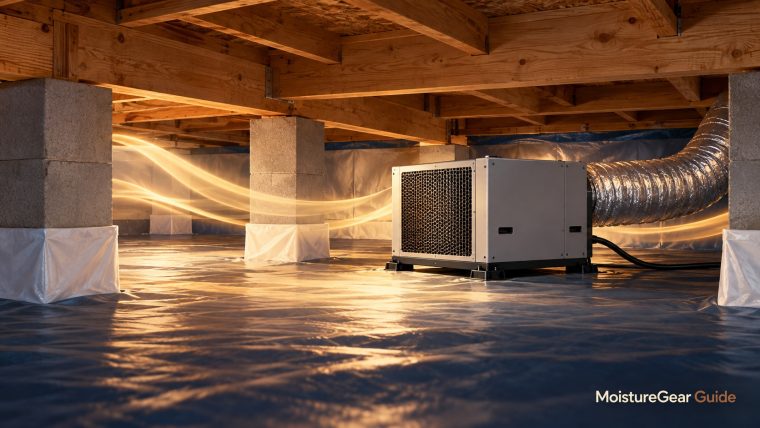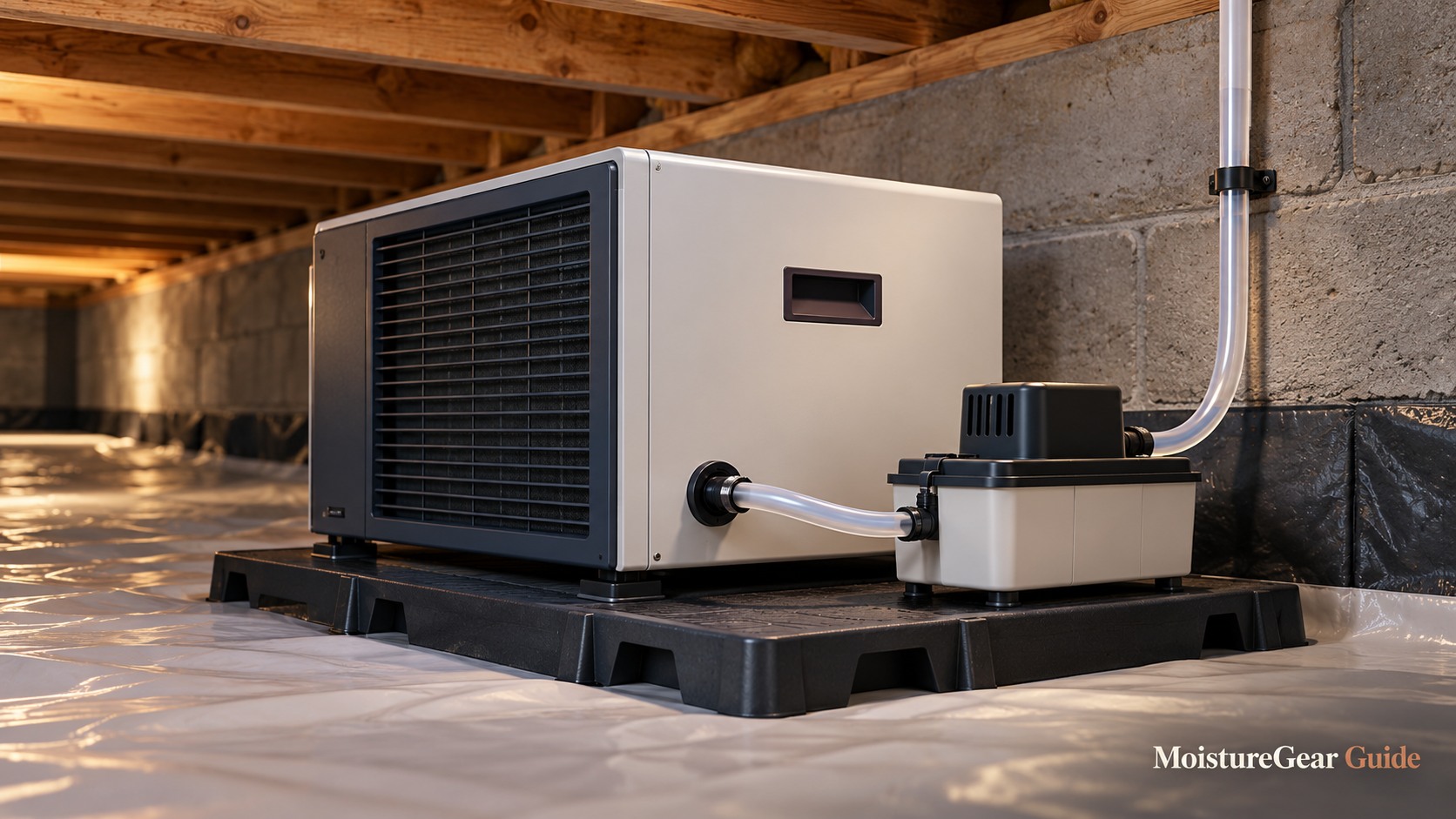
Finding the best crawl space dehumidifier with pump drainage starts with the water route. If condensate must climb above the appliance, cross a foundation obstruction, or reach an elevated drain, a suitable pump can make the installation practical. The right purchase matches that route, the crawl space’s moisture demand, and the available service access; it does not simply add a pump to the largest pint rating.
Below we compare two integrated-pump options and one low cabinet that can use a separate pump kit. We also explain when gravity drainage remains the better arrangement. For broader equipment selection, visit our crawl-space dehumidifier hub.
Research approach: This buying guide uses manufacturer specifications and published installation information reviewed on October 13, 2026. We have not independently tested these pumps or measured drying times. Recommendations describe applications to investigate, and every installation must follow the manual for the exact unit and accessory supplied.
The shortlist and the drainage distinction
| Candidate | Capacity at 80°F / 60% RH | Pump arrangement | Why consider it | Main tradeoff |
|---|---|---|---|---|
| AlorAir Sentinel HDi65S, non-Wi-Fi | 55 pints/day | Integrated condensate pump; gravity option also documented | Compact cabinet when upward drainage is required | Pump capacity and air-drying capacity must both suit the site |
| AlorAir Sentinel HDi90, built-in-pump version | 90 pints/day | Integrated condensate pump | More published removal capacity with a pumped outlet | Taller, heavier equipment with greater access demands |
| Santa Fe Compact70 with compatible pump kit | 70 pints/day | Separate optional condensate pump | Low cabinet and separately located pump hardware | Kit, tubing, power, and mounting add to the complete setup |
The first two entries come from AlorAir’s HDi65S page and HDi90 page. Santa Fe’s current catalog supplies the Compact70 capacity; the manufacturer describes an optional pump kit in its installation literature. A Compact70 sold alone should not be described as having an integrated pump.
First establish whether you actually need pumped drainage
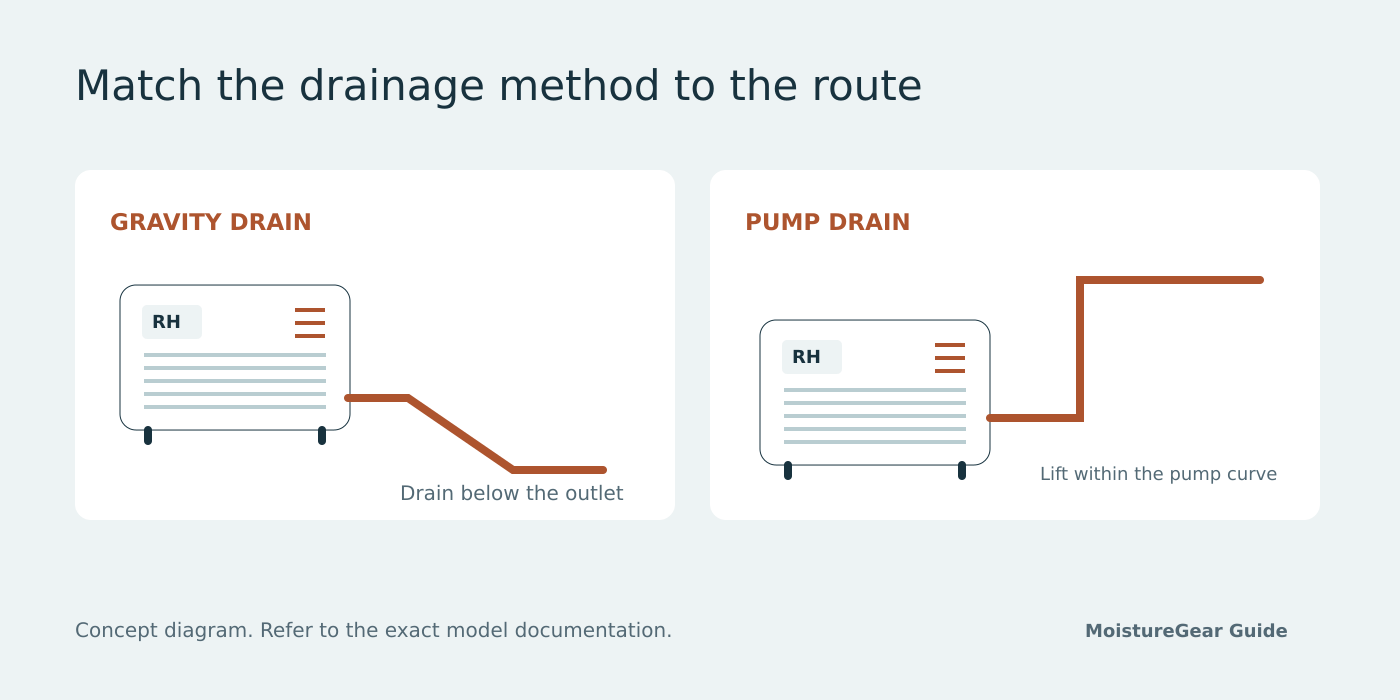
A pump is useful when water cannot reach an approved destination through the required gravity route. It is less useful when an appropriate drain is already below the unit and the hose can be installed correctly all the way to it. In that situation, the simpler arrangement may avoid an unnecessary reservoir, float, motor, and electrical connection.
Sketch the route rather than estimating it from memory. Identify the appliance outlet, the highest point the discharge line must cross, the termination, and any areas that are difficult to inspect. A drain on the other side of the crawl space might be lower overall yet still require the hose to pass over a footing. That interruption can make an apparently downhill route unsuitable.
Do not raise the appliance arbitrarily just to avoid buying a pump. A platform changes stability, access, and available headroom. Suspension requires a suitable kit and structural support. The complete arrangement should make sense for the unit and home, not merely allow a hose to clear one obstruction.
Our gravity-drain versus pump comparison explains the differences. Once you know which arrangement the site needs, the shortlist becomes easier to narrow.
AlorAir Sentinel HDi65S: for a compact pumped installation
The non-Wi-Fi HDi65S is a candidate when you want an integrated pump without moving to the larger HDi90 cabinet. The manufacturer publishes dimensions of 19.2 × 12.2 × 13.3 inches and a 55-pint daily rating at 80°F and 60% relative humidity. Those details make it worth evaluating where low clearance and drainage lift matter together.

Be attentive to the suffix and color when shopping. AlorAir separately describes Wi-Fi variants. A listing photograph, an app graphic, or the word “smart” elsewhere on a marketplace page does not establish that the base HDi65S includes wireless control. Confirm the actual SKU and supplied equipment.
The manufacturer’s current page advertises a 19.6-foot drain height for this model. Treat that as a published limit to verify against the matching manual, not permission to design a route at the limit. Pump performance depends on the route as well as elevation. Use the specified tubing and obtain manufacturer guidance if your installation involves a long run or an unusual discharge arrangement.
This option is sensible when the assessed air-drying demand fits the smaller machine and the pump can serve the planned destination. It is less appropriate when the smaller cabinet is being chosen only because it is easier to carry, while persistent moisture demand calls for a different solution. Compactness cannot compensate for poor sizing.
AlorAir Sentinel HDi90: for greater demand with an integrated pump
The base built-in-pump HDi90 pairs a 90-pint rating at 80°F and 60% RH with a condensate pump. The attraction is a higher published extraction rating than the HDi65S alongside the same general drainage purpose. Our HDi90 research review examines the full equipment decision.

Its larger cabinet makes planning more important. Allow a usable route to the final position, sufficient space to inspect drain connections, and access to remove the filter. A unit that can barely be pushed through an opening may be difficult to remove later for service. There also needs to be room for a technician rather than only room for the box.
Do not borrow a pump-lift figure from another Sentinel model or an older listing. Confirm the discharge limit and hose requirements for the purchased HDi90. Its Wi-Fi and ductable relatives are separately documented; controls and duct accessories should be checked against the precise version.
We would investigate the HDi90 when a moisture assessment points to greater removal demand and the crawl space can accommodate the cabinet comfortably. We would not upgrade to it merely to solve a drainage problem that a smaller, correctly sized pump model could already handle. Increased capacity and upward drainage are two separate requirements.
Santa Fe Compact70 plus external pump: separate the appliance and drainage hardware
The Compact70 gives you a different arrangement to consider. The cabinet drains by gravity, and a compatible external pump kit can receive the condensate and lift it to a suitable destination. That means the appliance and pump do not have to be evaluated as one inseparable package.

An external pump can be useful where its reservoir, connections, and controls can be placed in a more accessible location. The low dehumidifier cabinet may fit where a taller integrated-pump unit is inconvenient. However, the total installation includes both components. Space saved at the cabinet can be consumed by the reservoir, inlet arrangement, and tubing.
Before ordering, obtain the current Compact70 manual and the instructions for the specific pump kit. Santa Fe’s manufacturer-hosted installation literature documents the optional-kit approach, but current and older unit generations differ. Requirements for the actual part number should govern the drain configuration.
This route deserves attention when low cabinet height and accessible pump service are priorities. It is not automatically less expensive or more reliable than an integrated pump. Compare the full parts list and the service arrangement, including who will respond if the reservoir fills or the discharge line is blocked.
Air extraction and water transport are different capacities
A dehumidifier’s pint rating describes how much water it removes from air under specified conditions. The pump has to dispose of the resulting condensate through its own drainage route. A product can suit one task but fail to suit the other. For example, ample extraction capacity does not make a pump suitable for a discharge line outside its requirements.
Compare the air-drying figures at equivalent temperature and humidity. ENERGY STAR explains why cooler test temperatures reduce reported portable-unit capacity. An AHAM-style rating stated at 80°F is not equivalent to a portable DOE rating stated at 65°F, and a saturation headline is another different condition.
For pump selection, compare the permitted lift, tubing, length, and control provisions instead. If the manufacturer provides a performance curve or a maximum total run, use those instructions rather than creating a rule from another model. Keep the two decisions on separate lines of your buying worksheet.
If you have not collected temperature and humidity data, our crawl-space sizing guide can help. It is better to identify the conditions now than to discover after installation that the water route works while the far end of the crawl space remains damp.
Measure vertical lift and describe the whole route
Vertical lift is the height the pump must raise water, while the total tubing route includes horizontal distance and bends. Both matter. A ten-foot horizontal run is not the same thing as a ten-foot rise, and neither should be confused with the length of hose packed in the box.
Measure from the reference point specified by the pump or appliance manufacturer. If that reference is unclear, ask before finalizing the layout. Provide the manufacturer or installer with the proposed high point, total line length, tubing dimensions, bends, and discharge destination. A drawing often communicates more than the phrase “the drain is nearby.”
Leave a sensible margin rather than treating an advertised maximum as an installation target. Avoid unnecessary bends and arrangements that are hard to inspect. Do not connect assorted tubing simply because the diameters look close; fittings and tubing need to match the unit’s instructions.
Where the route has to pass through building assemblies or connect to plumbing, arrange appropriate installation work. A product guide should help you choose equipment, not encourage improvised modifications to structure, wiring, or regulated drainage.
Choose a legitimate discharge destination
A condensate pump does not give unlimited freedom to drain anywhere. The destination needs to be acceptable for the building and local requirements. An available pipe is not necessarily an appropriate connection, and a sump cover should not be modified without considering its intended enclosure and sealing arrangement.
An outdoor outlet raises additional questions. Water should not be discharged so that it returns toward the foundation, creates an unwanted wet area, or freezes and obstructs the line. Depending on climate and the route, year-round operation may need a different destination. Have the installation planned for the conditions in which the appliance will actually run.
The pump is also not a substitute for a sump system or site drainage. It transports the appliance’s condensate; it is not intended to remove standing groundwater from the crawl space. PNNL’s crawl-space floor guidance is a useful reference for separating bulk-water work from air-humidity control.
If the destination is uncertain, settle that question before selecting the dehumidifier. A confirmed route may favor gravity, an integrated pump, or a separate condensate pump. Buying first often forces a more awkward arrangement afterward.
Think through what happens when drainage stops
Pump faults are not the only cause of a full reservoir. A kinked line, loose fitting, obstruction, inappropriate lift, or unavailable drain can interrupt water removal. The useful buying question is how the specific system responds when it cannot discharge condensate.
Check whether the unit has an internal high-water response, whether an external pump provides a safety-switch connection, and whether those provisions are used in the proposed installation. Do not assume every pump and dehumidifier combination communicates automatically. An accessory switch that remains disconnected provides none of the intended system response.
A separate leak sensor can be a useful additional observation tool where it can be positioned and heard or monitored reliably. It does not replace the drainage protection required by the equipment instructions. Nor does a remote app ensure that someone will notice an alarm before damage occurs.
Plan a realistic response: who sees the alert, where the equipment can be disconnected safely, and who is called for service. Our pump-not-draining guide distinguishes accessible checks from faults that need professional attention.
Service access is part of pump selection
A pump adds parts that may need inspection or service, so it should not disappear behind a foundation pier or beneath ductwork. Keep the outlet connection visible where practical and allow room to reach the equipment’s service side. A cramped installation turns a minor drainage issue into a difficult removal job.
For an external reservoir, think about access to both the dehumidifier’s gravity outlet and the pump itself. A short connection can be convenient, but it should not place the reservoir where it is easy to kick or where the inlet is hard to inspect. Supports and tubing should make sense for the arrangement described in the pump instructions.
For integrated models, find out whether pump service is an authorized user task or something the manufacturer assigns to a technician. Public repair videos do not automatically make every internal procedure suitable for an owner. Keep electrical and internal component work within the appropriate service scope.
Document the unit, pump, tubing route, and accessible connection points after installation. Photographs help explain a problem to support without repeatedly entering the crawl space just to read a fitting or model label.
A useful order for commissioning the complete system
Begin with the installation requirements, not the humidity target. Verify the exact model, required settling period after transport, support, electrical supply, air clearance, and drainage instructions. The proper order varies by product; the matching manual should determine startup.
Once the equipment operates, observe the drainage cycle according to the manufacturer’s procedure. Confirm that water reaches the intended destination and inspect accessible connections. Avoid improvising a reservoir-fill test, opening pump housings, or pouring water into parts of the machine unless the manual specifically describes a user procedure.
Place an independent humidity sensor away from the discharge and compare readings across the crawl space. Record temperature as well as RH. You want evidence that the system controls the space, not merely evidence that condensate leaves the machine.
Return to the installation after representative wet weather and check the outlet again. A route that works on the first day may reveal a problem after a hose is moved or a termination becomes obstructed. Keep a short inspection record so maintenance is based on observations rather than guesswork.
Compare the complete cost of the three arrangements
An integrated-pump machine may reduce the number of separate items to buy, but its price still needs to be compared with compatible alternatives. A gravity machine and external pump require two equipment costs plus tubing, mounting, any control connections, and installation work. The lower cabinet price alone is not the total.
Include ownership items that apply to your route: replacement filters, accessible hose inspections, a monitoring device, and the possible labor to remove equipment for service. These are not precise forecasts of future expense; they are the categories that keep a comparison honest.
Check warranties by exact model, seller, purchase date, and component. A long appliance warranty headline does not establish identical pump coverage or pay for every removal and installation task. Ask how a drainage fault is handled and keep the answer with the purchase documents.
Avoid estimated energy savings built only from rated amps or an efficiency number. Actual operating time depends on the enclosure, weather, moisture sources, and setpoint. Our running-cost explanation shows how to create an estimate with visible assumptions.
Three buyer scenarios
A low crawl space with a suitable elevated drain: Investigate the HDi65S first if its rated capacity is appropriate. Confirm the route against the pump requirements and measure the complete installed envelope. The compact cabinet is useful only if it can be serviced after it is positioned.
A larger moisture load with comfortable access: Put the HDi90 on the shortlist when measured conditions and an assessment support its higher extraction rating. Make sure the pump is suitable for the same discharge route; more air-drying capacity does not extend the allowed drainage limits.
A low cabinet with a better external service location: Evaluate the Compact70 and a compatible kit as a complete system. This arrangement can make sense when the pump reservoir can be accessed easily, but include the extra space, power, and connection requirements in the plan.
If the drain can remain below the appliance with a correct gravity route, reconsider whether a pump is necessary at all. Our general crawl-space equipment guide includes gravity options that may meet the same humidity-control need with a simpler drainage arrangement.
Questions to resolve before ordering
Ask the seller for the exact SKU, whether the pump is integral or separate, and which accessories are actually included. Obtain the matching manual rather than relying on a family-wide brochure. Confirm the allowed route and any protection that responds to drainage interruption.
Ask the installer where the water will terminate, how both equipment and tubing will be inspected, and how the air-drying performance will be checked in distant sections. A clear answer should describe your home rather than repeat a maximum square-foot rating.
Finally, decide who will carry out routine checks. A pump makes water removal automatic when everything works; it does not make an inaccessible installation maintenance-free. Choose the arrangement you can inspect, support, and operate within its documented limits.
Selected sources
- AlorAir Sentinel HDi65S manufacturer page
- AlorAir Sentinel HDi90 manufacturer page
- Santa Fe Compact70 installation literature
- ENERGY STAR: Capacity and test conditions
- PNNL: Crawl-space water management

About the author
Davis Murphy
Davis Murphy writes about dehumidifiers, indoor humidity, and home moisture control at MoistureGear Guide. His articles explain how to compare equipment, understand capacity ratings, and plan for drainage and maintenance. He focuses on clear, practical guidance to help readers choose a dehumidifier suited to their space and needs.