A dehumidifier pump not draining can result from an incorrect outlet connection, an obstructed tube, a route beyond the pump's useful head, or a fault that needs service. It can also be mistaken for a problem when the unit has not collected enough water to trigger a pump cycle. Start by observing where the water is accumulating and what the machine reports; those two facts narrow the investigation far more than repeatedly resetting it.
This checklist covers safe external and owner-control checks for built-in pumps and separate condensate reservoirs. It does not provide internal electrical repair or float-switch bypass instructions. Keep the matching appliance and pump manuals nearby, and use our sizing and ownership hub for the broader maintenance plan.
Stop first if water or electrical conditions are unsafe
If water is reaching a plug, outlet, damaged cord, or electrical compartment, do not handle that connection in the wet area. Arrange appropriate electrical help and stop using the affected equipment safely. A draining fault can create a different problem from ordinary high room humidity.
An overflowing reservoir or active leak also needs prompt attention before unattended operation continues. Use the manufacturer's shutdown sequence when safe to do so. Avoid leaving the compressor collecting more water while the discharge arrangement is demonstrably unable to carry it away.
Preserve any displayed fault code or alarm with a photograph. Do this before a reset erases the useful information. A code's meaning belongs to the exact model and manual revision; the same number can describe a different fault in another product.
Locate the water before deciding which component failed
| What you observe | What to investigate first |
|---|---|
| Little or no collected water, no high-water indication | Whether dehumidification is active and enough condensate has accumulated |
| Water backs up at a gravity-drain appliance; external reservoir is dry | Gravity feed, outlet fitting, slope, and connection into the reservoir |
| External reservoir is full and the pump is silent | Permitted power/control checks, documented setup, then service |
| Pump runs but little water reaches the destination | Discharge route, kinks, blockage, excessive head, then service |
| Discharge reaches the destination but leaks elsewhere | Connections, damaged tubing, reservoir integrity, and termination |
| Water returns after pumping or rapid repeated cycles | Check-valve and route assessment through model-specific service |
These are investigation directions, not definitive diagnoses. Do not order an internal pump solely because one row seems to match. A technician may need to check the control, float arrangement, valve, or motor after the safe external observations are complete.
Check whether the machine is producing condensate
A dehumidifier at its humidity target may cycle off. A fan-only interval, startup delay, or defrost sequence may also occur without substantial immediate collection. If the reservoir is low and there is no water-backup indication, silence from the pump can be normal.
Look at room temperature and humidity alongside the unit's operating status. Confirm the setpoint and whether a dehumidification call is active. Do not lower the setting to an extreme value merely to force a drainage demonstration. Use the manufacturer's operating or test procedure when a check is needed.
Daily capacity is a standardized removal rate under stated conditions. It is not a guarantee of steady water flow in your room. The capacity-rating guide explains why a low drain total does not by itself prove pump failure.
If the room remains humid while almost no water is collected, the issue may be dehumidification rather than drainage. Airflow, temperature suitability, load, or a refrigeration fault may need assessment. A pump replacement would not correct an appliance that is not condensing water.
Identify the correct outlet and operating arrangement
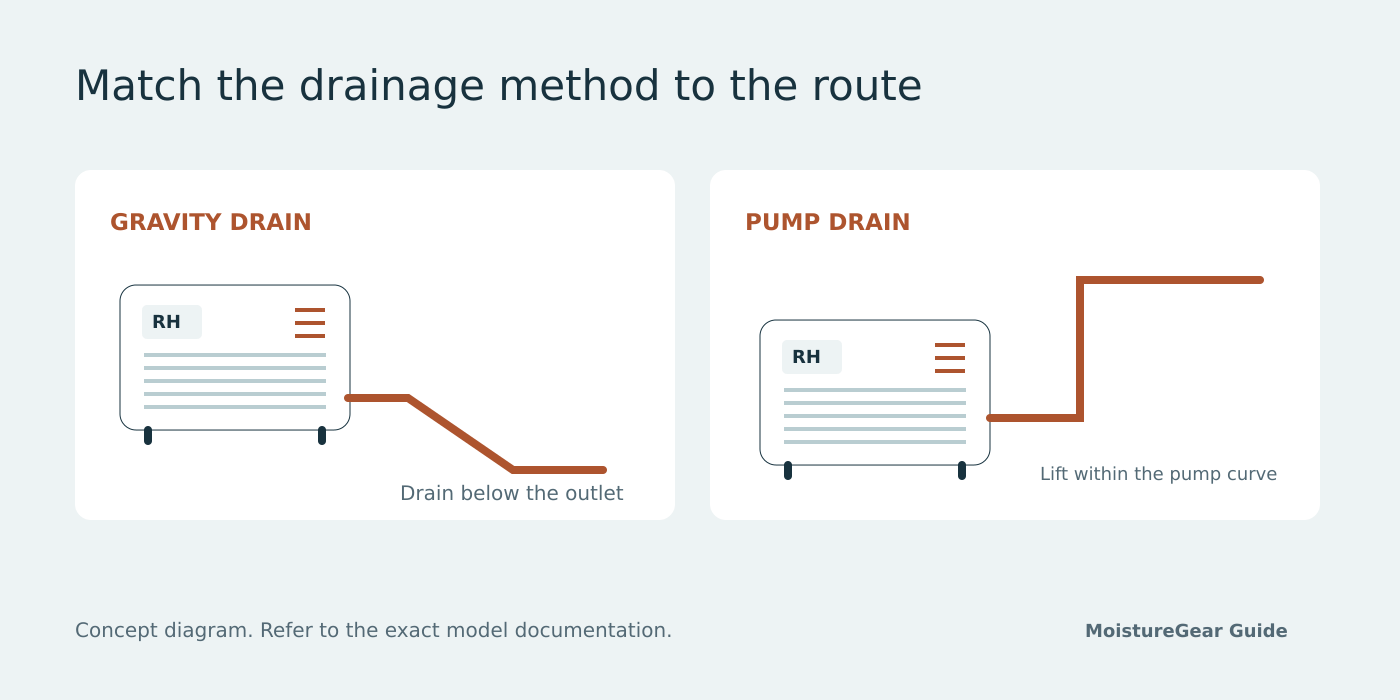
Portable equipment may have separate bucket, gravity-drain, and pump arrangements. A hose on a gravity outlet cannot lift water simply because the appliance also offers a pump feature elsewhere. Verify the designated pumped connection in the exact manual.
Confirm that any required owner-selectable pump setting is enabled and that the reservoir, bucket, plug, or connection is seated as instructed. Use the specific model's procedure; not every dehumidifier has a pump-enable button or a removable bucket.
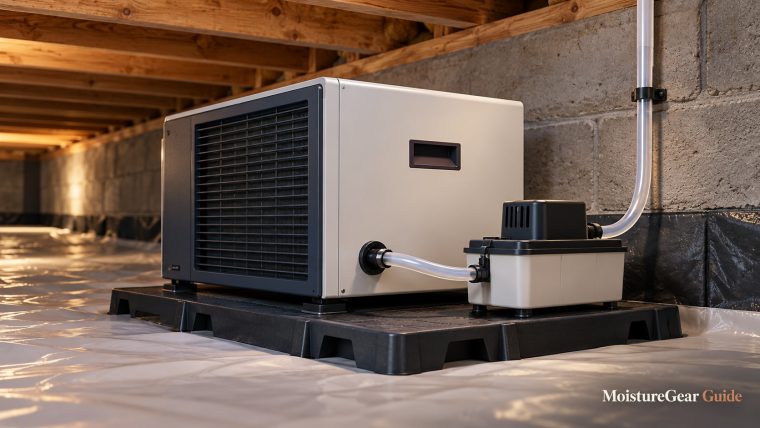
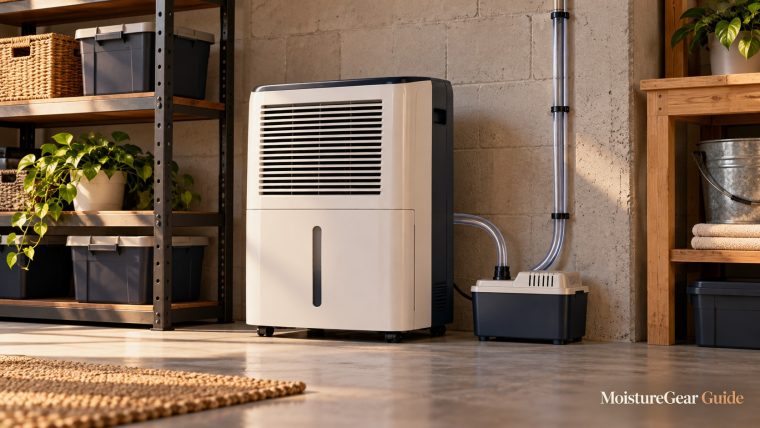
With an external reservoir, identify two lines: the gravity feed from the appliance and the pressured discharge from the pump. Follow them physically. It is possible for the pump to be healthy while water never reaches its reservoir because the feed route rises or is pinched.
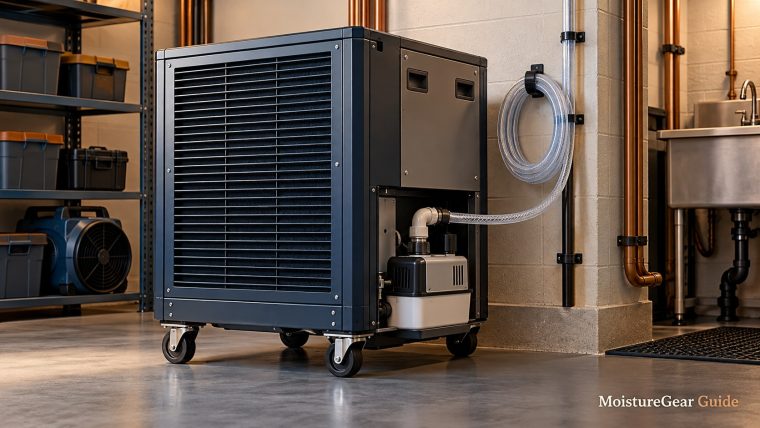
Our gravity drain versus pump guide shows that distinction. The HDi90 official product page identifies a built-in-pump arrangement, while a related gravity product can need a completely different external plan.
Inspect the full external discharge route
Follow the tube from the pumped outlet to the destination. Look for sharp bends, crushed sections, storage resting on the line, a disconnected end, or a termination that has become submerged or obstructed. Inspect hidden transitions around equipment and doorways as far as they can be reached safely.
Compare the route with the original installation photograph if one exists. A moved appliance can pull a connection loose or create a new kink behind its cabinet. Work by another trade can disturb a tube that was previously well supported.
Confirm the specified tube size and connection type. A replacement hose selected only because it fits loosely over a barb may be unsuitable. An undersized or restrictive route can change flow, while an oversized or poorly secured connection can leak.
Do not disconnect a pressured or water-filled line casually in a confined space. Isolate the equipment and follow its documented procedure before handling a permitted user connection. If the route cannot be inspected without unsafe access or opening the appliance, have the installer handle it.
Compare the route with useful pump performance
Vertical rise is not the same as tube length. The pump works against the elevation change plus resistance from the tube and fittings. A route can be below the published maximum vertical number yet still be unsuitable when the full installation is considered.
Shut-off head is especially easy to misuse. At that head, the pump delivers effectively no flow. The Little Giant VCMA-20-PRO curve illustrates that delivery changes with head, and the exact voltage version matters.
If the installation has a long route, substantial rise, tight bends, or recently changed tubing, ask the installer to assess total dynamic head. A bigger maximum number on an accessory listing is not a complete selection method.
This matters particularly after a relocation. A pump that worked beside a low drain may not serve a higher receptor across the basement. Verify the new route before concluding that the pump wore out at the same moment the installation changed.
External reservoir: distinguish feed from discharge
When the external reservoir stays dry while the dehumidifier's outlet backs up, inspect the gravity feed. The reservoir needs to receive water under the appliance's permitted arrangement. A feed hose that climbs over the reservoir's inlet cannot rely on the pump inside to pull it up.
When the reservoir fills but does not discharge, the problem lies later in the path or control. Check the safe, accessible power status and documented setup. A newly installed pump may have a shipping restraint or other preparation step; follow the exact manual without opening an energized housing.
Do not manually force the float or hold a switch closed to make the pump operate. The level control is part of the drainage protection. If an owner-level test is provided, use that test; otherwise preserve the observations and contact support.
Water remaining in the reservoir after a cycle is not automatically abnormal. Little Giant’s VCMA FAQ explains that its VCMA pump normally stops before emptying the bottom tank completely. That example should not be transferred to every pump design, but it shows why “not bone dry” and “not draining” are different observations.
Check power without performing electrical diagnosis
For a dry, accessible cord-connected pump, confirm the plug is installed as instructed and look for obvious supply interruption. An external pump and dehumidifier may use separate outlets, so the compressor running does not prove the pump has power.
If a protective device trips repeatedly, stop using the affected arrangement and obtain qualified help. Repeatedly resetting it without identifying the fault is not a drainage repair. Do not replace a protection device with a different rating or bypass it to continue operation.
Built-in pumps share appliance controls but can still have a component or control fault. A working display is not proof of power reaching every internal part. That assessment needs service rather than access to circuit boards or live testing.
Record whether a control indicator is lit, whether the pump makes a normal or unusual sound, and when the fault occurs. Those observations help support distinguish an absent cycle, a failed discharge, and an unrelated power interruption.
Use a purge or pump test only when documented
Some machines provide an owner-accessible purge or drain control, especially for transport or storage. Other devices operate only from reservoir level. Use the exact function described in the matching manual rather than guessing from a button name.
A successful documented purge shows that water moved during that test. It does not automatically prove that normal level control or every part of the route is functioning correctly. Observe where the water goes, whether a leak occurs, and whether the fault returns during normal operation.
If a purge does not work, do not keep pressing the button while a reservoir remains high or the pump sounds abnormal. Stop and report the result. Repetition can obscure the original symptom without resolving the cause.
Before transporting a built-in-pump unit, follow its prescribed draining and orientation instructions. Trapped water can spill after the equipment is moved, making a transport problem look like a new cabinet leak.
Avoid transferring chemical-cleaning recipes
A blocked drain or reservoir may require cleaning, but the permitted agent and access method depend on the model. A recipe suitable for one external condensate pump can damage another component or conflict with the dehumidifier's instructions.
Follow the owner-level maintenance procedure and the exact approved parts guidance. Do not pour bleach, strong solvents, or an improvised mixture into an internal reservoir. Do not combine cleaners. If the cleaning procedure requires internal service access you are not trained to perform, use qualified service.
Our crawl-space cleaning guide explains how to identify the filter and maintenance boundaries. Routine exterior and user-filter work can improve airflow, but it should not be described as a complete cure for an internal pump fault.
If a drain line's blockage returns frequently, investigate the underlying source of debris and the routing. Repeating a cleaning step indefinitely may conceal a poorly supported line, unsuitable termination, or equipment issue that needs a different remedy.
A safety switch is evidence to preserve
A supported overflow switch can stop condensate-producing equipment or signal an alarm. If that protection operates, the high-water condition needs attention. Bypassing it defeats the response to the problem you are trying to solve.
Not every pump switch can directly interlock with every dehumidifier. The appliance's permitted terminals, contact ratings, and wiring determine compatibility. Have the installer assess and test the actual connection instead of copying an air-conditioning wiring diagram into a portable-appliance setup.
Little Giant's VCMA FAQ distinguishes the high-water switch from the pump's ordinary operation and identifies which configurations include it. That distinction explains why a device can pump water without a connected alarm, but it does not mean alarm wiring is unnecessary where the installation calls for protection.
If the machine shuts down because of an external pump arrangement, inspect that arrangement before assuming the dehumidifier's compressor has failed. A protective interruption is a symptom with useful information.
Know when the external checks are complete
Contact qualified service when the reservoir remains full despite a correct route and permitted setup, when an internal fault indication returns, when there is leakage from the housing, or when electrical protection operates repeatedly. Also seek help when the tube or outlet cannot be assessed safely.
Internal float repair, motor replacement, control-board diagnosis, and sealed-system work are not the next steps in this owner checklist. A manufacturer's service chapter can contain technician procedures that require training and suitable tools.
For warranty support, preserve the model label, serial number, receipt, route photographs, and error indication. The warranty and authorized-seller guide explains why you should obtain service authorization before sending equipment away or paying for a repair.
Give support a specific description
A useful service message states the exact appliance and pump model, how the water is routed, and where it accumulates. Add the approximate vertical rise, tube size, whether the installation recently changed, and any displayed code. Explain the safe checks already performed.
For example: “The external reservoir fills, the pump runs briefly, and no water reaches the approved receptor. The visible tube has no kink, and the route was changed last week.” That is more informative than “the dehumidifier is broken.” It still leaves diagnosis to the technician.
Include a short video if it can be made safely without touching equipment or exposing electrical connections. Sound and timing can help support understand the event, but an unusual noise alone does not identify the failed component.
Recommission after a correction
After an approved cleaning, tubing correction, or service repair, confirm the complete route through the manufacturer's test process. Watch the feed, reservoir or internal collection behavior, discharge, and final destination. A repair is not complete until water reaches the intended place without a new leak.
Check any supported protection arrangement and restore the normal humidity target. Record the repair and keep the old and new route photographs if routing changed. Observe the system closely before returning to unattended use.
If replacement is needed, compare external condensate pumps or the relevant basement pump-equipped dehumidifiers. Choose around the real route and support requirements rather than replacing a mismatched component with another identical mismatch.
Selected primary references
- Little Giant: VCMA technical FAQ
- Little Giant: PRO range performance and configurations
- AlorAir: exact HDi90 built-in-pump configuration
About the author
Davis Murphy
Davis Murphy writes about dehumidifiers, indoor humidity, and home moisture control at MoistureGear Guide. His articles explain how to compare equipment, understand capacity ratings, and plan for drainage and maintenance. He focuses on clear, practical guidance to help readers choose a dehumidifier suited to their space and needs.