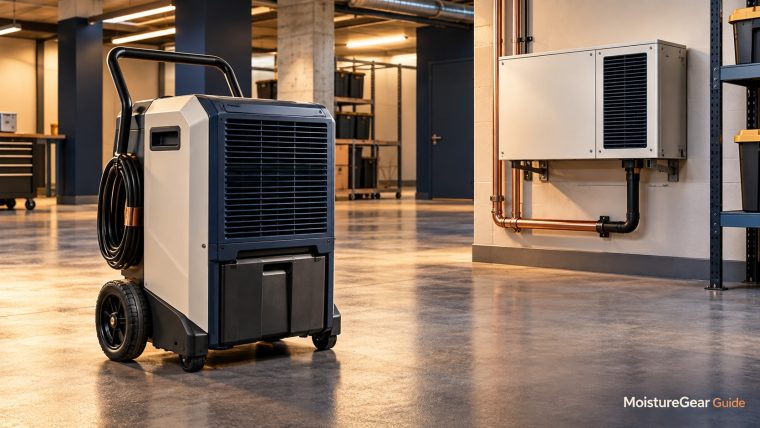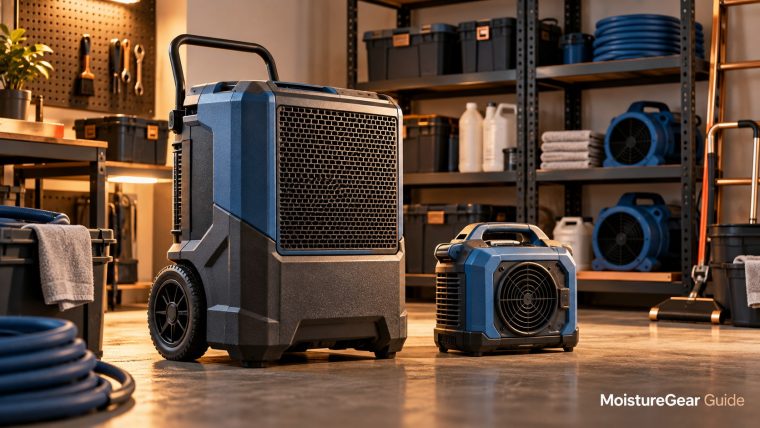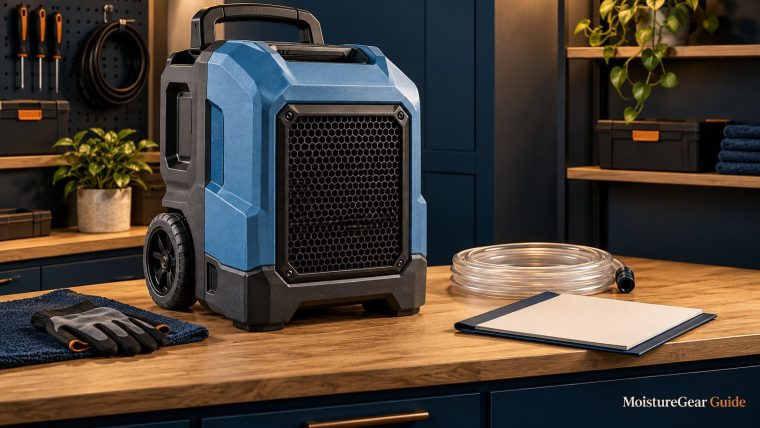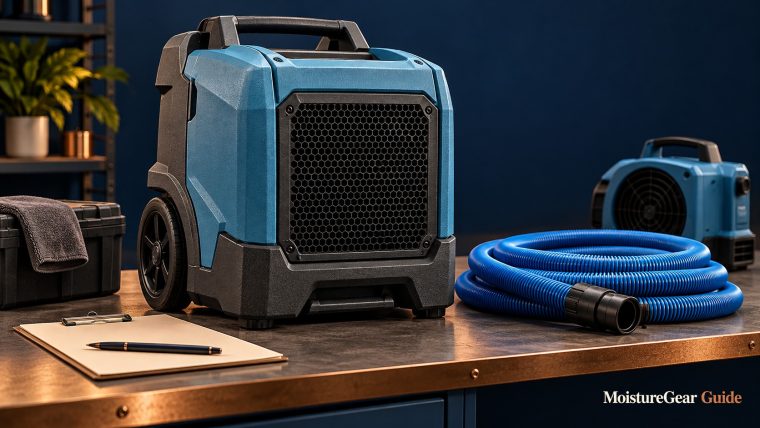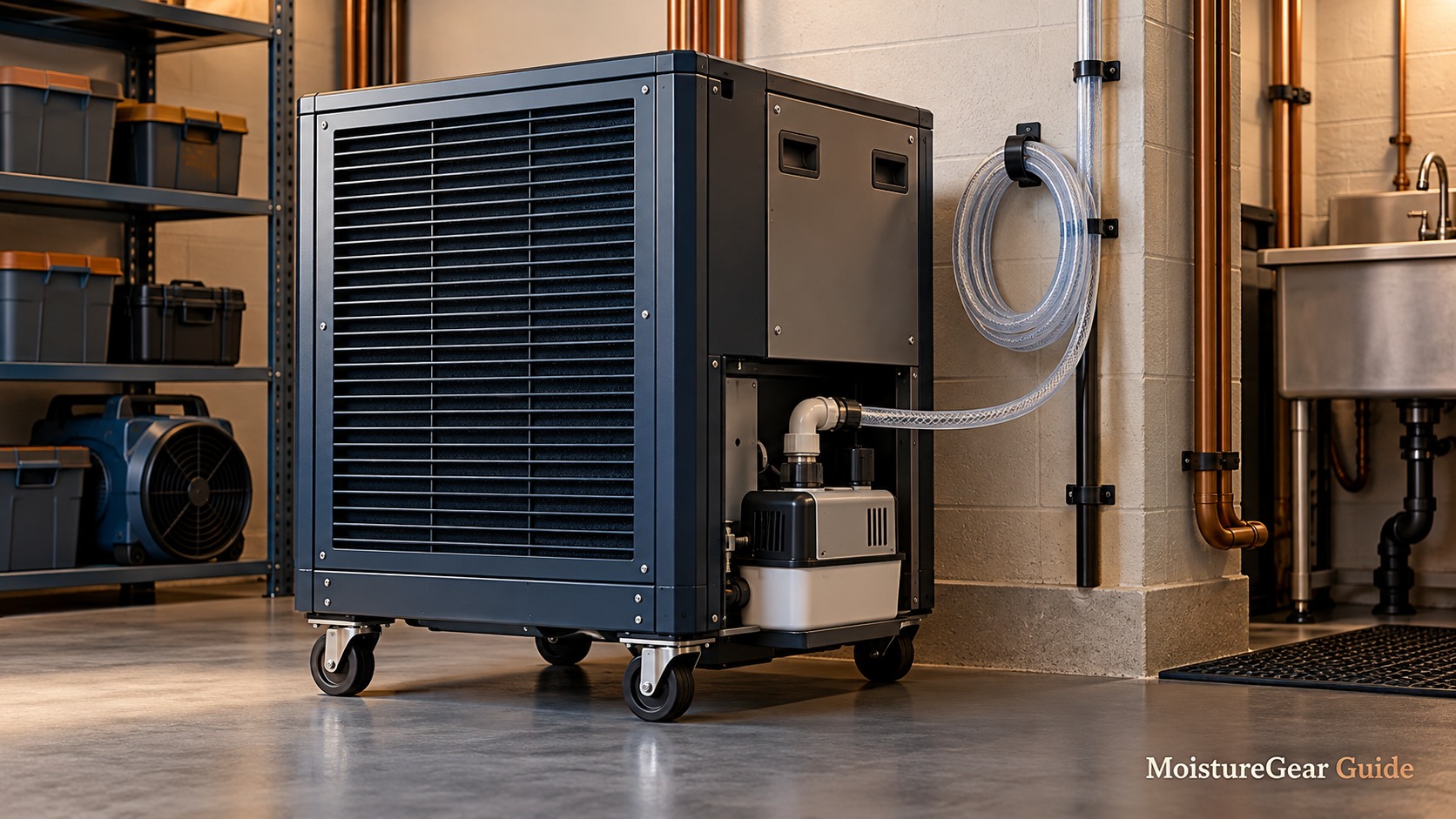
The best commercial dehumidifier with pump drainage is a machine whose condensate system matches the building, hose route, and level of supervision. A built-in pump can solve the problem of a drain above the equipment, but it cannot make an unsuitable discharge destination safe or prevent every hose obstruction. Before comparing removal capacity, establish where the collected water will go and which documented pump arrangement can get it there.
This buying guide focuses on drainage. For broader product choices, use our commercial dehumidifier hub and commercial equipment comparison. For the refrigeration technology, see the LGR shortlist. Those are separate decisions: a strong water-removal machine still needs a dependable route for its condensate.
Our shortlist uses current manufacturer pages and matching accessible documents. We have not independently tested pumping, fault protection, noise, or reliability. A documentation gap is a question to resolve with the seller, not an invented performance result.
The pump-equipped shortlist
| Candidate | Suitable buying situation | What is established from current primary documentation | What still needs purchase-specific confirmation |
|---|---|---|---|
| AlorAir Storm LGR Extreme | Compact temporary drying | Current app/non-app pages describe a built-in pump | Correct hose, permitted lift, and manual matching the delivered generation |
| Dri-Eaz Revolution LGR | Compact professional equipment | Current manufacturer family is restoration-oriented; manual documentation identifies automatic pumping | Current manual, drain accessories, controller generation, and exact pump limits |
| Dri-Eaz LGR 6000Li | Repeated use where wheels suit the route | Manufacturer describes pump basin and purge features | Current drain instructions and accessories for the seller’s offer |
| AlorAir Sentinel HDi90, built-in-pump version | Installed crawl-space or building-support role | Specific product page identifies pump drainage | Matching instructions, permitted route, and differences from other HDi90 variants |
| Phoenix DryMAX XL Pro, current R454B version | Professional drying with a documented elevated drain | Current manual states pumping up to 20 feet with the attached hose | Full route suitability, discharge destination, and correct product generation |
The final column is a purchase checklist, not a claim that these products have no pump specification. Documentation needs to match the delivered unit. We do not carry an older manual's number into a current product recommendation when the generation is unclear.
Why the pump changes the decision
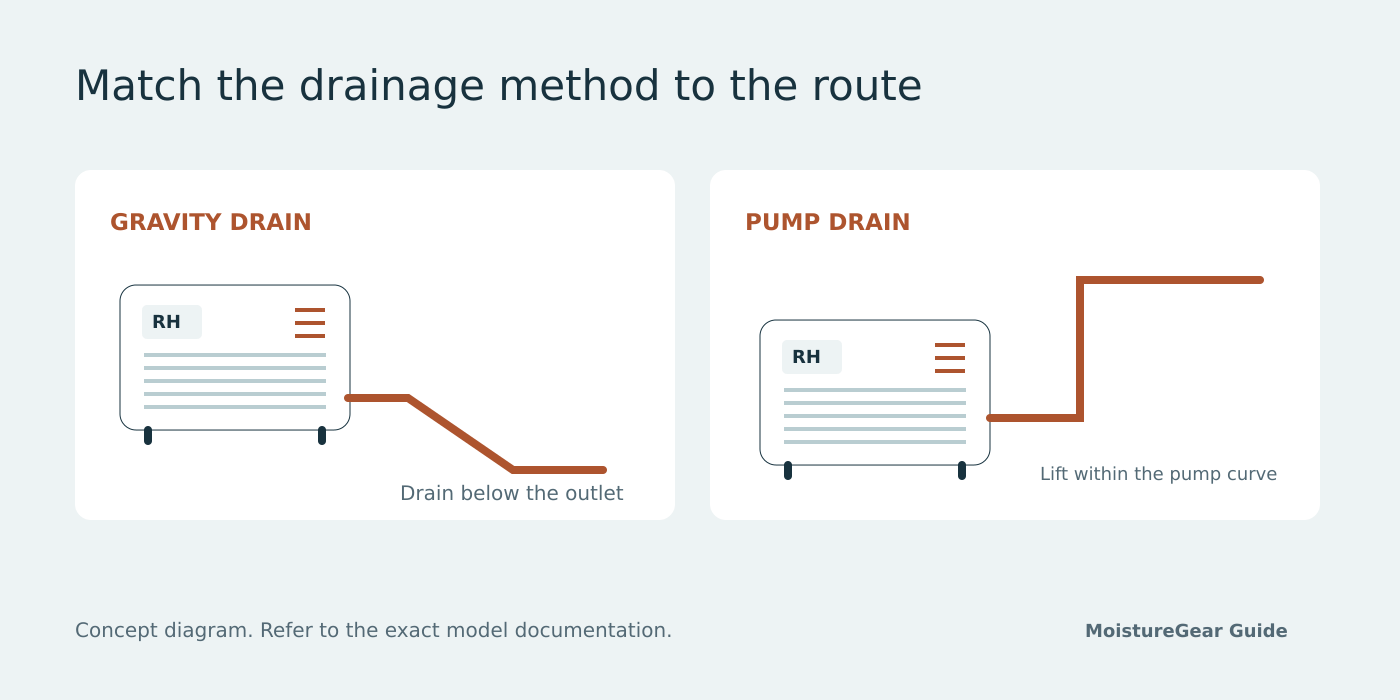
A gravity drain depends on continuous fall from the equipment outlet to the destination. A pump can send condensate upward within the manufacturer's limits, which opens up placements where a floor drain is unavailable. That is useful in a basement, temporary work area, or installed space with a suitable higher drain.
However, a pump introduces an additional system: a reservoir or basin, a level-control arrangement, a discharge connection, a hose, and a powered mechanism. Their condition matters. The equipment can be extracting moisture normally while a kink, loose connection, or blocked termination prevents that water from reaching the destination.
The correct choice therefore includes both the dehumidifier and the drainage layout. A buyer who orders a machine first and looks for a drain afterward may discover that the hose route crosses a busy doorway, the rise exceeds the permitted arrangement, or the proposed drain cannot be used as imagined. Our gravity-versus-pump guide explains the basic alternatives, including when a separate compatible condensate pump may be worth discussing with an installer.
AlorAir Storm LGR Extreme: compact drying, version-sensitive drainage
AlorAir's current non-app page and Smart App Control page both list condensate-pump drainage. For a buyer moving equipment among rooms, the integrated pump avoids treating the machine as a bucket appliance. It also creates a useful reason to verify the included hose and connection before the first job.

The catch is that the Storm LGR Extreme name spans documentation with different generations. An old specification sheet or a retailer's image may not describe the exact equipment being sold today. Ask the seller for the matching instructions and the limits for the drain arrangement. Do not assume a number from a similar AlorAir cabinet applies.
Storm is a reasonable candidate when compactness and temporary deployment matter, provided the documented route suits your site. It is a less certain purchase if the seller cannot identify the actual version or explain what is included. Our Storm review separates the current-page claims from the questions the individual offer must answer.
Dri-Eaz Revolution: confirm the present-generation instructions
Revolution is attractive where compact equipment makes transport and room access more practical. The current Legend Brands page includes the Command Hub version. That matters because older marketplace offers can show previous controls even when they use the same familiar model name.

Available historic manufacturer manuals describe automatic condensate pumping, but the current product page's manual link leads to a document folder that could not be independently read for this guide. We therefore do not publish a pump-rise or included-hose number as a current-model guarantee. A prospective buyer should obtain those details from the seller's matching manual.
That distinction protects a real purchase decision. A hose shown in a photo does not establish its length, rating, condition, or inclusion in the offer. An elevated destination also needs more than a vague claim that the machine has a pump. Choose Revolution for its documented compact role, then qualify its actual drainage package. The current Revolution review provides the corresponding model-identification checks.
Dri-Eaz LGR 6000Li: useful pump features in a wheeled machine
The LGR 6000Li manufacturer page describes a pump basin and a final-purge process. Those details are relevant to a unit that is moved after a drying assignment. A machine can retain water internally even after the visible hose looks empty, so the manufacturer’s shutdown and transport procedure deserves attention.

The wheeled format can suit repeated professional deployment, but the equipment still needs a clear, protected drain route at each job. A long hallway does not automatically mean a simple installation if the hose crosses a doorway or changes elevation several times. Plan equipment placement and discharge together, with access to inspect the line during ordinary visits.
Consider this model when its capacity and handling arrangement fit the rest of the workload. Request current pump instructions and accessories as part of the quote. Avoid making its drainage comparison from a legacy manual or a third-party lift claim. If a rental supplier offers it, ask to see the exact drain setup they authorize before relying on their equipment for an elevated destination.
Sentinel HDi90: permanent placement creates different pump priorities
The HDi90 built-in-pump version is a candidate for an installed role rather than frequent wheeled deployment. A permanent drain arrangement can be protected and documented carefully, but it can also become easy to forget once the cabinet disappears beneath a building.

Keep filter and drain access part of the installation design. A pump-equipped machine should not be installed where reaching the connection requires moving the unit through a difficult access opening every time. The installer should identify the appropriate route and explain which inspections and maintenance remain the owner's responsibility.
AlorAir lists separate HDi90 configurations. Verify the actual built-in-pump version, control options, and any intended ducting instead of assuming every HDi90 offer is equivalent. Our HDi90 buying review covers the capacity and installation considerations. A permanent system that needs pumping also benefits from a discussion of fault visibility and suitable additional monitoring for the property.
Phoenix DryMAX XL Pro: the strongest documented lift example here
The current May 2026 XL Pro manual states that condensate can be pumped up to 20 feet with the attached hose. Its A2L specification sheet lists a 33-foot hose. These are different measurements: the hose length is the tubing supplied, while the stated vertical lift concerns elevation.

This is a useful example of the evidence to request from every supplier. It is not a universal 20-foot rule for commercial equipment, and it is not permission to add arbitrary tubing or fittings. An actual route can introduce restrictions or circumstances that need manufacturer confirmation. The permitted installation in the matching manual governs use.
The current XL Pro is dealer-sold professional equipment. Confirm the exact generation, especially where older R410A and current R454B documentation appear together. If the proposed route approaches a limit or needs an additional pumping arrangement, have the supplier and appropriate installer specify it. Do not improvise a second pump system from an internet comparison table.
Measure lift and distance separately
Vertical rise is the difference in elevation relevant to the manufacturer's stated pump arrangement. Total hose distance is the route the water travels. A 25-foot route with a modest rise is not the same installation as a 25-foot vertical climb. Similarly, a long supplied hose does not tell you how high the pump can send water.
Hose diameter, bends, restrictions, fittings, and the manufacturer's permitted extensions also affect the installation. Generic pump-head charts can help explain those relationships, but they do not substitute for instructions specific to an integrated dehumidifier pump. When a document provides a maximum, ask what complete arrangement that number assumes.
Write down the highest point in the route, the destination, and the length along the intended path. Avoid estimating from straight-line distance across the room. A hose may have to follow walls, bypass doorways, or reach a drain in another area. This simple route record helps the seller answer an actual question rather than approving an undefined "basement pump setup."
The destination must be suitable for the discharge
Choose a destination that can accept the condensate during expected operation. A nearby sink, drain, or other location might be physically convenient while still needing a plumbing or property-use check. Local requirements and site conditions determine what is appropriate; a product manual's list of possible destinations is not a universal permission for every building.
If the plan uses a container, assign active supervision and an emptying schedule appropriate to the actual collection. Do not label that arrangement unattended continuous drainage. Collection can change as the room conditions change, so a previous day's small amount is not a dependable overflow limit.
For permanent installations, avoid arrangements that can send water back toward the structure, onto a walkway, or into an area where it may freeze. An approved route should remain suitable through the seasons in which the equipment will operate. A plumber or installer can settle destination and connection questions that a dehumidifier comparison article cannot resolve for an unseen property.
Hose routing is part of site management
Protect the discharge hose from sharp bends, crushing, disconnection, and traffic. During temporary work, another person may move equipment or close a door without realizing that the line serves a condensate pump. The route should be visible enough to inspect while remaining clear of exits and normal movement.
Leave appropriate access to the machine's connection. If the outlet is hidden against a wall, a small leak can continue unnoticed. Likewise, a hose termination tucked into a cluttered area can be hard to check during routine visits. Good routing makes a drainage check quick and obvious rather than requiring a search.
At a commercial site, identify who may move the unit and what they must do first. The operator's shutdown and purge requirements are model-specific. A hose that looks dry externally can still be connected to a machine with retained condensate. Moving it without the correct process can create spills even when the pump has been working normally.
Fault handling: ask what the machine actually reports
A pump-equipped dehumidifier should have a documented process for handling a drainage problem. Find out whether the controller reports a reservoir or pump-related alert, what operation stops, and what user checks the manual permits. A simple alarm can be useful if someone is present to see it; its value is different in an unattended building.
Connected monitoring needs equally precise questions. Does the system report the relevant fault? Does it require Wi-Fi, an accessory, a paid service, or a particular app? Does the responsible person receive an alert, or merely have the ability to open a dashboard? Avoid treating remote viewing and automatic notification as the same feature.
A moisture or leak sensor may add information in a permanent installation, but it must be selected and placed appropriately. It cannot repair a blocked hose or replace periodic inspection. Our pump-not-draining guide explains safe external checks and the point at which support or a technician is needed.
Built-in pump or separate condensate pump?
An integrated pump can simplify the equipment package and reduce the number of separate items transported to a job. The manufacturer has designed it around the dehumidifier's reservoir and controls. The tradeoff is that a pump problem can become a problem with the entire appliance, depending on service access and the approved repair process.
A separate compatible condensate pump can be useful with an appropriate gravity-drain dehumidifier, particularly in a permanent layout. However, the complete arrangement needs proper positioning, electrical supply, tubing, overflow protection, and compatibility. It should not be assumed to work merely because both products are sold as drainage equipment.
Compare these options by the site and service process. For a business, separate components may simplify replacement in some cases, while integrated equipment may simplify daily setup. Our condensate-pump selection guide covers supporting equipment. An installer can determine whether a proposed external pump and safety-switch arrangement is appropriate for the actual unit.
Maintain the drain without creating a new fault
Use the matching manual to establish inspection and maintenance intervals. External hose condition, the connection, and the destination are useful ordinary checks. Filter maintenance also belongs in the routine because air circulation and condensate production are part of the same working machine.
Do not pour cleaners into the pump or reservoir unless the actual instructions specify an approved product and process. A treatment suitable for another condensate system may not be suitable here. Similarly, do not substitute an unapproved hose or modify a level switch to clear an alert. The objective is to keep the designed system working, not to bypass the part reporting a problem.
If servicing requires opening an electrical enclosure, handling refrigerant components, or replacing an internal pump, use manufacturer support or a qualified technician. Accessible parts do not automatically make the procedure an appropriate consumer repair. Record the model, serial number, alert text, and visible drain condition so the technician can work from specific information.
Give the next operator a useful drainage record
For a shared commercial site, record which equipment the discharge line belongs to and where it terminates. Include the installed route, relevant manual, permitted rise confirmed for that exact machine, and the contact responsible for changes. That makes the system less dependent on the memory of the person who first set it up.
Temporary jobs need a smaller handover record: location of the machine, destination, hose route, latest observed discharge condition, and any active alert. If another crew moves equipment or changes room access, the operator should recheck the route before relying on the previous setup. A line that worked before a door or cart was moved may no longer be clear.
A permanent installation can benefit from photographs showing the connection and termination in their intended positions. Use the same view during later inspections so a displaced hose or new obstruction is easier to notice. Date the record after an actual check, rather than leaving an undated note saying drainage is fine.
These records support supervision. They do not replace the appliance's protective controls or establish that pumping will continue indefinitely without inspection. Their value is making responsibility and the approved arrangement clear.
Commission the arrangement before leaving it unattended
Once a suitable installation is complete, inspect the route and connection using the manufacturer's operating process. Confirm that discharge reaches the intended destination during normal pumping or an approved pump test. Do not invent a test by adding water inside a machine whose instructions do not authorize it.
Check the termination after other equipment is positioned. A hose can be routed correctly and then crushed by a cabinet, cart, or door. Verify that people responsible for the site know its purpose and will not disconnect it to clear space. The same practical check applies when a temporary drying setup moves from one room to another.
Keep a written record of the installed route and the instructions. For an installed system, photographs can make later inspections easier. For a fleet, a standard external hose inspection before and after each job helps reveal damage while the unit is accessible. These are operational records, not a guarantee that an unattended system cannot fail.
A purchase worksheet that exposes missing details
Before paying, ask the seller or installer to answer these questions in writing:
- What is the full model, controller, and generation of the supplied equipment?
- Is the pump integrated, and which hose and connection are included?
- Which matching manual states the permitted lift and route requirements?
- Is the proposed destination acceptable for this building and use?
- What alert or shutoff occurs when the pump cannot drain normally?
- Which checks can the owner perform, and which require service?
- Who supplies approved replacement tubing, connections, and pump parts?
- What warranty terms cover pump components, labor, and freight?
If the answers remain vague, the drainage plan is unfinished. It is better to resolve that before purchase than after a unit begins producing condensate in an inaccessible location. The manufacturer and seller should be able to identify documentation for the equipment they supply.
Keep the drying task within the equipment’s role
A condensate pump removes water collected inside a dehumidifier. It is not a floodwater extraction pump. Standing water, electrical hazards, sewage contamination, and hidden damage require their own assessment. The EPA flood guidance explains why safe cleanup and drying form a broader process.
Where water damage is the reason for purchase, use our buy-versus-rent guide to compare equipment access with appropriate professional help. A suitable pump solves one important practical problem. It does not establish that the rest of the restoration is complete.
Selected sources
- AlorAir Storm LGR Extreme pump-equipped product
- Legend Brands Revolution LGR
- Legend Brands LGR 6000Li
- AlorAir Sentinel HDi90 built-in pump
- Phoenix DryMAX XL Pro May 2026 manual

About the author
Davis Murphy
Davis Murphy writes about dehumidifiers, indoor humidity, and home moisture control at MoistureGear Guide. His articles explain how to compare equipment, understand capacity ratings, and plan for drainage and maintenance. He focuses on clear, practical guidance to help readers choose a dehumidifier suited to their space and needs.