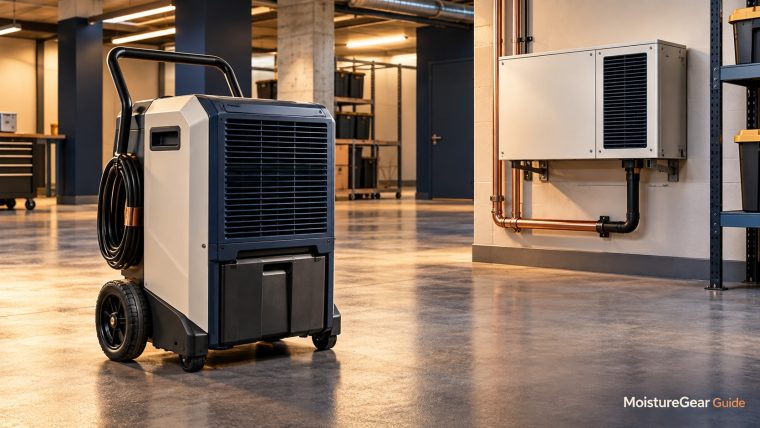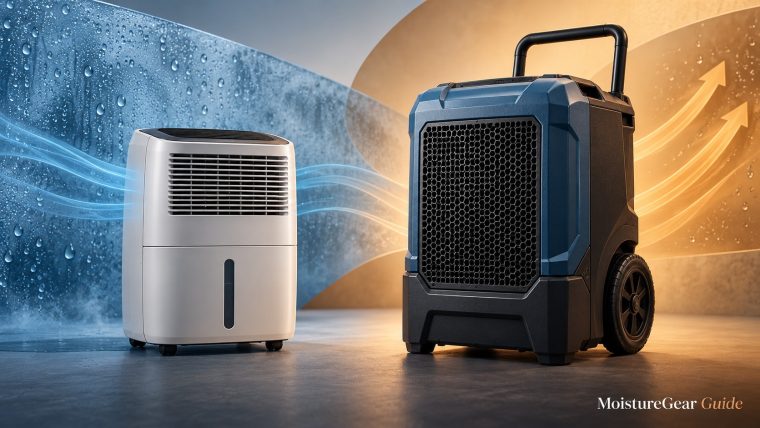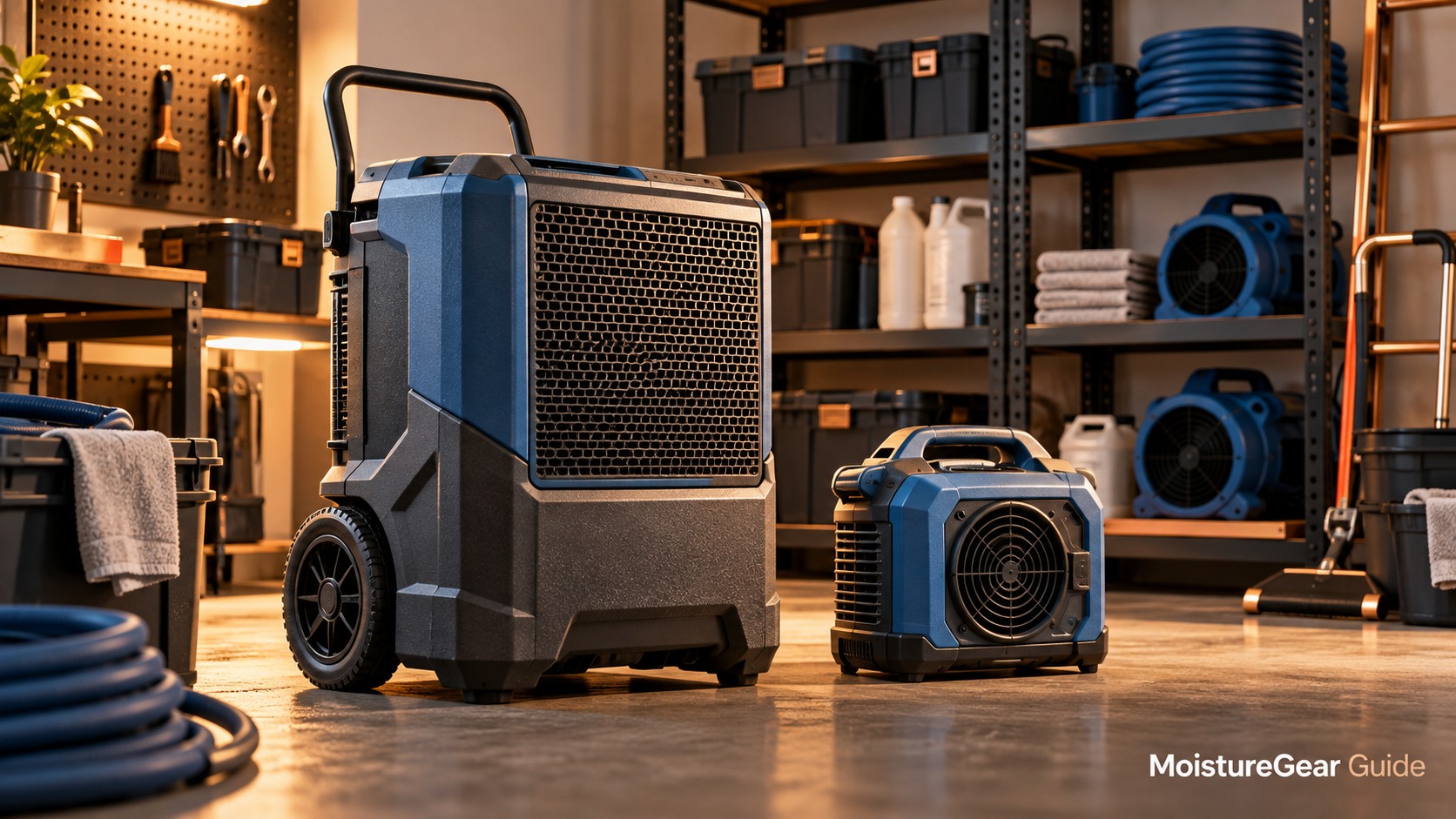
The best LGR dehumidifier is the one that maintains a useful drying environment while fitting your workload, transport routine, and service arrangements. A larger saturation number does not settle that decision. Compare the same rating conditions first, then investigate how the machine handles changing air conditions, how you will move it, and what happens when it needs a filter, pump service, or a repair.
LGR means low-grain refrigerant. These machines still condense moisture using refrigeration, but their design aims to keep extracting water as the air becomes drier. This is a focused equipment shortlist. Our commercial dehumidifier hub covers permanent control and other applications, while the LGR-versus-conventional guide explains the technology choice.
Four documented candidates, compared fairly
| Model and documented version | Pints/day at 80°F and 60% RH | Published handling information | Most relevant purchase question |
|---|---|---|---|
| Dri-Eaz Revolution LGR, current Command Hub page | 80 | 63 pounds; compact stackable form | Does compact deployment justify the offer and support available? |
| AlorAir Storm LGR Extreme, current non-app/app pages | 85 | Compact cabinet; pump-equipped family | Which exact version and matching instructions will arrive? |
| Dri-Eaz LGR 6000Li, current Command Hub page | 100 | 99 pounds; wheeled format | Can the access route and vehicle accommodate the heavier unit? |
| Phoenix DryMAX XL Pro, current R454B documentation | 135 | 85 pounds; wheels and adjustable transport handle | Does the larger rated capacity fit the actual jobs and dealer package? |
The reference condition is essential: all four removal figures above are stated at 80°F and 60% relative humidity. They are manufacturer ratings rather than independent comparative results. They do not predict the daily collection in a room at another temperature or later in a drying job. In particular, they should not be mixed with saturation figures from retailer titles.
This shortlist includes dealer-sold equipment as a performance and workflow benchmark. Marketplace search links are an invitation to verify offers, not proof that the current version is available from an authorized Amazon seller. A dealer-supported purchase can be the more appropriate route when precise configuration and service matter.
How we built the shortlist
We used current manufacturer product information, specifications, and accessible manuals to identify models with useful documented distinctions. We assessed rated water removal at a shared condition, carrying versus rolling arrangements, controls, drainage, and ownership questions. We did not run the products side by side or test low-grain extraction, app reliability, noise, or long-term durability.
Documentation changes deserve attention. A familiar model name can survive changes to the controller, refrigerant, or accessory package. Some current product-page manual links lead to gated document folders, and older files remain indexed in search engines. Where those materials could not establish a current-model fact, we left out the disputed number instead of filling it from a retailer description.
Dri-Eaz Revolution: choose it around compact deployment
Revolution is the clearest candidate here when cabinet space is central to the working day. The current Legend Brands product page gives the 80-pint AHAM rating and identifies the current Command Hub feature set. Its compact form can matter when several units share a vehicle or when the job involves small rooms and awkward access.
Think of a drying operator carrying equipment between a bathroom, a utility room, and a small apartment. A large upright machine might offer more capacity at a reference point, yet take more truck space or complicate access. A compact unit can be useful when the job can be divided into manageable areas with appropriate airflow. That is a workflow advantage, not evidence that Revolution dries every material faster.
The controller is another reason to investigate it. Current Command Hub functionality supports viewing operating data and connected management. If your existing equipment already uses the same system, compatibility can simplify training and daily checks. If you have no need for remote oversight, do not price the entire decision around connectivity that will rarely be used.
The main constraint is handling. Sixty-three pounds is still a load that requires planning, especially on stairs or at vehicle height. Ask the seller about the current unit, the supplied accessories, and an approved transport approach. Compare the width of narrow doors and storage spaces with the actual cabinet and any attached components. Our Revolution review goes deeper into current-versus-legacy offers.
AlorAir Storm LGR Extreme: scrutinize the offer, not the name
The current Storm LGR Extreme non-app page lists 85 pints per day at 80°F/60% RH. AlorAir also offers a Smart App Control version. Both current pages describe an integrated condensate pump. That makes Storm a candidate for compact temporary drying where the purchaser wants to compare different levels of connected control.
A specification difference of five pints at the reference condition is not enough to declare it the winner over Revolution. The usefulness of each machine depends on the actual environment and complete setup. Likewise, a larger advertised saturation figure should not be treated as a low-grain result. Saturation is a different test condition, while this buying decision is about maintaining useful removal as the air dries.
Storm demands a careful version check because historical manuals and current pages can describe different generations. Ask for a photo of the actual unit's identification label and control panel where a seller's offer is unclear. Get confirmation about the app feature, included hose, manual, and seller support. Keep that written confirmation with the receipt.
If the offer is appealing only because it appears cheaper, check the complete cost before concluding that it is a better value. Freight, return arrangements, accessories, service shipping, and the availability of a suitable replacement during downtime all affect ownership. The Storm research review explains what can be established from the current manufacturer pages and what still needs confirmation for the individual purchase.
Dri-Eaz LGR 6000Li: a step up that changes the transport plan
The LGR 6000Li page publishes 100 pints per day at the same AHAM condition, along with current Command Hub controls. Its wheeled form serves a different handling preference from a compact carry-oriented cabinet. It is worth considering when the operator wants more reference capacity and can accommodate the published 99-pound machine.
A clear route across a large floor is favorable for wheeled equipment. Several short staircases, a high loading deck, and tight storage may change that judgment. Map the route on your typical jobs rather than imagining an unobstructed showroom floor. Consider thresholds, lift assistance, securing equipment in a vehicle, and whether the machine has to be moved after the building is occupied again.
Its published process airflow differs from the compact models, but airflow alone is not a water-removal score. Air must spend useful time interacting with the cold surfaces, and the equipment controls adapt to operating conditions. A larger fan figure cannot replace comparable extraction data. It also cannot establish how well air will reach remote wet materials behind room partitions.
For an existing Dri-Eaz fleet, common controls and supplier arrangements may be valuable. For a first purchase, compare that convenience with the installation and handling costs it creates. Request the current generation's manual and included accessories before ordering. A commercial operator should know the service contact and turnaround process before the machine becomes central to a drying schedule.
Phoenix DryMAX XL Pro: investigate capacity and handling together
Phoenix's current product documentation and A2L specification sheet publish 135 pints per day at 80°F/60% RH. Its wheels and transport-handle arrangement make it a useful alternative when the buyer expects repeated movement around job sites and wants a larger reference extraction figure in a relatively low cabinet.
This does not make it the correct option for every job. More rated capacity can be unused in a small, well-controlled area, while separated rooms may still require additional units. A high-capacity dehumidifier cannot remove vapor from a closed room it does not meaningfully circulate through. The job layout has to support the equipment you buy.
The XL Pro is also part of a broader Phoenix connectivity ecosystem. Bluetooth features are distinct from the connections and services that make remote oversight possible. Ask the distributor to demonstrate the actual workflow, identify any additional device, and explain any relevant service plan. A feature list with the word "remote" is less useful than a clear account of how your operator will receive data from your buildings.
Do not confuse this product with DryMAX XL or DryMAX XL Pro+. Current R454B documentation also differs from older R410A material. Have the distributor match the manual to the unit. Because current official documents have inconsistencies in a few secondary specifications, this guide does not use amperage or cabinet depth to rank it. The capacity, product family, and major handling features provide the useful shortlist distinction without inventing certainty.
What low-grain performance actually means
In restoration language, "grains" generally refers to a measure of water vapor carried by air, commonly expressed as grains per pound of dry air. Lower grains mean less vapor in that air. Relative humidity measures something different: how close the air is to saturation at its current temperature. Warming air can reduce its relative humidity without removing the same amount of water that the percentage drop might suggest.
An LGR machine is intended to continue making useful condensate in drier conditions where a simpler refrigerant design may struggle. Many designs use an internal heat-exchange or pre-cooling arrangement; others achieve low-grain performance through different refrigeration and airflow engineering. Phoenix's GTR technical explanation is one example of why no single internal layout describes every LGR machine.
The buying implication is to ask for performance information relevant to your expected conditions, rather than assuming that the initials guarantee a particular result. If a supplier provides a low-grain data point, record temperature, RH, airflow assumptions, and the exact unit generation alongside it. Our how LGR dehumidifiers work guide explains this without requiring refrigeration-service knowledge.
Ask for data that can answer your real question
A chart of removal against temperature and humidity is more informative than an unsupported claim that a unit is "industrial strength." If the intended job is a cool room approaching its drying target, ask what published evidence covers that condition. The reference AHAM rating establishes one point; it does not describe an entire performance curve.
Sometimes the answer is that no comparable manufacturer curve is available. Treat that as uncertainty, not a reason to assume the machine with the biggest number wins. A rental trial under an appropriate professional drying plan, or a supplier demonstration with clearly defined conditions, can answer practical questions that a webpage cannot.
For repeated use, capture consistent observations from your own jobs: location, temperature, incoming and outgoing air readings, operational status, drain condition, and material-moisture progress. These records can inform later purchases. They still do not become a controlled comparison if jobs differ in wet materials, room layout, or incoming moisture. Their strength is helping you evaluate your workflow.
Service access is a purchasing feature
An accessible filter matters because a restricted air path can interfere with normal operation. A pump and drain arrangement that can be inspected according to the manual matters because condensate has to leave the unit. Neither feature proves long-term reliability, but both affect the practical work of ownership.
Ask the supplier what an owner can maintain, what requires a technician, and which parts are stocked locally. Look for a current parts list and a specific service contact. A technician familiar with the product is more useful than a generic assurance that replacement parts exist somewhere. For a fleet, a consistent stock of approved filters and hoses can simplify daily routines.
Do not open electrical enclosures or refrigeration systems merely because a manual includes technical service diagrams. Current refrigerant generations require appropriate expertise. Choose equipment whose service route you can actually use, and separate ordinary operator maintenance from work reserved for qualified service personnel. Downtime planning is particularly important if the equipment protects a building that cannot wait for a lengthy repair shipment.
Use existing-equipment records to improve the shortlist
If you already operate drying equipment, write down what the current machines handle well and where they cause difficulty. Separate inadequate reference capacity from slow setup, poor access, difficult transport, or unclear controls. Replacing equipment with a higher pint rating may help the first problem while leaving the others unchanged.
Include the actual conditions of troublesome assignments where appropriate records exist. A machine struggling in an unusually cold room raises a different question from one operating in a large open area with continuous humid outside air entering. Share those observations with the supplier, with the understanding that job records are not controlled laboratory tests.
Then ask what the candidate changes in that specific workflow. More rated capacity, better handling, common controls, or a clearer service route are meaningful answers. An unqualified promise to dry every job faster is not. This approach can also reveal that keeping an existing machine for smaller assignments and adding a different capability is more sensible than replacing the whole fleet with one model.
Drainage: establish the route before comparing prices
LGR restoration units often use automatic condensate pumps. That is useful because a temporary job may not provide a gravity drain below the machine. However, the pump rating belongs to a particular unit and hose arrangement. Do not assume one model's permitted rise applies to another product with a similar cabinet.
Specify the destination, vertical lift, hose route, and how the end will be secured. A drain line draped through a doorway can make a technically capable setup unsuitable for a working site. A container needs active monitoring; it is not a permanent substitute for a discharge arrangement that can handle the full collection.
On purchase day, ask how the pump reports a drainage fault and what the operator is expected to check. The commercial pump guide provides a focused worksheet for that decision. Understanding the shutoff and purge process also helps avoid water spills when a machine is moved after use.
Build a complete purchase comparison
Put competing quotes side by side only after making their contents comparable. Include the machine, exact controller, hose, filter, delivery, useful transport accessories, and the service arrangement. If connected operation is required, include any gateway, connectivity cost, or software plan. A low machine-only price can lose its advantage once the necessary setup is included.
For operating cost, ask for an appropriate electrical figure for the exact unit and condition rather than multiplying an advertised amp figure into a guaranteed energy bill. Compressor demand, fan operation, and duty cycle change with use. Our electricity-cost guide explains how to create a labeled estimate with your local energy price.
For warranty cost, check labor and freight separately from covered parts. A multi-year refrigeration-parts warranty is not equivalent to multi-year comprehensive service. Verify the seller relationship and applicable terms before treating the longest number in a banner as the best support package.
Three different buyers, three different priorities
A property manager who needs one machine for occasional localized drying may value simple transport, understandable controls, and a nearby supplier more than a remote-monitoring ecosystem. If utilization will be low, the rent-or-buy comparison deserves attention before ordering any specialized equipment.
A restoration operator handling several jobs at once may prioritize common controls, vehicle packing, service familiarity, and consistent accessories. In that setting, a modest difference in reference capacity can matter less than avoiding confusion when technicians rotate between machines. The strongest purchase may be the one that integrates into an established process.
A facilities team seeking permanent humidity control should first confirm that LGR jobsite equipment is the appropriate class. A fixed installation may need ducting, remote room control, discreet placement, and building-specific load assessment. The broader commercial guide separates that assignment from portable structural drying.
Inspect the delivered equipment while the purchase is easy to correct
Before committing the machine to regular work, compare the delivered label, panel, and accessories with the seller's description. Check for shipping damage and keep photographs of the unpacked equipment. Follow the manual's placement and startup requirements; do not assume that transport-rest instructions from another model apply.
Then verify the features that influenced your choice. Confirm the controls you need, the drain connection, and the service contacts. If connectivity was a major reason for buying, establish it under the conditions in which the equipment will operate. A good return period is useful only if you identify a mismatch while there is time to resolve it.
Set up an ownership record with the serial number, manual, receipt, warranty terms, and maintenance information. That modest administrative step prevents uncertainty later about which product generation was purchased and which instructions apply. It also gives a technician the information needed to discuss a fault without starting from a vague model nickname.
Common questions before choosing
Does the highest AHAM rating win? It is a helpful capacity comparison at one condition. It cannot decide transport suitability, service quality, installation fit, or performance at every temperature and moisture level.
Does a falling RH number prove a building is dry? No. Material moisture and room-air humidity are different measurements. The EPA’s moisture guidance distinguishes equipment used to assess air and building materials. A qualified drying plan determines the appropriate endpoint.
Can an LGR dehumidifier remove existing mold? It controls air moisture; it does not replace contamination assessment, appropriate material handling, or remediation. Choose the equipment for its documented drying role and use professional help when the damage or water source calls for it.
Selected sources
- Legend Brands Revolution LGR
- Legend Brands LGR 6000Li
- AlorAir Storm LGR Extreme
- Phoenix DryMAX XL Pro specification sheet
- Phoenix GTR technology explanation

About the author
Davis Murphy
Davis Murphy writes about dehumidifiers, indoor humidity, and home moisture control at MoistureGear Guide. His articles explain how to compare equipment, understand capacity ratings, and plan for drainage and maintenance. He focuses on clear, practical guidance to help readers choose a dehumidifier suited to their space and needs.