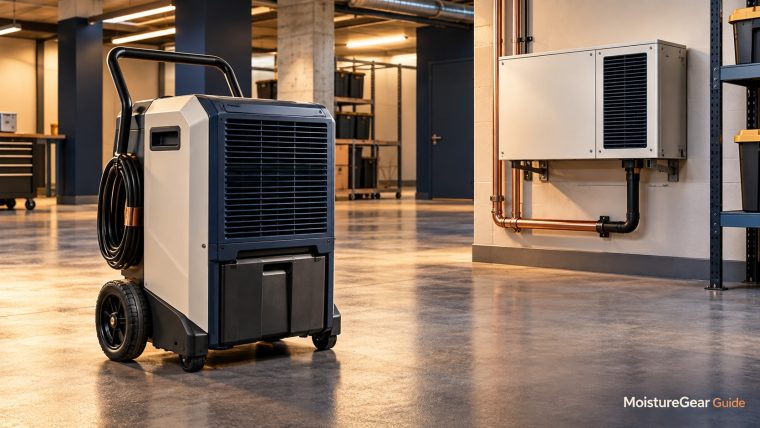
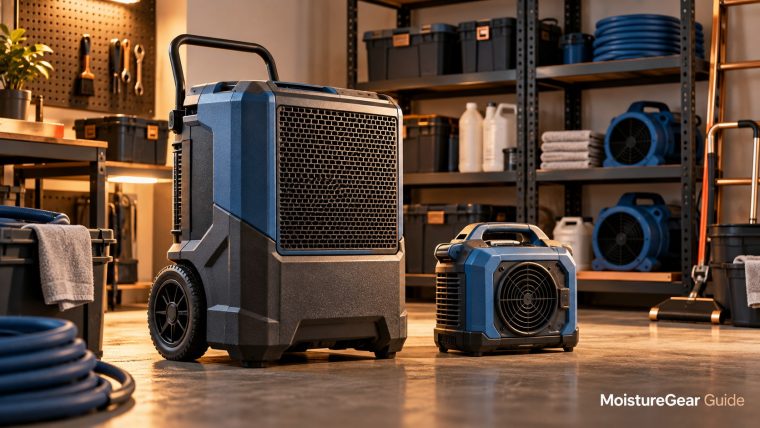
This Dri-Eaz Revolution LGR review focuses on the current manufacturer-listed model with Command Hub controls, a compact restoration dehumidifier whose older and newer offers need careful identification. Its published 80-pint daily removal at 80°F and 60% RH provides a useful reference, but the strongest purchase case is compact deployment, useful operating information, and a support package suited to professional drying work.
We used current Legend Brands product and controller documentation, checked related service resources, and examined the limits of available manuals. This is a specification-based review. We have not independently tested extraction, sound, energy use, connected functions, durability, or performance during structural drying. The commercial dehumidifier hub and LGR equipment shortlist provide the surrounding comparisons.
Current manufacturer-page facts
| Item | Published information | Practical meaning |
|---|---|---|
| Manufacturer item | 111995 | A useful identifier, but still confirm controller and generation |
| Water removal at AHAM | 80 pints/day at 80°F/60% RH | One reference condition for comparable ratings |
| Water removal at saturation | 144 pints/day at 90°F/90% RH | A distinct hotter, wetter reference point |
| Maximum process airflow | 180 CFM | Air through the equipment, not guaranteed circulation around every room |
| Published weight | 63 pounds | Compact equipment still needs a safe handling plan |
| Dimensions, H × D × W | 17.6 × 12.5 × 21.5 inches | Check turning, fittings, transport, and working clearance as well |
| Current controller | Command Hub with Bluetooth and Wi-Fi features | Confirm the actual offered panel and connection requirements |
The figures above come from the current Revolution product page. We use pints for the removal comparison because a secondary liters figure on the page is inconsistent with its pint figure. The article does not use that inconsistency to invent a different capacity; it identifies the published US reference rating and keeps the uncertainty out of the comparison.
Why the control generation matters
A familiar product name can remain in retailer catalogs after the control panel changes. The current Revolution page includes Command Hub, but an older image, used machine, or remaining stock offer may describe an earlier controller. The name "Revolution LGR" alone therefore does not establish the exact monitoring and interface you are buying.
Ask for a photograph of the supplied unit's panel or written confirmation of the controller. If the seller describes connected features, have them identify the particular system and relevant accessories. An upgraded unit can also have a different ownership history from a factory-supplied current machine, which matters to an individual used-equipment purchase.
Legend Brands' Command Hub documentation lists upgrade arrangements for selected i-Series equipment. That establishes that updates exist; it does not make every older unit automatically equivalent to a new offer. Confirm compatibility and the exact installation through the manufacturer or an appropriate service provider rather than assuming a universal retrofit.
The compact cabinet is the clearest buying distinction
Revolution's low, compact form is useful to investigate when equipment must share a vehicle or enter small rooms. A professional fleet can value packing several suitable units for different assignments rather than dedicating most of the loading area to one larger cabinet. This is a workflow consideration, not a promise of faster drying.
A small bathroom, a utility area, or a divided property can favor equipment that is practical to position near the required air path. A larger machine left outside a closed room may have more nominal capacity while doing less useful work in that room. Placement and circulation are part of the drying plan.
The published 63-pound weight still requires attention. Consider the route from delivery point or vehicle to operation, including stairs, thresholds, door turns, and loading height. Ask about approved transport arrangements and use appropriate handling assistance. Compact does not mean safe for every person to lift or carry without equipment.
What the 80-pint rating can tell you
The AHAM removal rating gives a comparison point at 80°F and 60% relative humidity. It can be compared with another model rated at those same conditions, provided the exact versions are identified. It cannot be extended unchanged to a cold basement, a drying room near its target, or a building with large incoming moisture loads.
The separate 144-pint saturation figure comes from 90°F and 90% RH. Those hotter, wetter conditions make much more vapor available. A retailer title emphasizing the higher number should not lead you to expect that amount of collection every day in ordinary use.
When comparing Revolution with a current Storm LGR Extreme listing, keep their AHAM points together. Do not compare one product’s saturation number against the other’s AHAM number. Our saturation-rating guide explains the distinction that often changes an apparently dramatic capacity gap.
LGR performance requires more than one reference point
Low-grain refrigerant equipment is intended to maintain useful extraction as air becomes drier. That makes it relevant to structural drying, where the conditions at the beginning and later stages can be different. Revolution's product family belongs in that comparison, but this review does not supply independent low-grain performance results.
A supplier claiming superior late-stage performance should identify the conditions and evidence. Matched AHAM numbers provide one reference point, while lower-moisture behavior requires information describing that part of the operating range. A technology label alone cannot rank products or predict the time to dry a specific material assembly.
Our how-LGR-works guide explains why dew point, temperature, and water-vapor content matter. For the purchase, ask whether the documented equipment is suitable for the expected conditions and how the operator will verify that the drying process is progressing appropriately.
Command Hub can help manage work, with clear limits
The current controller documentation describes access to real-time conditions, job information, maintenance reminders, and connected management. Those features can be useful when operators need consistent data across equipment or when a manager coordinates several locations. A well-used controller can make the machine's operating state easier to understand.
However, equipment data does not replace on-site inspection or moisture readings in affected materials. A screen showing drying trends cannot establish that hidden insulation or a wall cavity is ready to close. It also does not identify and correct the source of incoming water.
Clarify the distinction between local Bluetooth access, internet-connected functions, and actual notifications. Ask which functions are included in the offered controller, which need setup or a service account, and whether connectivity will work where the unit operates. Check firmware and current instructions rather than assuming older app descriptions remain accurate for every panel.
Drainage must match the delivered generation
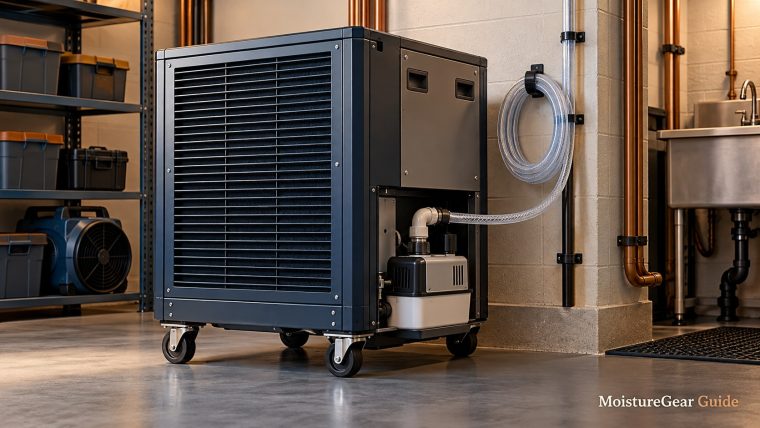
Revolution is a restoration dehumidifier with automatic condensate pumping described in manufacturer manuals. Nevertheless, the current product page's linked manual led to a document folder that could not be read for this review. Older indexed manuals do not establish every detail of the current package, so we do not publish a present-generation lift or included-hose number as a guarantee.
Obtain the manual supplied with the exact machine. Confirm the hose, connection, maximum permitted arrangement, and suitable destination with the seller or manufacturer. Measure the vertical rise separately from total tubing distance. Where drainage is essential to the purchase, unresolved limits should be settled before the unit reaches the site.
During use, keep the line clear of kinks, traffic, and accidental disconnection. A container needs a supervision plan; it is not unattended continuous drainage. Our commercial pump guide explains the purchase worksheet, and the pump troubleshooting guide separates safe user checks from internal repair.
Plan airflow through the actual rooms
The published 180-CFM figure describes process airflow, not a guarantee that all air in a divided building reaches the equipment effectively. Door positions, room shapes, obstructions, and placement can limit access to moist air. A correctly sized dehumidifier can still be poorly located.
For a drying assignment, the responsible professional determines the working area and airflow arrangement. Several separated locations may need multiple units or other suitable equipment. One compact machine placed outside the intended enclosure cannot be assumed to control every closed room attached to it.
For longer-term humidity control, assess the layout and approved installation options. Do not improvise an HVAC connection from the fact that a product can be used in different buildings. The broader commercial equipment guide distinguishes permanent building control from temporary jobsite drying.
Evaluate power, temperature, and room comfort together
Follow the exact electrical requirements in the delivered instructions, and do not infer circuit suitability from an unused outlet. Other equipment on the circuit and any history of water exposure matter. Questionable electrical conditions need an electrician rather than an improvised cord arrangement.
The room's temperature also affects useful extraction. A permitted operating range is not a capacity curve. If a property stays cold, request relevant performance information and consider whether the planned equipment class suits the environment. The cold-basement guide addresses that application without treating a low minimum as proof of full rated removal.
Refrigerant dehumidification discharges warmed air. That can be part of a professional drying plan and can create comfort concerns in an occupied space. We do not rank Revolution for quietness because this review has no controlled sound comparison. Placement and operating hours should reflect the people using the building.
The service channel is part of the value proposition
For professional equipment, ask where maintenance and repairs will happen before buying. Legend Brands' service and technical-support portal provides a route to manuals, parts resources, and repair information. The existence of resources is useful, but the buyer still needs a practical supplier and service plan for the individual purchase.
Ask which filters and hoses are appropriate, what ordinary checks the operator may perform, and which work needs a technician. A service diagram is not a recommendation that an untrained owner open electrical or refrigerant systems. Keep preventive care within the actual instructions.
If the machine is central to a business, plan for downtime. A unit may need transport to a service location, and a building may still require humidity control while it is away. The value of an accessible service channel cannot be reduced to a capacity number or an invented reliability score.
Compare warranty details rather than remembered claims
This review does not quote a complete current Revolution warranty period because the product page's current warranty document could not be independently read. Obtain the written terms applicable to the seller and supplied model. Do not rely on a historical retailer description or a generic statement that all professional equipment has the same coverage.
Check covered components, labor, freight, exclusions, seller eligibility, and the process for making a claim. A used, refurbished, or upgraded machine may require additional clarification. Keep the receipt and identification information, and document any written seller commitments.
Legend Brands' registration page explains that registration supports technical and safety communications and directs warranty questions to the product inserts or support. It should not be interpreted as a promise of extra coverage. Our warranty guide gives a broader purchase checklist.
Alternatives worth comparing before buying
AlorAir Storm LGR Extreme offers another compact pump-equipped restoration family with app and non-app descriptions. Phoenix DryMAX XL Pro provides a larger published AHAM rating with different transport features and a dealer route. Dri-Eaz LGR 6000Li offers a wheeled, heavier format with current Command Hub controls.
Compare those options at matching conditions and with comparable accessories. A small difference in reference water removal is not enough to decide the purchase, while a larger cabinet can be unsuitable for a particular vehicle or opening. The LGR buying guide keeps the shortlist tied to those practical distinctions.
If the need is ongoing humidity control in one home, consider a product selected specifically for the basement or installed system. If the need follows a single water-damage event, rental versus purchase may be the more useful comparison. A professional restoration machine is a specialized commitment, not automatically the best household appliance.
A secondhand Revolution needs a separate condition assessment
A used offer can appear attractive because the family name and reference capacity are familiar. Its actual value also depends on age, controller, service history, included accessories, physical condition, and support eligibility. This review cannot infer those details from a stock photograph or an unverified claim that the machine runs.
Request the actual identification and panel photos, and ask what maintenance or repairs have been performed. A short demonstration of the fan and display does not establish useful extraction under stated conditions or the condition of the pump. If the machine is being purchased for professional use, an appropriate inspection by someone familiar with the product can be more valuable than a vague seller assurance.
Check approved accessories separately. Missing tubing, incompatible connections, or a neglected filter can create additional cost. Clarify which current instructions apply and whether the control software remains supported for that exact hardware. Do not assume a controller upgrade or a warranty transfer is included simply because those possibilities exist elsewhere in the product family.
Price any uncertainty as part of the offer. If the unit needs service before deployment, obtain an actual assessment and cost rather than assuming that a minor cleaning will restore its performance. Also decide what happens if the machine becomes unavailable during its first assignment.
A new dealer-supported package and a used machine are therefore different proposals, even when their cabinets share a name. Compare each one against the same intended workload with its actual support and accessories. A low secondhand price is meaningful only when the delivered equipment can be identified and its condition evaluated appropriately.
Qualify a marketplace offer in five checks
First, identify the exact unit and controller. The current manufacturer item number helps, but confirm the actual panel instead of relying on a copied title. Second, request the matching instructions and complete accessory list. A used hose pictured beside a cabinet is not proof that an appropriate new hose is included.
Third, verify the seller relationship and support route. Fourth, review delivery, return, and warranty arrangements, including freight. Fifth, inspect the delivered equipment before integrating it into a working fleet. Photograph shipping condition and identification, and resolve a mismatch while the transaction is easy to correct.
The search link above does not establish availability, authorized status, or the current generation. If an offer cannot be qualified, obtain a suitable dealer quote. Buying the correct configuration with a clear service route can matter more than finding the lowest headline machine price.
A drying review cannot certify a building
Revolution removes vapor from air; it does not extract standing floodwater, disinfect affected materials, or measure moisture in a closed wall. Significant water damage can create electrical and contamination hazards that need assessment before powered drying equipment is used.
The EPA’s flood cleanup guidance and material-moisture guidance explain why drying is a broader process. Use qualified help where the source, materials, or extent of damage require it. A lower room-air RH and a full collection container are observations, not a restoration endpoint.
For a properly defined drying role, Revolution deserves consideration because the current compact format and controller features are meaningful. The final purchase should establish the actual generation, working route, drain, and support package. Those are the details that turn an attractive specification into useful equipment.
Selected sources
- Legend Brands Revolution LGR current product page
- Legend Brands Command Hub documentation
- Legend Brands service and technical support
- Legend Brands registration guidance
- EPA material-moisture guidance

About the author
Davis Murphy
Davis Murphy writes about dehumidifiers, indoor humidity, and home moisture control at MoistureGear Guide. His articles explain how to compare equipment, understand capacity ratings, and plan for drainage and maintenance. He focuses on clear, practical guidance to help readers choose a dehumidifier suited to their space and needs.