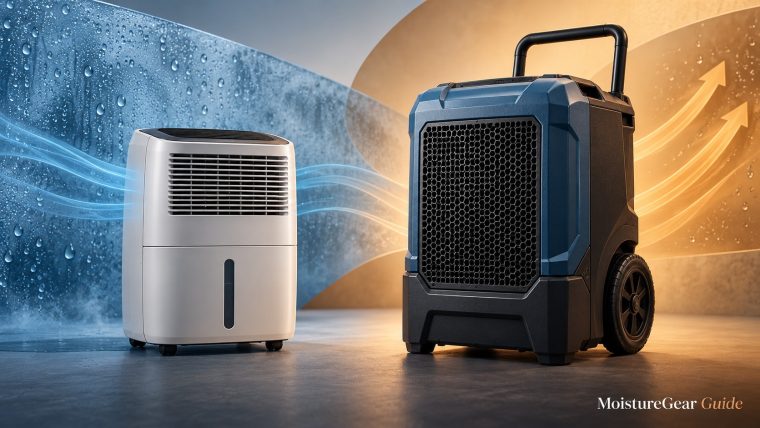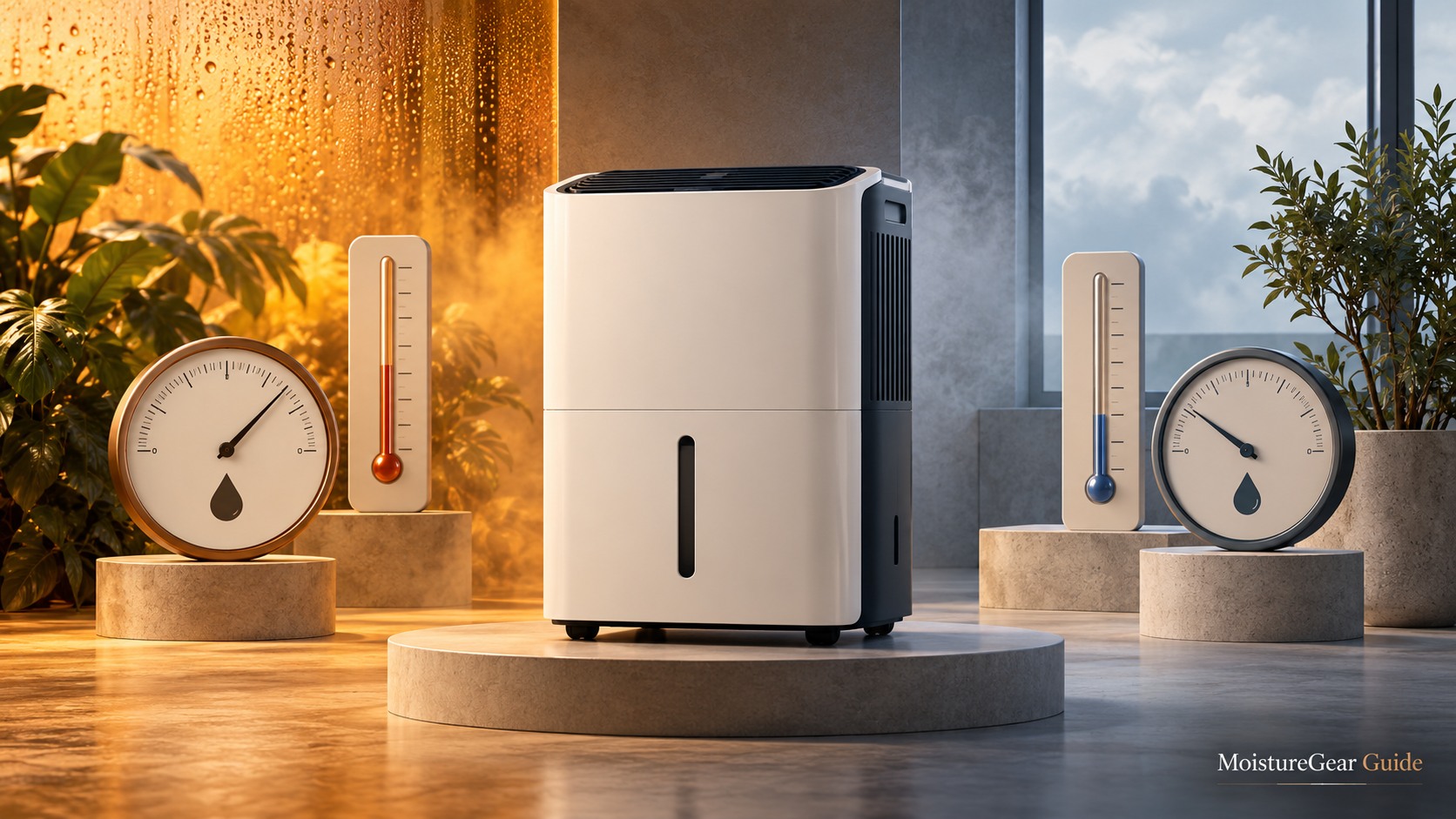
Dehumidifier saturation vs AHAM ratings explain why a single product can advertise two very different water-removal numbers. The larger figure usually describes hotter, wetter inlet air; the smaller manufacturer AHAM figure commonly describes 80°F and 60% relative humidity. Neither number can be interpreted properly without its test conditions. For everyday moisture control, comparing equivalent conditions is more useful than choosing the biggest advertised pint total.
The difference becomes especially important with crawl-space and restoration equipment, where maximum-removal figures frequently appear in product titles. This guide focuses on that warm-and-wet comparison. The separate AHAM versus DOE guide covers federal consumer rating conditions and changes over time. Both are part of our sizing and ownership library.
One machine, two inlet conditions
A refrigerant dehumidifier draws room air across a cold coil. Water vapor condenses, collects, and leaves through a tank or drain. The quantity collected depends partly on how much water vapor reaches the coil. Changing the inlet air changes the machine's available work, even when the physical appliance remains the same.
A manufacturer may therefore publish capacity at more than one condition. An 80°F/60% RH entry allows a comparison with products measured under that same condition. A very warm, very humid entry illustrates another operating point. The second figure is not extra capacity unlocked by a setting, and the two numbers should not be added together.
Think of them as two descriptions of the same product in different environments. Your actual crawl space may match neither. If its air is cooler and its target humidity lower, neither headline predicts exactly what will arrive at the drain during a particular day.

“Saturation” is a marketing label that needs a definition
In physical terms, saturated air is at 100% relative humidity for its temperature. Product listings do not always use the word that precisely. Some dehumidifiers label a high-humidity condition such as 90°F/90% RH as “saturation.” Others publish maximum figures using a different stated condition, or omit the condition from the title.
This is not a reason to guess that every manufacturer uses 90°F/90% RH. It is a reason to inspect the model's table. Ask for the exact dry-bulb temperature and relative humidity. If they are missing, treat the figure as unconfirmed comparison information until the manufacturer explains it.
The National Weather Service explanation of dew point and humidity is useful background: relative humidity changes with temperature, while dew point provides another way to describe moisture. A high RH number alone does not identify how much vapor is present without considering temperature.
A verified example: AlorAir Sentinel HD55S Wi-Fi
The official HD55S Wi-Fi product table, inspected October 13, 2026, gives 120 pints per day at 90°F/90% RH and 55 pints per day at 80°F/60% RH. It explicitly attaches the saturation label to the former and the AHAM label to the latter.

| Published condition for this exact example | Published removal rate |
|---|---|
| 90°F, 90% RH, labeled saturation | 120 pints/day |
| 80°F, 60% RH, labeled AHAM | 55 pints/day |
The 120-pint figure is roughly 2.18 times the 55-pint figure. That arithmetic describes the gap between those two published operating points. It is not a conversion factor for another model, and it does not tell you how the HD55S will perform at 65°F, 50% RH, or any other unlisted condition.
It is also not a reason to call every HD55 model a 120/55 unit. The separate HD55 Blue product page currently identifies 113-pint saturation and 53-pint AHAM figures. Suffixes and generations matter. Our HD55 research review keeps the product identity central to the comparison.
Why hot, damp air gives the machine more to collect
Warmer air at high relative humidity presents more vapor per volume than cooler air at the same relative humidity. In a hot, damp test, the dehumidifier can encounter substantially more available moisture. Its condensation process operates under a different temperature relationship from the one in a cool basement.
That difference explains the direction of the change, but it does not predict a universal numerical ratio. Designs differ in coil arrangement, airflow, refrigerant circuit, compressor operation, and controls. Once temperature and humidity move away from a published operating point, those differences become relevant.
Avoid treating water removal as proportional to the RH percentage alone. Moving from 60% to 90% RH does not justify multiplying every pint rating by 1.5. Temperature changed in the example as well, and the machine's response is not a straight-line percentage calculation.
A practical comparison table needs separate columns
If you are comparing three products, put same-condition capacities together. Keep high-humidity maximum figures in a separate column. This preserves useful information while preventing the maximum value from silently taking the place of a standard-condition value.
| Candidate information | Correct treatment |
|---|---|
| 80°F/60% RH capacity published for every candidate | Compare those figures directly, while checking model identity |
| Saturation figures with different or missing conditions | Show the conditions or mark the figure unmatched |
| Only a maximum figure available | Request an equivalent-condition rating before ranking capacity |
| Area coverage claim available | Record separately from water-removal rate |
| Low-humidity performance data available | Review for the actual use case, especially jobsite drying |
A fair table can contain missing cells. A complete-looking table filled with invented conversions is less useful. If one manufacturer's documentation does not support an equivalent figure, explain the uncertainty and compare the verified features that matter to the installation.
Those features include clearance, permitted temperature, pump arrangements, service access, and power requirements. A small difference in rated capacity may be irrelevant if one candidate cannot fit through the crawl-space opening or drain to the available destination.
Saturation ratings do not establish square-foot coverage
A removal rate measured in very humid air does not prove that the machine will control every building of the advertised area. Coverage depends on the incoming moisture load and the conditions the owner wants to maintain. An enclosure with leaking plumbing cannot be sized from floor area and a maximum pint label alone.
Start with the building. Document its dimensions, current temperature and humidity, ground vapor control, openings to outdoor air, and whether standing water is present. The crawl-space sizing guide turns those observations into a more useful equipment discussion.
A dehumidifier can remove airborne moisture while the source continues to add water. That is not the same as correcting drainage, roof runoff, groundwater intrusion, or plumbing leaks. If liquid water enters the space, source control and a building assessment belong ahead of a bigger capacity purchase.
Maintenance humidity is a different problem from initial drying
A newly installed unit may collect a lot of water during the first period of operation. Damp materials can release moisture into the air as conditions improve. After the space stabilizes and sources are controlled, the continuing load can be lower.
This change can make a machine appear to have lost output even while it maintains the setpoint successfully. Comparing a first-day drain quantity with a saturation rating misses the purpose of humidity control. If the room is dry enough and the unit cycles normally, collecting less is expected.
Keep a simple log: room temperature, room RH, operating status, and any unusual event such as heavy rainfall. Those records help distinguish controlled maintenance operation from a persistent load. They are much more informative than a drain bucket photograph without temperature, humidity, or elapsed time.
Restoration work adds a further question: performance in drier air
At the start of a drying job, inlet air may be warm and wet. Later it can become much less humid while wet materials still require attention. A maximum-removal figure addresses one high-moisture condition; it does not establish how efficiently the machine continues the job as the inlet air dries.
This is where design and published performance across conditions become important. LGR stands for low-grain refrigerant, a type of refrigerant dehumidifier intended to extend useful moisture removal into drier conditions. It is not a label for desiccant equipment. Read our LGR versus conventional comparison for the technology decision.
For purchase research, ask whether the manufacturer supplies additional lower-humidity data and the exact model to which it applies. The LGR operation guide explains why the drying stage matters. Do not infer late-stage jobsite performance from one saturation number.
Drying air is also different from establishing that a water-damaged building is fully dry or safe to occupy. Professionals may need to evaluate material moisture, concealed cavities, contamination, and electrical safety. A large-capacity dehumidifier alone cannot answer those questions.
How to interpret a real home’s collection rate
Suppose an owner sees several gallons leave the drain over a day. That observation establishes collected water over that period if it is measured accurately. It does not by itself establish the unit's rated efficiency or identify its laboratory capacity.
To interpret the observation, record the inlet environment and actual compressor operating time. Was the space already at the setpoint? Was the unit in defrost? Did the pump pause because of a routing problem? Was a door left open? A large collection total can indicate a high incoming load, not necessarily superior control.
Similarly, a small quantity with persistently high RH can point to a problem worth investigating. Check the permitted operating conditions, airflow, and drain. If those are appropriate, discuss the load and equipment with the installer or manufacturer. The HDi90 review shows how published capacity, pump configuration, and practical fit belong in the same decision.
Four misleading shortcuts to avoid
Using the largest number from each listing. One product’s largest figure may be measured in much wetter air than another’s. A comparison sorted by those numbers can reward the test condition instead of the equipment.
Assuming “saturation” means identical conditions. The word may not mean literal 100% RH in the manufacturer table. Keep the exact conditions next to it every time you compare it.
Converting by a fixed ratio. Even two products with similar capacities can respond differently as the temperature falls or air dries. The HD55S example’s ratio is not transferable.
Judging success by maximum daily collection. The objective in a maintained crawl space is to control humidity. A unit that reaches the selected level and then rests may be succeeding while producing far less water than a hot-and-wet capacity figure.
A better purchasing sequence
Begin by defining the application and the acceptable operating environment. Permanent crawl-space control, basement comfort, ducted house control, and temporary restoration work involve different practical requirements. Select the relevant product family before comparing numerical ratings.
Next, identify a same-condition capacity basis. Write down the exact SKU, test temperature, and RH for every candidate. Use official documents first and seller listings to identify the offered configuration. If the seller title and official sheet disagree, request clarification before buying.
Then check drainage, electricity, dimensions, access, and support. A permanent unit tucked beneath the house must still allow filter maintenance and drainage inspection. A restoration machine needs a transport and power plan. Neither application benefits from a theoretical capacity advantage that is unusable at the site.
Finally, set up a monitoring plan. A separate hygrometer can help you observe the space independently of the dehumidifier's sensor. Measurements collected in representative room air are better for judging results than measurements in the warm discharge stream.
When the specification is unclear
A concise manufacturer inquiry is often enough: “For this exact model and generation, please confirm the conditions for the advertised saturation capacity and provide the capacity at 80°F/60% RH.” If the installation is cool, add the actual temperature and ask for suitable performance data rather than only the minimum operating temperature.
Save the reply alongside the manual and purchase record. That creates a checkable basis for your decision, especially when a retailer's title changes or an updated product replaces the older model. Avoid treating a reply about an entire brand as model-specific evidence.
A seller that cannot explain capacity conditions may still sell a legitimate product. The issue is incomplete buying information. You can move to a better-documented option or accept the uncertainty knowingly, but you should not turn an undefined maximum figure into a confident performance claim.
Keep the capacity record with the equipment
A useful ownership folder contains more than a receipt. Save the exact specification sheet you used, its test conditions, the model-label photograph, and any manufacturer clarification. If you later replace the unit, those records let you compare the old and new machines on a known basis rather than relying on a retailer title remembered from years earlier.
Record the operating conditions separately. Your home's log might show typical maintenance temperatures, seasonal humidity peaks, and the times when drainage stops. That information should inform the next purchase, while the specification sheet preserves what the manufacturer actually published. Mixing those two records leads to claims such as “this unit only removes ten pints” without explaining that it was cycling at the target in cooler air. Clear records help an installer assess whether additional capacity, a better enclosure, or a different drainage arrangement would solve the problem.
Remaining questions
Is a saturation capacity useless?
No. A properly defined high-humidity figure describes a real published operating point and can help compare machines under equivalent hot, wet conditions. It simply needs its own column and context. It is a weak basis for predicting maintenance operation in a cooler enclosure.
Should I ignore the AHAM figure if my crawl space is cooler?
Use it for like-condition comparisons, while recognizing that your actual removal rate may differ. Look for relevant cooler-condition data and choose equipment permitted for the actual environment. A standardized comparison and an application assessment serve different purposes.
Does the difference prove the manufacturer exaggerated performance?
Not when both numbers and their conditions are clearly identified. Problems arise when a maximum label is presented without conditions or compared with another product's cooler rating. Transparent documentation lets you interpret both figures fairly.
Is the higher-capacity model always worth buying?
Only if its useful capacity and features address your load and installation. Paying for an impressive saturation total adds little value when clearance, drainage, controls, or support make the machine a poorer fit. A carefully matched model is a better investment than a headline number.
Selected primary references
- AlorAir HD55S Wi-Fi: exact capacity conditions
- AlorAir HD55 Blue: separate model specifications
- National Weather Service: dew point versus humidity

About the author
Davis Murphy
Davis Murphy writes about dehumidifiers, indoor humidity, and home moisture control at MoistureGear Guide. His articles explain how to compare equipment, understand capacity ratings, and plan for drainage and maintenance. He focuses on clear, practical guidance to help readers choose a dehumidifier suited to their space and needs.