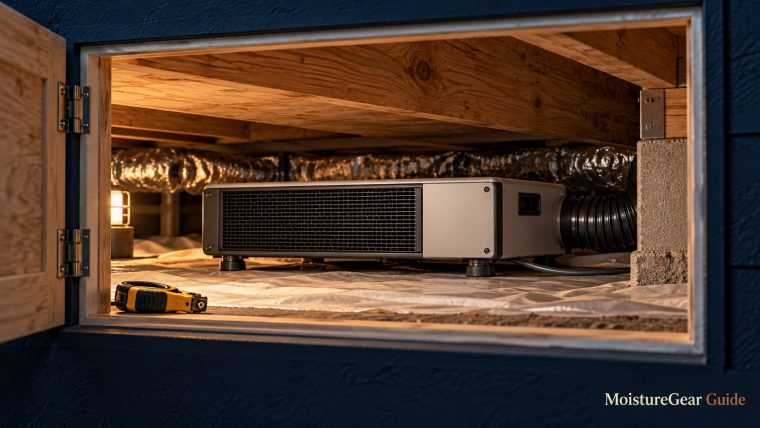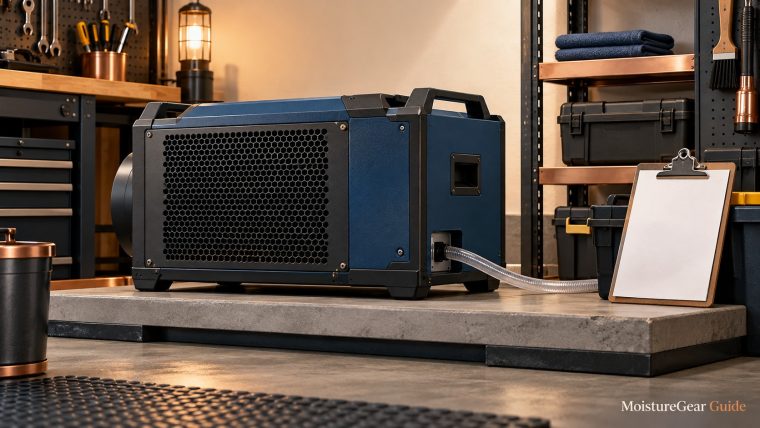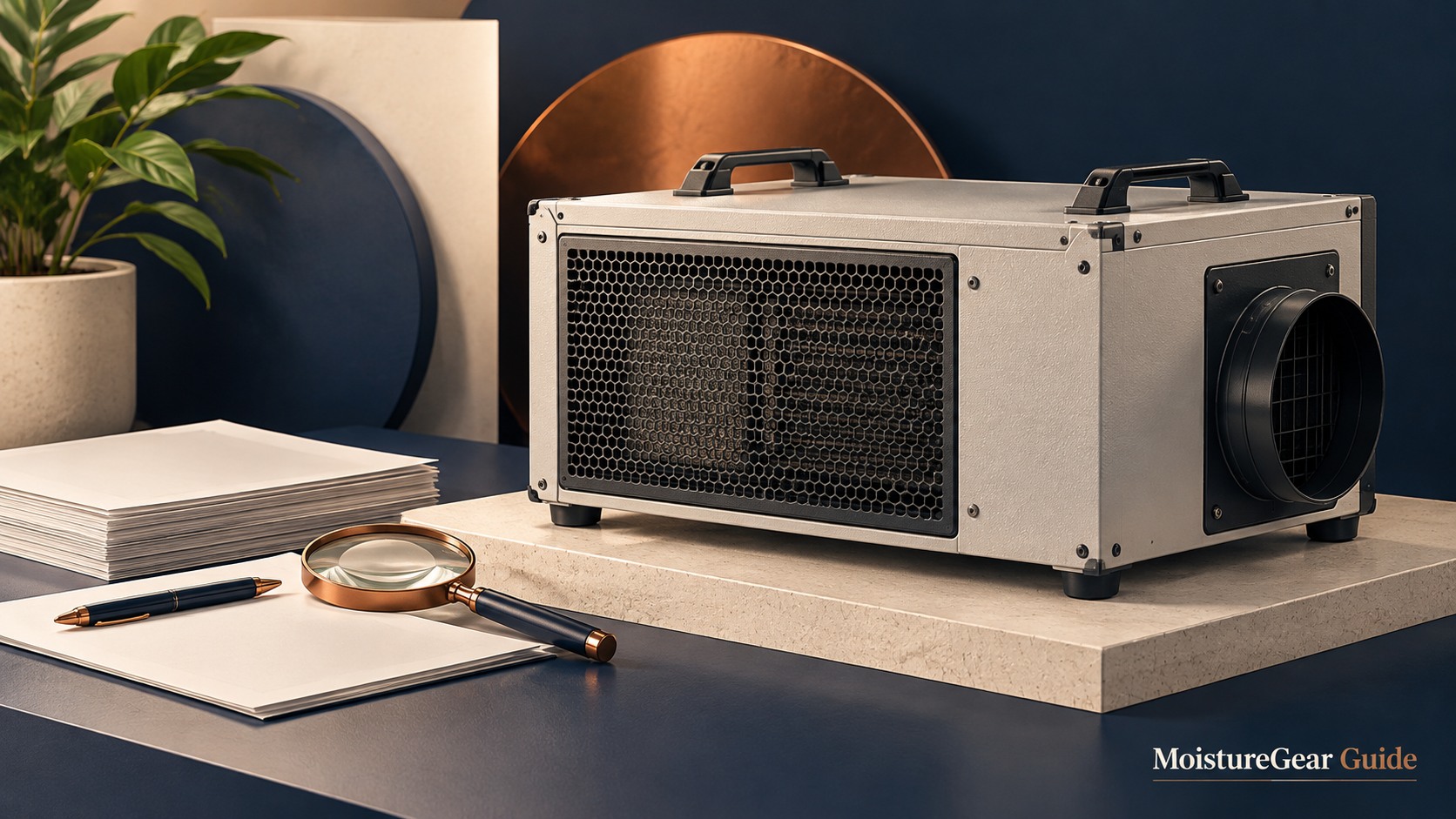
This AlorAir Sentinel HD55 review examines the blue, non-Wi-Fi, gravity-draining model using published manufacturer information. Its compact cabinet makes it a candidate for tight crawl-space access, while its drainage arrangement favors a site with a suitable downhill route. The current blue-model documentation lists 53 pints per day at 80°F and 60% relative humidity, a detail worth checking before confusing it with the similarly named HD55S.
Our recommendation is conditional: investigate the HD55 when the assessed moisture demand suits this capacity class and permanent gravity drainage is practical. It becomes less attractive when the water must climb above the outlet, when separate bays need a different air-distribution plan, or when the complete installed position is too cramped for maintenance.
Review method: We reviewed the official product page, manufacturer specification sheet, warranty information, and relevant capacity guidance on October 13, 2026. We have not run a hands-on drying, noise, energy, or endurance test. The assessment below explains what the published design means for a buying decision and where a site-specific or model-specific answer is still needed.
For the wider equipment and installation context, visit our crawl-space dehumidifier hub. It links this model review with sizing, humidity monitoring, and alternative drainage arrangements.
The exact HD55 covered here
AlorAir uses closely related names across its compact range. The blue HD55, HD55S, HD55P, Wi-Fi versions, and other pump configurations should be evaluated as distinct products. A search result containing “55” does not establish an identical capacity rating, filter, drain arrangement, or controller.

The current blue HD55 page and its manufacturer specification sheet agree on a 53-pint figure at 80°F and 60% RH. The model name is not a rounding rule that allows a reviewer to replace this with another variant’s 55-pint specification.
Older and current literature differ on some hardware details. For that reason, this review does not assign a refrigerant or precise unit weight to every HD55 sold under the name. Obtain the actual SKU, nameplate information, and matching manual when those details affect handling or installation.
During research, the blue model’s user-guide link resolved to a file named for HD55S. A buyer should request confirmation of the correct manual rather than assume all instructions in that file apply to the blue model. The specification comparison below uses the details that can be matched clearly.
Published specifications and their practical meaning
| Specification | Blue HD55 documentation | What it tells a buyer |
|---|---|---|
| Capacity at 80°F / 60% RH | 53 pints per day | Comparable with another figure only at the same stated conditions |
| Saturation headline | 113 pints per day | A different, much wetter rating condition; not ordinary daily output |
| Cabinet dimensions | 19.2 L × 12.2 W × 13.3 H inches | A starting point for access planning, excluding installed clearance |
| Drainage | Gravity | The outlet route must remain valid without upward pumping |
| Electrical supply | 115 V / 60 Hz | Confirm the exact unit and suitable site supply before installation |
| Published operating range | 33.8°F–104°F | Allowed operation does not imply constant capacity throughout the range |
| Published airflow | 120 CFM | Air must still reach the inlet and circulate through the intended area |
The table summarizes the manufacturer information linked above. It does not establish real-world drying time, sound levels in your home, or comparative durability. Those questions require appropriately controlled testing or useful operating evidence from the actual installation.
What the compact cabinet can solve
A short horizontal cabinet can be easier to position under a low floor than a tall room appliance. The HD55’s published dimensions make it worth measuring against tight entrances and passages. The benefit is physical fit, especially where you have a suitable open bay beyond the hatch.
Measure the complete route. An access opening can be wide enough while a duct or pier immediately behind it prevents the machine from turning into position. The final location also needs room for the drain, filter removal, supports, and a person carrying out maintenance.
Do not use cabinet height as the minimum permissible crawl-space height. If the unit needs to be elevated for its gravity route, the support adds to the installation. An optional accessory may add length or require more clearance on a service side.
Our low-profile crawl-space guide explains this measurement process. Compactness is a useful feature when it creates a maintainable installation; it is less useful when the machine only just fits and every routine task requires moving it.
Gravity drainage is the main buying constraint
The blue HD55 does not provide integrated pumped drainage. That is not automatically a disadvantage. If the outlet can reach a suitable destination through the manufacturer’s required route, gravity avoids adding a pump solely to transport condensate.
The limitation is elevation and configuration. A line that must rise over an obstruction or climb to a drain above the unit needs a different arrangement. Do not assume a lower final termination makes every intermediate hose position acceptable.
An external condensate pump might be part of a compatible installation, but the equipment, reservoir, inlet, power, and controls should be evaluated together. Adding a pump changes the complete cost and service needs. It can also reduce the apparent simplicity that made the gravity unit attractive.
Before ordering, draw the route and compare it with our gravity-drain versus pump guide. If upward drainage is the central requirement, put the HDi90 review and compact integrated-pump alternatives on the shortlist rather than forcing a gravity-only purchase into the site.
Understanding the 53-pint and 113-pint figures
The 53-pint figure is associated with 80°F and 60% RH in the blue-model specification sheet. The 113-pint headline represents saturation capacity. Those are two descriptions of the same equipment under different conditions, not competing claims about what you will collect in normal use.
A cool crawl space maintaining moderate humidity will not necessarily resemble either laboratory condition. As the environment changes, the amount of water available for extraction and the machine’s performance change too. Daily collection volume cannot be predicted from the package headline alone.
ENERGY STAR’s capacity explanation also shows why a portable unit rated at a cooler test temperature should not be compared directly with this warm-condition figure. A lower reported number can reflect a different test basis rather than a weaker machine.
Read our saturation-versus-AHAM guide before comparing the HD55 with another product. The practical question is whether documented performance suits the site, not which retailer prints the biggest pint number.
Where the HD55 makes a reasonable shortlist candidate
The most coherent application is an enclosed crawl space with moisture sources appropriately managed, sufficient circulation, suitable temperature conditions, and a valid gravity outlet. Here the compact cabinet and permanent drainage arrangement address clear ownership needs.
A protected basement or similar space may also fit the manufacturer’s application description, but the installation still needs to satisfy the exact manual. This review focuses on crawl-space use; our basement buying guide evaluates those different ownership circumstances.
A smaller machine is not selected by footprint alone. Exposed ground, water entry, or persistent humid outdoor air can change the load. Foundation divisions can keep one appliance from reaching the whole area even when a coverage headline seems generous.
Use our crawl-space sizing guide to collect the temperature, humidity, enclosure, and layout details. The HD55 belongs on a shortlist when those details support its role, not simply because it is compact or priced below larger equipment.
Where another arrangement may be better
If water must be pumped upward, a factory pump model may be a cleaner equipment decision than a gravity cabinet with added accessories. A compatible external pump can still be sensible, but compare the complete system rather than assuming the lower cabinet price settles the choice.
If the assessed ongoing demand is substantially greater, a higher-capacity machine may be appropriate provided it can be installed and serviced. Our HD55 versus HDi90 comparison weighs that decision with consistent rating conditions.
If the crawl space is divided, first consider the air path. Increasing capacity in the same poorly connected bay may not improve the far section. Approved ducting, relocation, or a different system plan may be more useful than changing a pint figure.
If access makes routine inspection unrealistic, include that in the purchase decision. A remote monitor helps you see conditions, but it does not clean a filter, inspect a connection, or remove the unit for service. Choose equipment and placement that make those physical tasks workable.
Low-temperature operation needs realistic expectations
The manufacturer publishes a low end of 33.8°F for the operating range. That is a permitted-limit statement, not evidence that the 53-pint capacity remains available at that temperature. Automatic defrost is documented, but the feature does not make laboratory output independent of ambient conditions.
If the crawl space is cool during the period when moisture control is needed, ask the manufacturer or installer how the exact unit performs there. Do not estimate a cooler-condition capacity using a universal percentage deduction from the 80°F number.
Record actual inlet temperature over time. A sensor near a warm discharge or a brief reading during warmer weather can give an incomplete picture of the environment. Pair temperature with RH and weather context.
Equipment operating within its allowed range can still be a poor fit for a particular moisture demand. That distinction keeps a low-temperature marketing feature from becoming an unsupported performance promise.
Airflow and controls in the real installation
The published airflow describes the appliance under the manufacturer’s stated setup, not the amount of useful circulation reaching every corner of your crawl space. Obstructions, position, and any approved accessories affect the installed arrangement.
Identify the inlet and discharge, then keep the required clearances. Do not assume the unit can be positioned tightly against a wall because another portable dehumidifier uses a top outlet. The exact cabinet needs its own air path.
Confirm any remote controller or duct accessory against the specific model and manual. A product photograph may display optional components, and a generic controller is not automatically compatible. Wi-Fi functions are not established by the base blue HD55 name.
Our placement guide explains how to check the equipment location and independent sensor readings. A sensible installation controls the intended area rather than only showing a favorable percentage at the machine.
Maintenance is easier when planned before installation
Find out how the filter is removed and which tasks the manufacturer identifies as owner maintenance. Keep enough access to carry them out without moving the cabinet or straining the drain connections. A compact unit can still be inconvenient if its service side faces a pier.
Check the accessible drain route at the intervals appropriate to the installation and manual. Changes in the crawl space, displaced tubing, or a blocked termination can interrupt a previously working arrangement. Avoid treating the lack of a bucket as proof that the drain needs no attention.
Internal electrical work, refrigerant work, and unapproved chemical cleaning should not become routine owner tasks. If instructions or online videos conflict with the manual for the actual unit, ask the manufacturer for the proper service scope.
Our crawl-space cleaning guide helps separate user checks from authorized servicing. Record the model and serial details, retain purchase documents, and keep photographs of the installed drain and supports for support calls.
What a purchase price does not include automatically
The equipment price may exclude a support kit, remote controller, external pump, tubing, monitoring device, and installation work. Compare the complete arrangement required by your home rather than a bare cabinet against another seller’s accessory bundle.
Marketplace variation selectors can change the item behind a similar headline. Confirm the exact blue HD55, the parts actually supplied, and the seller before checkout. The Amazon button below searches for the model; it does not certify stock, price, seller authorization, or bundle identity.
Where an installer offers equipment and setup together, ask for the itemized model and configuration. A higher total may include useful work and commissioning, or it may include extras you do not need. The comparison becomes clearer once every offer describes the same required functions.
Running cost should use actual assumptions
A rated electrical figure and an efficiency claim do not establish a universal monthly bill. The amount of energy used depends on actual operating power, duration, control behavior, weather, enclosure, and target conditions.
If you need a budget estimate, make those assumptions visible. Use a suitable measurement method within its electrical ratings or ask the installer for an appropriate way to gather operating data. Do not use an unsuitable smart plug simply because it is convenient to view remotely.
Our electricity-cost guide explains the calculation. Once the installation is operating normally, revise the estimate with observed runtime or measured energy rather than claiming savings based on a larger model’s different capacity rating.
Also distinguish initial drying from ongoing control. A period of high operation after source repairs may not represent the usual month, and a dry season may not represent humid summer use. A short record is useful evidence; it is not automatically an annual forecast.
Warranty and support deserve a model-specific check
Read AlorAir’s current warranty page and confirm the applicable terms for your purchase date, unit, and seller. Promotional banners, older manuals, and marketplace descriptions may not present the same coverage details.
Ask which components, labor, freight, removal, and reinstallation are covered at each stage. The published warranty process places responsibilities on the owner as well as the manufacturer. Keeping the original packaging and records can matter if service requires shipping.
A long warranty headline is not a reliability measurement and does not guarantee a free replacement for every fault. Installation conditions and excluded damage matter. Avoid buying from an uncertain channel on the assumption that every seller under a familiar marketplace name receives identical support.
Our warranty and authorized-seller guide gives you a question list. Resolve those questions before the equipment is installed in a location that makes removal difficult.
Two examples of the buying decision
For an accessible enclosed crawl space with an uncomplicated downhill outlet, the HD55’s compact gravity arrangement is worth evaluating. The remaining questions are capacity under the measured conditions, clearance, and support. Extra pumping features may provide little value if the existing route is already suitable.
For a similarly sized crawl space whose only approved termination is above the appliance, the same cabinet can become a less straightforward purchase. An external pump might work, but its complete cost and maintenance should be compared with integrated-pump equipment before ordering.
These examples show why the drain is central to this model. They do not assign the HD55 a universal maximum home size or promise a particular drying time. The site description should determine whether the compact gravity approach is actually appropriate.
Our buying assessment
The blue Sentinel HD55 is a credible shortlist candidate for a compact permanent gravity-drain installation when its documented capacity and operating conditions match the home. Its useful features are cabinet fit and the straightforward water-removal arrangement, with exact variant identification essential.
Choose a different plan if upward drainage, greater documented demand, difficult distribution, or inaccessible maintenance changes those requirements. Compare the complete alternatives in our crawl-space buying guide rather than treating the HD55’s price or saturation headline as the final answer.
Before paying, confirm the model, matching manual, installed fit, approved drain, complete accessory list, and support terms. Those checks make the purchase reviewable and give the installation a clear basis for follow-up measurements.
Selected sources
- AlorAir Sentinel HD55 Blue manufacturer page
- AlorAir Sentinel HD55 Blue specification sheet
- AlorAir product warranty
- ENERGY STAR: Dehumidifier testing and capacity

About the author
Davis Murphy
Davis Murphy writes about dehumidifiers, indoor humidity, and home moisture control at MoistureGear Guide. His articles explain how to compare equipment, understand capacity ratings, and plan for drainage and maintenance. He focuses on clear, practical guidance to help readers choose a dehumidifier suited to their space and needs.