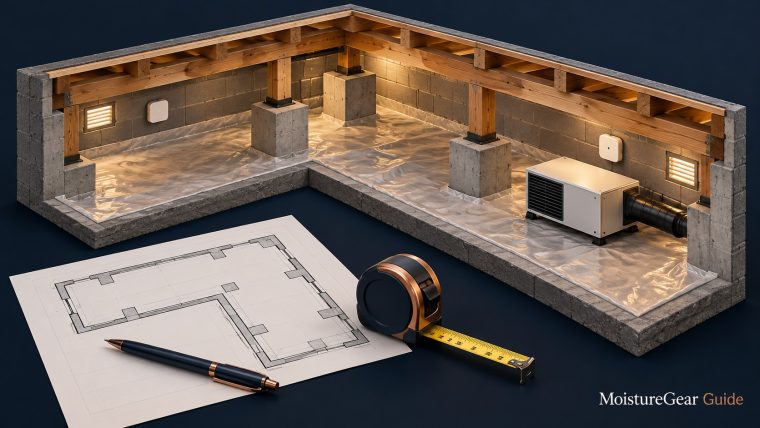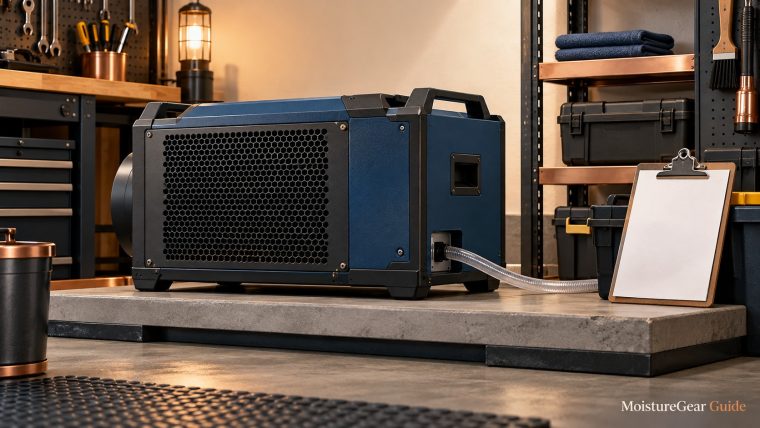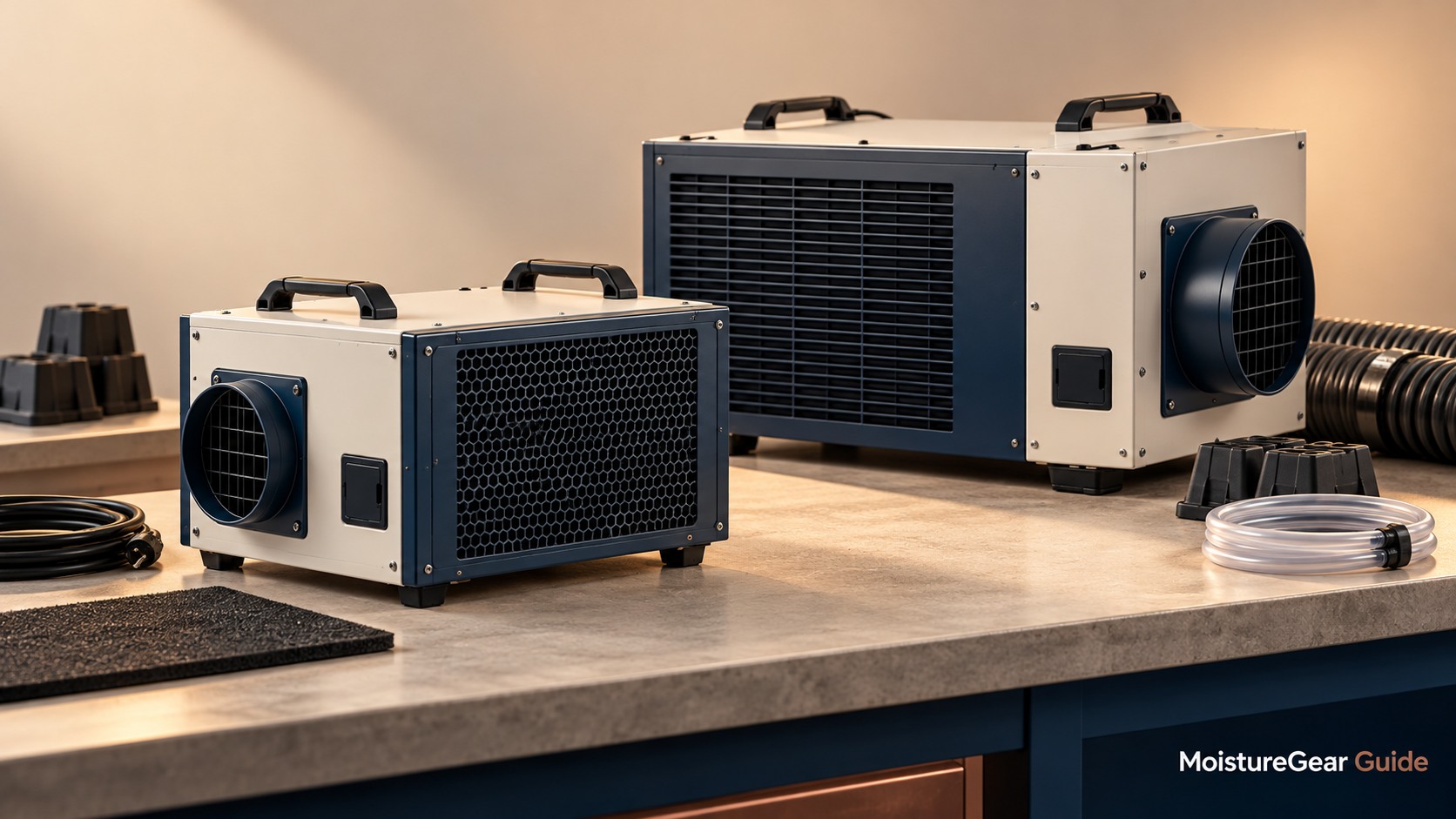
The AlorAir HD55 vs HDi90 choice is primarily a decision about capacity, drainage, and installed fit. The blue HD55 is a smaller gravity-draining cabinet with a published 53-pint daily rating at 80°F and 60% RH; the base built-in-pump HDi90 publishes 90 pints at the same conditions and needs more physical space. Choose between them by the job your crawl space actually requires.
The HDi90’s higher rating and pump are useful when the site needs both. The HD55 can be the more straightforward arrangement when its capacity suits the measured environment and water has a valid downhill route. A larger model is not a cure for active water entry or an air path that fails to reach a separate bay.
Comparison basis: We reviewed current manufacturer pages and specification sheets on October 13, 2026. This is a research comparison of the blue non-Wi-Fi HD55 and non-Wi-Fi built-in-pump HDi90, not an independent performance test. HD55S, HD55P, Wi-Fi, and ductable configurations are separate products and bundles.
The differences at a glance


| Buying factor | Blue Sentinel HD55 | Sentinel HDi90, built-in pump | Practical consequence |
|---|---|---|---|
| Capacity at 80°F / 60% RH | 53 pints/day | 90 pints/day | HDi90 has more published extraction at equal conditions |
| Drainage | Gravity | Integrated condensate pump | Different routes and maintenance requirements |
| Cabinet dimensions | 19.2 L × 12.2 W × 13.3 H inches | 23.2 L × 15.2 W × 17.7 H inches | HD55 is smaller in all three listed dimensions |
| Published operating range | 33.8°F–104°F | 33.8°F–104°F | Shared limits do not prove equal cool-condition performance |
| Electrical supply | 115 V / 60 Hz | 115 V / 60 Hz | Both need an appropriate supply for the actual unit |
| Base-version app control | Not established by the base name | Not established by the base name | Verify a specific Wi-Fi version if app functions matter |
| Drainage accessory decision | External pumping if a compatible lifted arrangement is required | Matching pump discharge components and route | Compare complete installed systems rather than cabinets alone |
The HD55 manufacturer sheet and HDi90 manufacturer page establish the central comparison. The current HDi90 September 2025 sheet corroborates its cabinet and operating information.
Capacity: a genuine difference at matching conditions
At the published 80°F / 60% condition, the HDi90’s rating exceeds the HD55’s by thirty-seven pints per day. That is a meaningful specification difference when an assessment supports greater removal demand. It is not a forecast that the HDi90 will collect thirty-seven extra pints daily in every crawl space.
Actual extraction changes with temperature, humidity, available moisture, and operation. A larger machine maintaining an already-controlled environment may collect less than either warm-condition headline. A machine dealing with ongoing source problems can run frequently without establishing a satisfactory building condition.
Do not compare the HD55’s 113-pint saturation headline with the HDi90’s 90-pint AHAM-style rating and conclude that the smaller model removes more water. The conditions differ. Our saturation-versus-AHAM guide explains why that comparison is misleading.
Likewise, a portable appliance’s cooler-condition figure belongs beside its stated temperature and humidity. ENERGY STAR’s testing explanation provides the context. Consistent conditions make the comparison useful; they still do not eliminate the need to size for the home.
When the higher capacity has a clear purpose
The HDi90 deserves consideration when measured conditions, enclosure, and an appropriate assessment indicate a demand beyond the smaller equipment class. It may also provide useful reserve for the conditions anticipated in a permanent plan, provided that margin has a reason.
Ask what the capacity recommendation assumes about repairs and source control. A model chosen for an unrepaired water-entry problem may not be the right ongoing equipment choice after that work. The reverse can also occur when an initially optimistic enclosure assumption does not match the actual site.
Do not treat a maximum coverage claim as a complete sizing calculation. Two crawl spaces with the same area can have different temperatures, incoming moisture, and layouts. One may be open and well enclosed; another may have exposed soil or sections divided by foundation walls.
Our crawl-space sizing guide helps collect those details. Choose the higher-capacity model when it addresses documented demand, not simply because the larger figure appears safer in a comparison table.
Drainage: the difference that can settle the choice
The blue HD55 uses gravity drainage. Where the outlet can reach an approved destination through a correct route, that arrangement can be straightforward and does not require an integral pump. The physical simplicity is valuable only when the complete route works.
The built-in-pump HDi90 is designed to transport condensate through a permitted pumped route. That can solve an upward-drainage problem that gravity alone cannot. It does not give unrestricted freedom to extend tubing or choose any termination.
Draw the route before choosing the model. Identify the elevation changes, high point, total run, obstructions, and approved destination. The final drain being lower than the cabinet does not prove that a gravity hose can cross every obstacle between them.
The gravity-versus-pump guide explains the arrangement choices. If drainage favors one model but capacity favors the other, compare a third option or a compatible complete system rather than pretending that one feature decides everything.
An external pump changes the HD55 comparison
An appropriately selected external condensate pump can be part of a gravity-unit installation, but the arrangement should be compatible with both sets of instructions. The dehumidifier must drain correctly to the reservoir, and the pump must serve the intended discharge route.
Add the reservoir location, electrical supply, tubing, controls, support, and service access to the comparison. A lower cabinet price does not establish a lower complete cost once those items are included. Nor does an external pump automatically provide a better fault response than an integrated one.
The benefit may be an accessible pump location or a compact equipment position. The drawback may be extra components and connections. Evaluate the actual arrangement instead of assuming that the external-pump route is either inherently economical or inherently inferior.
If you need compact pumping without the HDi90’s capacity, AlorAir’s HDi65S is another model to investigate. Its current published 55-pint rating at 80°F / 60% and compact cabinet illustrate why the HD55-versus-HDi90 decision does not need to be an artificial two-product choice.
Physical fit: the HD55 has a smaller published cabinet
The HD55 is shorter, narrower, and lower in the listed dimensions. That can matter at the hatch, the first turn inside the crawl space, and the final equipment bay. The difference is practical rather than cosmetic.
Measure the route and installed envelope for both units. A cabinet that passes through the hatch may still fail to turn past a pier or duct. At the operating position, include supports, drainage connections, any approved accessories, and the service-side space.
A gravity installation may need elevation that consumes some of the HD55’s headroom advantage. A pumped arrangement can change that geometry, but the HDi90’s taller case still needs room. Do not compare cabinet heights as though they were complete minimum installation heights.
Our low-profile equipment guide walks through these measurements. Where the larger cabinet cannot be installed and serviced properly, its extra capacity is not a useful feature at that location.
Consider the effort of installation and removal
The HDi90’s current manufacturer information lists a seventy-and-a-half-pound unit. The blue HD55 literature contains differing weight information across generations, so use the actual supplied unit’s details rather than assigning one mass to every listing.
Plan handling according to the manufacturer’s instructions and the route. An appliance should not be turned into an unapproved operating position just to fit beneath a beam. Appropriate assistance and supports matter more than whether a product page calls the unit portable.
Removal also belongs in the decision. Warranty service may require a technician to reach panels or extract the machine. Difficult access can create labor costs even when a covered component is supplied.
If an installer handles both equipment and setup, ask how service removal would work. A useful answer identifies the route and connection points rather than assuming the appliance will never need to leave its position.
Cool-condition performance remains a separate question
Both models publish the same broad operating-temperature range in the cited information. That does not prove that they remove comparable proportions of their rated water volume at the cool end. A permitted limit describes operation, not a complete performance curve.
If your crawl space is cool during the moisture-control season, ask for relevant information for the exact model. Record inlet conditions rather than the warm discharge environment. Avoid calculating output using an invented universal temperature correction.
Automatic defrost changes how the equipment operates when frost conditions occur. Its presence does not mean the 80°F extraction rating remains available unchanged. Follow the matching manual when interpreting fan, compressor, and defrost behavior.
The appropriate question is whether each candidate can control your conditions within its documented limits. A shared minimum temperature is useful screening information, but it should not be used to declare either machine an independently proven cold-climate winner.
Controls and model variants can distort a price comparison
Compare the same type of offer. A base unit with an optional remote controller is not the same bundle as a Wi-Fi model. A photograph with collars or accessories does not establish their inclusion or compatibility.
Check whether the desired function is environmental monitoring, remote target changes, equipment error alerts, or controlling an additional zone. Those are distinct needs. A standalone humidity sensor does not automatically communicate with the appliance or its pump.
If remote observation is the goal, use our crawl-space monitoring guide. An independent sensor remains useful for checking a distant bay regardless of the control arrangement at the cabinet.
For fuller model details, see the HD55 review and HDi90 review. Keep the version you evaluated tied to the exact offer selected at checkout.
Neither model replaces an air-distribution plan
Foundation divisions and obstructions can prevent one unit from serving the whole crawl space effectively. A favorable reading near the cabinet does not establish that the remote section has the same conditions. Capacity and circulation need to be evaluated together.
Position the inlet and discharge according to the exact manual and approved arrangement. If ducting is required, confirm model compatibility, supplied adapters, and layout requirements rather than adding arbitrary flexible runs.
The manufacturer separately names ductable HDi90 versions, so a distribution plan should specify the equipment it actually requires. Accessories and allowed installation configurations should be checked against the same SKU.
Our placement guide explains follow-up measurements. If the far bay remains damp while the equipment area is controlled, revisit the air path before deciding that the HD55 simply needs to be replaced by the HDi90.
Compare operating cost with visible assumptions
The HDi90 removes more water under the matching published condition, but it does not follow that it always costs less to run. Nor does the smaller HD55 automatically have the lower monthly bill. The result depends on actual power, operating time, weather, moisture load, and control behavior.
A useful estimate identifies energy-use assumptions and your electricity tariff. If measurements are available, ensure that the measurement device and method are suitable for the appliance. Electrical current alone is not a complete energy record.
Use our electricity-cost guide to compare clearly labeled scenarios. Initial drying operation should be distinguished from ongoing maintenance of the space, and a dry-season month should not automatically become a humid-season forecast.
Reducing uncontrolled moisture sources can also change operation. PNNL’s crawl-space water-management guidance keeps the building work in view. A model upgrade should not become the presumed substitute for fixing a known leak or water-entry path.
Maintenance and support are part of both purchases
Both installations need accessible filter care, drainage inspection, and the maintenance required by the matching manual. The HDi90 adds an integrated pump to that ownership arrangement; an HD55 with an external pump has a separate component to inspect and support.
Ask who services the equipment, which owner tasks are permitted, and how faults are handled. Do not compare long-term reliability from cabinet material, warranty length, or a few retailer comments alone. Those are not controlled endurance studies.
Read AlorAir’s current warranty terms for the relevant model, seller, and purchase date. Clarify parts, labor, freight, removal, and reinstallation rather than interpreting a promotional duration as complete coverage.
Save the documents and any written configuration confirmation. Warranty changes and legacy manuals make it especially useful to keep the terms that applied to the actual purchase. Our authorized-seller and warranty guide explains the questions to resolve.
Four scenarios that make the tradeoffs clearer
A compact enclosed space with an easy downhill drain: Investigate the HD55 if its documented capacity matches the assessment. Its smaller case and gravity arrangement have a clear purpose. Paying for additional capacity or pumping without a site need may add little practical value.
A greater assessed load with upward drainage: The built-in-pump HDi90 becomes a coherent candidate when the cabinet can be installed comfortably. Confirm the pump route as well as the air-drying requirement; satisfying one does not prove the other.
A smaller load but upward drainage: Compare a compact pump model or a compatible external-pump system. The HDi90 may otherwise solve the drainage problem with more capacity and cabinet than the site requires.
A divided crawl space with a damp remote bay: Assess distribution and sources before upgrading. A higher-rated machine in the same isolated position may leave the underlying problem unchanged.
These are decision examples, not numerical prescriptions. Each assumes appropriate source control and a valid installation within the equipment instructions.
What the installation handover should show
Whichever model you select, ask the installer to leave the exact equipment details, control setting, drain arrangement, and maintenance instructions together. Keep a photograph of the cabinet label and the accessible connections. Record where an independent sensor will monitor conditions and which distant section will be checked.
The handover should also explain what you should do if humidity rises, the drain stops, or an error appears. That makes ownership more practical than a vague assurance that the larger unit has extra capacity. A clear record lets you distinguish a changed source or installation condition from an equipment fault without guessing which version or configuration was originally installed.
Questions that should decide the purchase
Ask which rated capacity matches the measured conditions, whether gravity or pumping suits the approved water route, and whether the complete equipment envelope fits. Ask how the air reaches every intended section and how those conditions will be checked after startup.
Then compare complete offers, including necessary accessories and support. The model that looks cheaper before a pump, controller, or installation work is added may not have the lower total. The larger unit may be justified, but the reason should be specific.
For the HD55, the convincing case is compact fit with adequate capacity and valid gravity drainage. For the HDi90, it is higher documented demand with suitable pumping and sufficient space. If the home needs a different combination, use our crawl-space dehumidifier hub to compare alternatives before settling on either model.
Selected sources
- AlorAir Sentinel HD55 Blue specification sheet
- AlorAir Sentinel HDi90 manufacturer page
- AlorAir HDi90 September 2025 specification sheet
- AlorAir Sentinel HDi65S manufacturer page
- ENERGY STAR: Testing and capacity
- AlorAir product warranty

About the author
Davis Murphy
Davis Murphy writes about dehumidifiers, indoor humidity, and home moisture control at MoistureGear Guide. His articles explain how to compare equipment, understand capacity ratings, and plan for drainage and maintenance. He focuses on clear, practical guidance to help readers choose a dehumidifier suited to their space and needs.