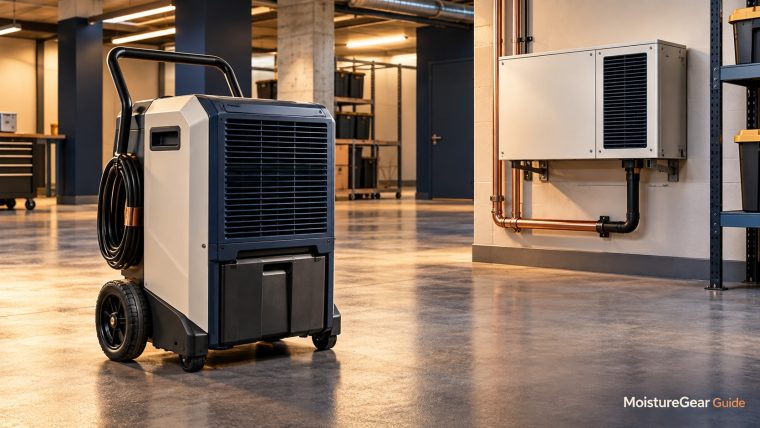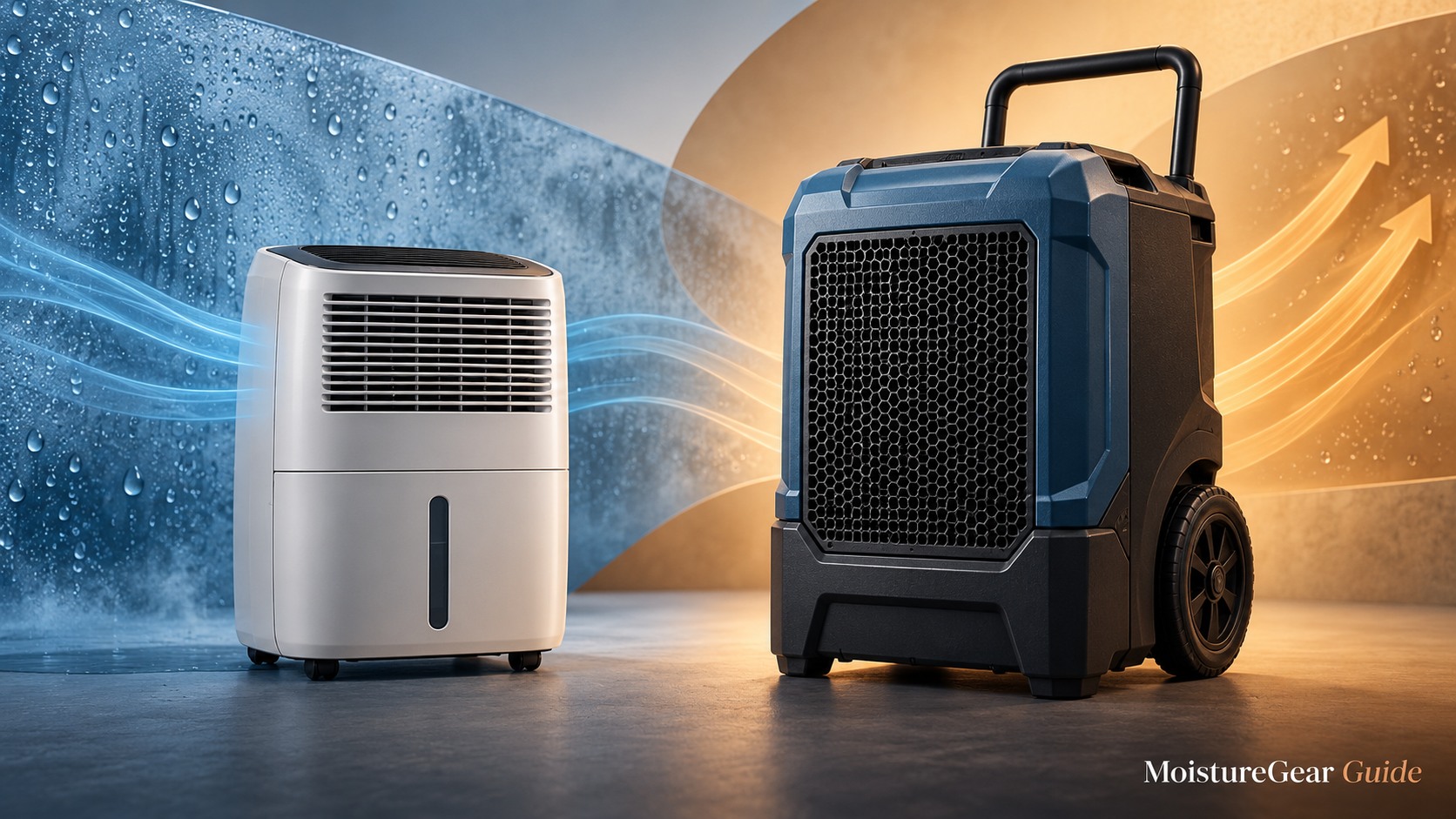
An LGR vs conventional dehumidifier decision is really a question about the conditions in which you need the equipment to keep removing moisture. Both types use refrigeration to condense water from air. An LGR design aims to extend useful performance as that air becomes drier, which can matter during structural drying. A conventional machine can still be the right choice for ordinary humidity control when its documented capacity and operating range suit the room.
The initials do not guarantee faster drying in every building, lower running cost, or a particular cabinet size. This comparison explains the purchase decision and its limitations. Visit our commercial dehumidifier hub for related equipment guides, or the LGR operating explanation if you want a fuller account of the refrigeration process.
This comparison uses primary product and technical documentation to explain buying criteria. It does not report independent performance, energy, or durability tests.
The important difference at a glance
| Question | Conventional refrigerant equipment | LGR refrigerant equipment |
|---|---|---|
| How does it collect water? | Air contacts cold surfaces and moisture condenses | The same underlying refrigeration process, with design changes intended to sustain extraction in drier air |
| What can make it suitable? | Adequate documented performance in normal humidity-control conditions | Useful performance at lower vapor content during a changing drying job |
| Is it necessarily commercial? | No; both room appliances and professional machines can use conventional refrigeration | Common in restoration equipment, but the exact product and application still matter |
| Does the label settle capacity? | No; check rating conditions and performance evidence | No; check rating conditions and relevant low-grain evidence |
| Is it a desiccant? | No | No |
| Can it certify that materials are dry? | No | No |
The strongest buying evidence is a performance description at conditions relevant to the assignment. A technology label can explain why a design may be useful, but it cannot establish how that product will behave in your particular building.
Why extracting water becomes harder as the room dries
At the start of a moisture-removal job, humid air can provide a generous supply of vapor to a cold coil. As water is collected and the air becomes drier, its dew point falls. The machine has to cool that air sufficiently for condensation to continue. The balance between incoming air conditions, refrigeration capacity, airflow, and defrost behavior becomes more important.
A simple way to understand this is to imagine two rooms at the same temperature. One contains much more water vapor than the other. The colder surface needed to produce condensation from the drier room is a more demanding target. A device that performs well in the wetter room may extract much less in the drier one.
That does not mean it is defective. It means the operating point has changed. LGR designs seek to make the later, lower-moisture conditions more workable. The useful comparison is how the actual machines respond across that range, rather than how quickly their collection buckets fill during the first very humid hour.
What “low grain” describes
In drying terminology, vapor content is often expressed in grains per pound of dry air. A grain is a unit of mass; the full expression describes how much water vapor is present relative to the dry air. "Low grain" refers to a lower amount of that vapor, not a grain-like material inside the dehumidifier.
Relative humidity is a different measure. It describes how close the air is to saturation at its current temperature. If the air is warmed, its RH can fall without an equivalent reduction in its water-vapor mass. That is why a lower discharge RH number alone does not establish how much water a dehumidifier is removing.
Inlet and outlet temperature and humidity can be used together to evaluate the moisture change across equipment. Instruments and operating conditions affect those readings, and a trained drying operator interprets them alongside material measurements. For a consumer purchase, the important lesson is simple: do not equate a large RH percentage change with an independently measured extraction rate.
Many LGR designs pre-cool incoming air
An internal pre-cooling arrangement can reduce the incoming air's temperature before it reaches the main cold coil. Bringing the air closer to its condensation condition allows the refrigeration system to use its cooling effect more productively. Heat exchange within the unit is one way manufacturers achieve that result.
The exact layout varies. A heat exchanger, coil arrangement, refrigerant management, airflow control, and defrost logic can all be parts of a manufacturer's design. The consumer does not need to identify every pipe to make a sensible purchase. What matters is that the design has documented performance relevant to the intended job.
It is also inaccurate to say that every LGR machine must contain one identical pre-cooling component. Phoenix's GTR technical explanation describes achieving LGR performance through a different balance of condenser design and airflow without the traditional inlet pre-cooling arrangement. The category describes an intended performance capability more usefully than it describes a universal parts diagram.
Where a conventional machine can make good sense
A room needing routine humidity control may spend most of its operating time within conditions a suitable conventional refrigerant dehumidifier handles well. If the moisture source is addressed, the unit can circulate through the space, and drainage is dependable, paying for restoration-oriented extras may not improve the owner's experience.
Consider an accessible basement with seasonal humidity. The useful requirements may be an appropriate operating range, sensible noise level, clear controls, a practical continuous drain, and service support. Low-grain drying data matters less if the room is maintained at an ordinary target and there is no structural drying assignment.
The correct conventional product still needs careful sizing and installation. A poorly enclosed space or a closed-off wet room can defeat a larger machine. Our basement dehumidifier guide covers those application questions. Do not purchase a cheaper category merely because it seems simpler; purchase it because its documented capabilities meet the actual requirement.
Where LGR can earn its place
Structural drying creates changing air conditions. Moisture evaporates from materials into the room while the dehumidifier removes vapor, and the job may continue after the easy early-stage water has been collected. Useful extraction at drier operating conditions can help maintain the environment needed for further moisture movement.
Professional operators may therefore value LGR equipment alongside transport features, condensate pumping, service access, and meaningful operating data. These are related working needs, but they are not the same feature. A machine can be LGR and still have an awkward hose arrangement or an unsuitable access route for a particular job.
Our LGR shortlist includes current documented candidates such as Revolution, Storm LGR Extreme, LGR 6000Li, and DryMAX XL Pro. Its recommendations are use-case assessments from published sources rather than independent performance rankings. If a supplier claims a substantial advantage late in drying, ask for the conditions and evidence supporting that claim.
Do not compare saturation to AHAM capacity
A conventional machine's rating at one condition cannot be compared fairly with an LGR machine's rating at a hotter, wetter one. This is a common source of confusion in product titles, where the largest removal number attracts attention but the test conditions appear much further down the page.


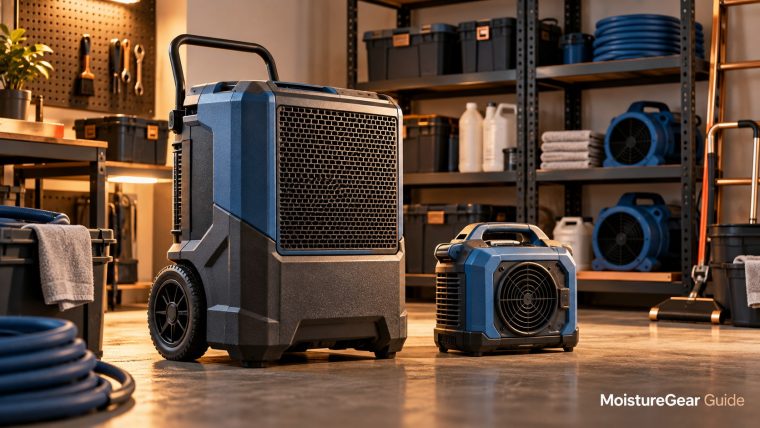
Named examples from the discussion. Cabinet appearance does not establish low-grain performance; compare the documented rating conditions.
The current AlorAir Storm LGR Extreme page, for example, lists 85 pints per day at 80°F/60% RH and 180 at 90°F/90% RH. The current Dri-Eaz Revolution page lists 80 pints at the AHAM condition. Compare the two AHAM points if you want that particular reference comparison; do not place 180 beside 80 as if they were equivalent measurements.
Even matched AHAM points do not establish low-grain superiority. They establish a comparison at the stated reference environment. A low-grain claim needs its own relevant evidence. Our saturation-versus-AHAM article explains why the headline figures differ.
Temperature can outweigh the technology label
Refrigerant dehumidifiers depend on achieving a useful relationship between the incoming air and the cold surfaces. In cooler conditions, frost and defrost behavior become important, and the amount of moisture available in the air changes. A permitted minimum operating temperature does not promise full rated removal near that minimum.
LGR is not a blanket solution for every cold space. Check the exact operating limits, any available performance information, and whether the intended environment changes over time. A product permitted to run in a cool room may still remove substantially less there than at its AHAM reference point.
For demanding cold or very low-dew-point applications, another equipment class may be appropriate. That decision needs professional assessment rather than a generic claim that a desiccant always wins in winter. If the application is a cold basement, our cold-basement buying guide keeps the discussion tied to practical residential conditions.
An LGR is still different from a desiccant system
A desiccant dryer uses a material that adsorbs moisture, often with a regeneration process that restores its ability to collect water. An LGR machine uses refrigeration and produces liquid condensate. The different mechanism changes installation, energy, air handling, and application considerations.
Do not treat the words "low grain" as proof that a product can replace any desiccant dryer. Specialist work can require conditions beyond an ordinary portable LGR machine's capabilities. A manufacturing process, museum environment, or unusually cold installation may call for engineering that is not represented by a consumer restoration shortlist.
Likewise, do not choose a desiccant because its description sounds more technical. The proper choice follows the required condition, moisture load, equipment limits, and installation. The Phoenix product-manual catalog separates LGR and desiccant equipment, which illustrates that manufacturers themselves treat these as distinct technologies.
Dry air does not equal dry materials
A dehumidifier changes the air. The moisture held in wood, concrete, insulation, flooring, or a wall assembly can take a different path and time to leave. A dry-feeling room can therefore contain materials that still need attention. A machine collecting less water can indicate changing room conditions without proving that the assembly is ready to finish.
The EPA’s moisture-investigation guidance distinguishes air-humidity instruments from equipment used to assess moisture in building materials. For restoration, a qualified operator defines appropriate measurements and an endpoint relevant to the affected materials.
This is also why an impressive early collection does not establish superior drying. One setup may extract a large amount of vapor from incoming outdoor air while another effectively controls the intended enclosure. The quantity of condensate has to be interpreted in context. Neither conventional nor LGR equipment eliminates the need to stop leaks and manage contamination where it exists.
Extra heat can be helpful or inconvenient
Both conventional refrigerant and LGR equipment reject heat into their discharge air. The outgoing air is warmed by the refrigeration cycle, and electrical input contributes additional heat to the space. A smaller RH reading at the discharge partly reflects that temperature change as well as the vapor removed.
During a professionally planned drying job, warmth can support evaporation from suitable materials. In an occupied room, it can add discomfort. The effect depends on room size, ventilation, equipment demand, and any cooling system. Do not assume that an LGR machine cools the space because it contains refrigeration.
If heat or noise will affect occupants, include those concerns early in the selection. Ask for meaningful data and a placement plan rather than relying on unqualified "quiet" claims. For an installed building system, the discussion may involve ducting and equipment placement rather than a portable unit beside the occupied area.
Read a performance graph with the conditions attached
When a supplier provides a chart, identify the axes and the test assumptions before looking for the highest line. Removal against RH at one temperature is different from removal against temperature at one RH. A low-grain data point is different again. Keep the model, generation, and operating arrangement attached to the chart.
Check whether both machines were evaluated on a comparable basis. One chart may describe a favorable laboratory setup while another describes a different inlet condition or an installed arrangement with added resistance. Similar units on a vertical axis do not guarantee that the curves answer the same question.
Look for the part of the chart where your equipment will actually work. If most of the assignment occurs later in drying, the first hot and humid reference point is not the whole story. If the equipment maintains a normal room condition, an extreme low-grain point may have little relevance to its value.
Finally, separate a demonstrated extraction difference from a claim about whole-job time. The chart describes the machine under its stated assumptions. Material drying, circulation, access, and incoming moisture still affect a building. Use the evidence to qualify a candidate, then use an appropriate job plan to decide the equipment quantity and deployment.
Compare costs without promising a universal payback
LGR equipment may cost more than a simpler room appliance, but price comparisons should include the intended working process. A restoration operator might value useful late-stage performance, service support, and handling. A homeowner maintaining one visible room may not need those same features.
There is no defensible universal payback period from the technology label alone. To estimate value, compare the complete offers and the expected utilization. Include filters, hoses, transport accessories, support, and any connectivity cost. For operating expense, use a suitable consumption figure or properly measured energy data from the exact application.
A hypothetical reduction in job hours is not a saving until the evidence shows it for the work in question. Avoid multiplying a manufacturer's broad efficiency statement by your electricity rate and presenting the result as guaranteed. Our electricity-cost guide explains a more transparent estimate, with assumptions stated where the equipment’s actual duty cycle is unknown.
Use a three-question selection process
First, identify the normal and demanding conditions. Is the unit maintaining a room's humidity, drying materials after an assessed event, or serving a specialist process? What temperature and vapor conditions will occur? Do not make the choice from the wettest moment alone if the later stage determines the useful equipment.
Second, ask for matched performance evidence. Record the exact model and generation, reference conditions, and any relevant low-grain data. If that evidence is unavailable, acknowledge the uncertainty. Seek a suitable trial, professional supplier advice, or an option with better documented application support.
Third, qualify the installation and ownership process. Confirm drainage, electrical requirements, airflow access, handling, ordinary maintenance, and the service contact. A capable refrigeration design is only one part of the whole setup. This final check often explains why the apparently strongest product is unsuitable for a specific room or working routine.
Questions people often ask
Can a conventional machine be used professionally? Yes, if the exact product is suitable for the job and the documented requirements are met. Professional use does not magically change its performance range or authorize an unsuitable installation.
Is LGR automatically more energy efficient? The label does not establish an efficiency comparison at every condition. Compare relevant data under matching conditions, and consider actual operating time and total ownership.
Can either type handle flood cleanup alone? No. Electrical safety, the source of the water, contamination, material assessment, and verification may require professional help. The EPA flood cleanup guidance explains the wider process.
Selected sources
- Phoenix GTR technology explanation
- AlorAir Storm LGR Extreme reference ratings
- Dri-Eaz Revolution LGR current specifications
- Phoenix equipment manual catalog
- EPA moisture-investigation guidance

About the author
Davis Murphy
Davis Murphy writes about dehumidifiers, indoor humidity, and home moisture control at MoistureGear Guide. His articles explain how to compare equipment, understand capacity ratings, and plan for drainage and maintenance. He focuses on clear, practical guidance to help readers choose a dehumidifier suited to their space and needs.