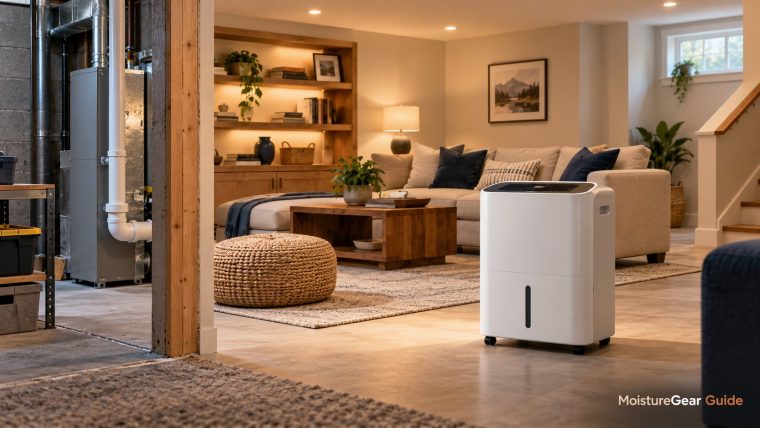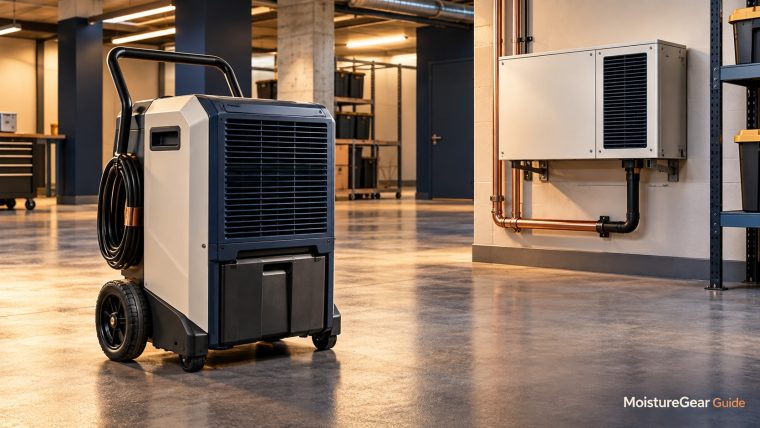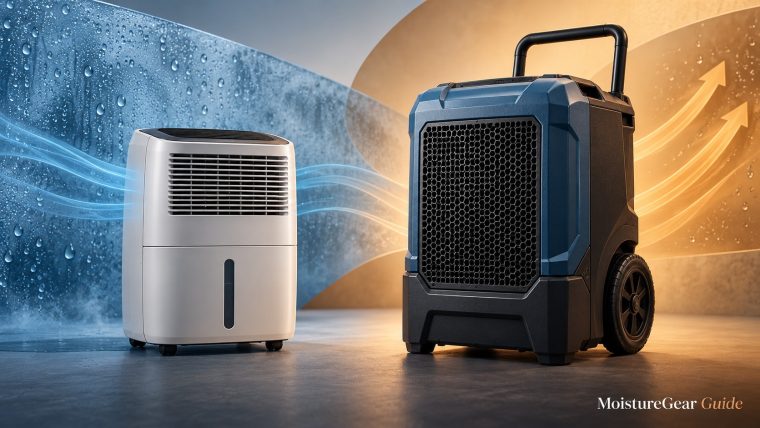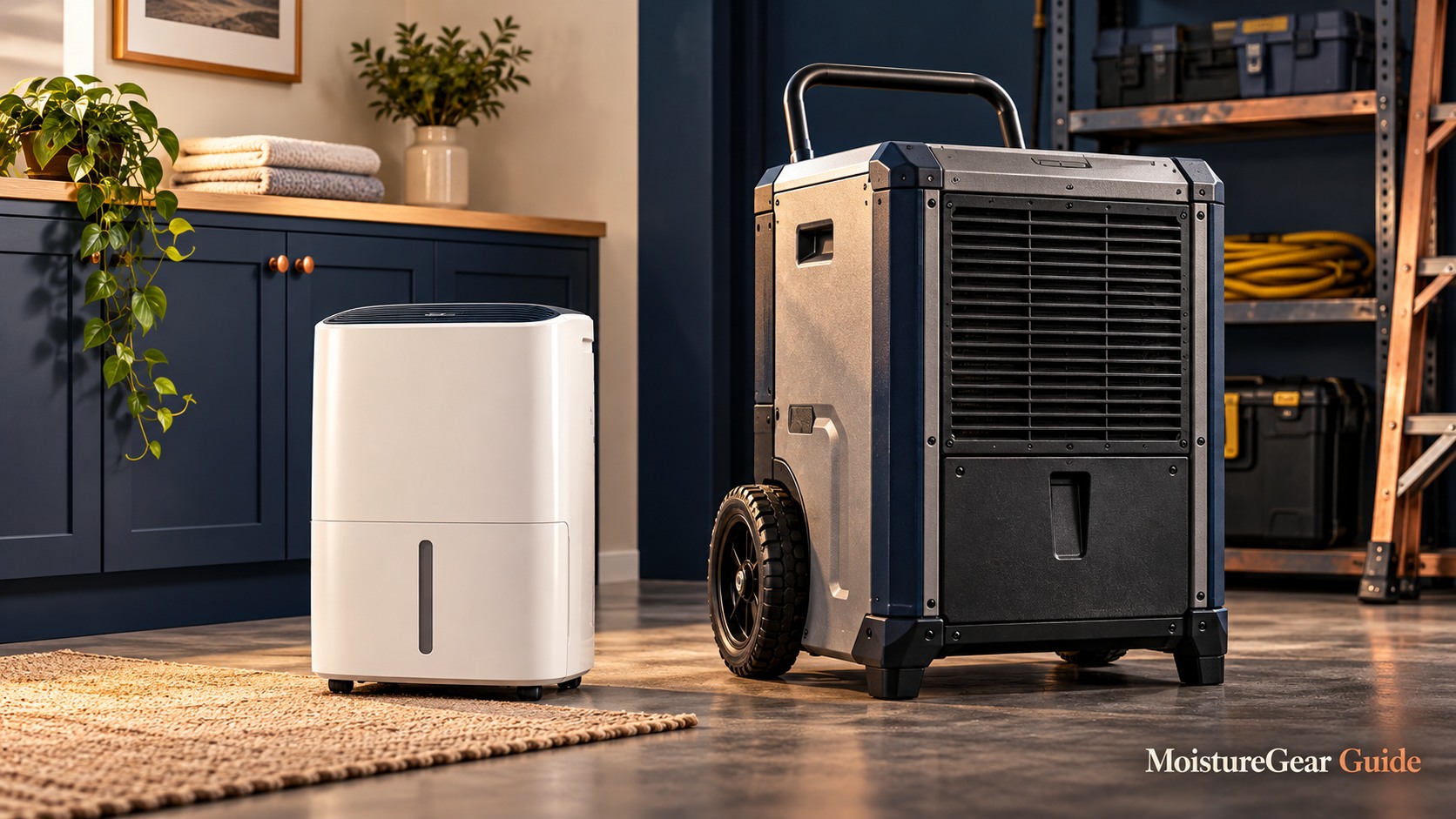
A commercial vs residential dehumidifier comparison should begin with the work the machine will do, not the color or shape of its cabinet. A portable appliance can be enough for routine humidity control in an accessible room. Professional equipment becomes more relevant when drainage, repeated transport, installed placement, changing drying conditions, or a dependable service process create requirements that a room appliance cannot meet conveniently.
There is no useful rule that every commercial product is better than every residential product. The labels cover a broad range of equipment, and manufacturers use them differently. This guide examines the features that can justify the extra commitment. For equipment shortlists and related topics, visit our commercial dehumidifier hub.
This comparison uses primary product and technical documentation to explain buying criteria. It does not report independent performance, energy, or durability tests.
Compare the assignment before the equipment
| Requirement | A residential portable may be suitable when | Professional or installed equipment deserves consideration when |
|---|---|---|
| Room humidity control | One accessible area needs a manageable moisture load controlled | The enclosure or building layout requires a specialized installation |
| Drainage | A bucket or approved continuous drain is practical | Pumped drainage and a protected route are essential to operation |
| Transport | The machine rarely moves | It moves among jobs, buildings, or challenging access routes |
| Controls | A humidistat and ordinary operating status are sufficient | Job records, inlet/outlet data, or coordinated monitoring have a real use |
| Maintenance | Filters and ordinary owner care can be handled locally | Parts access, service downtime, and fleet consistency affect business operations |
| Water damage | A professional has confirmed a limited, suitable role | A defined restoration plan calls for purpose-built drying equipment |
Neither column is a sizing formula. A small room with continuous incoming moisture can be harder to control than a larger well-enclosed space. Conversely, a large professional cabinet can be unnecessary in a room where a correctly sized portable appliance meets the need.
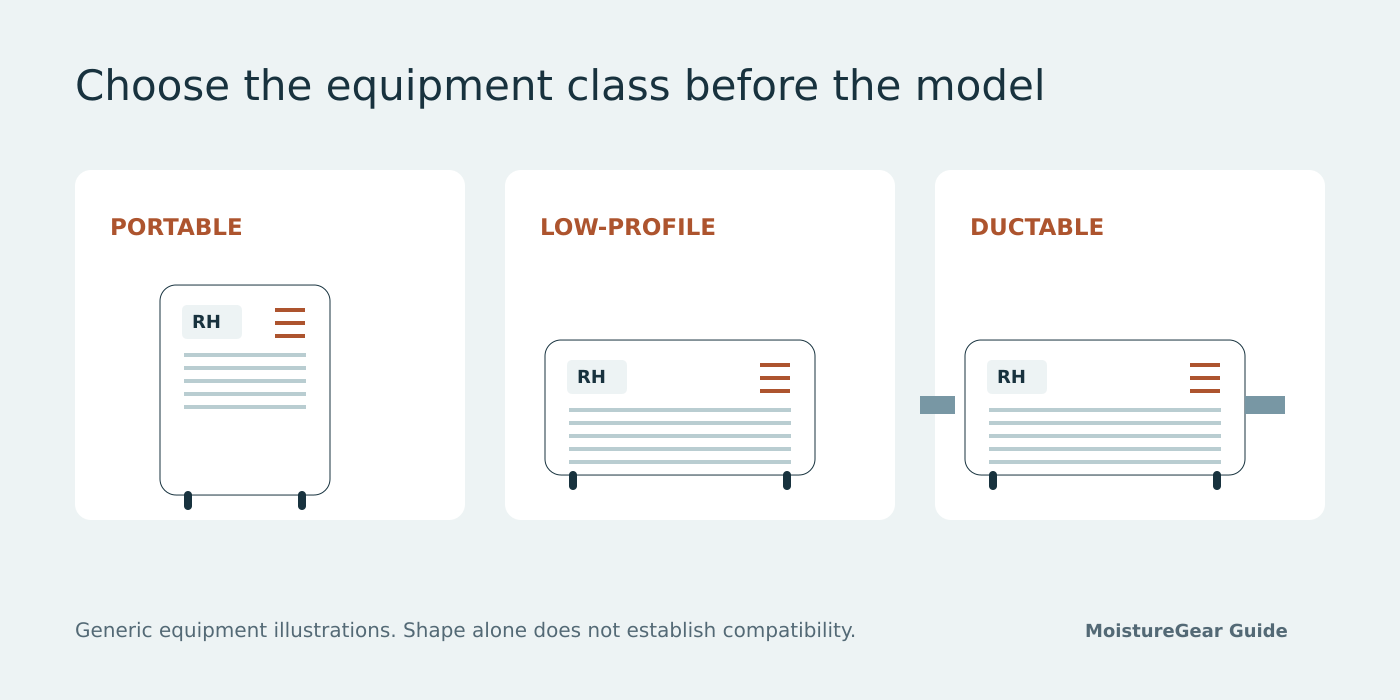
Capacity numbers can make the categories look further apart
A product title showing 180 pints and another showing 50 pints may appear to settle the comparison. It does not unless the numbers use equivalent procedures and conditions. Warm, very humid air makes more water available for condensation than a cooler room. Changing the reference condition changes the daily removal figure.
For example, AlorAir's Storm LGR Extreme page distinguishes 85 pints per day at 80°F/60% RH from 180 pints at 90°F/90% RH. Those are ratings for the same named product at different conditions. The larger one is not evidence that the machine removes twice as much water in a normal basement.
Residential labels and listings can reflect a different DOE test basis. Whole-house equipment also has its own relevant procedures and installation context. Do not attempt to convert every comparison using a universal multiplier. Our AHAM-versus-DOE guide explains why the procedure and product class matter, while the saturation-rating guide addresses the large figures common in commercial listings.
“Commercial” does not automatically mean LGR
Commercial equipment can include conventional refrigerant machines, LGR restoration units, installed humidity-control products, and specialist systems outside an ordinary consumer shortlist. The buyer's task determines which of those categories is relevant. It would be a mistake to choose all of them from one capacity leaderboard.
LGR stands for low-grain refrigerant. These units still use a refrigeration cycle but aim to sustain useful extraction as the air becomes drier. That can be valuable during structural drying, where conditions change over the course of the job. It is different from desiccant drying, which uses a moisture-adsorbing material rather than relying on a cold coil to produce condensate.
If the need is everyday humidity control in a conditioned room, LGR may not be the feature worth paying for. If the need is repeated restoration work, its performance range can become more important. Our LGR-versus-conventional comparison explains the specific technology decision. Check the model’s documented suitability instead of assuming a professional name identifies its internal design.
Drainage often matters more than a larger cabinet
A residential portable can be perfectly practical when someone can empty its collection bucket or an approved gravity drain is available. The difficulty begins when those conditions do not match the building. An inaccessible room, prolonged unattended operation, or a drain above the appliance can change the requirements.
An integrated pump can make equipment placement more flexible within its documented limits. It adds a powered drainage system that must remain accessible and maintained. A professional cabinet does not make the discharge hose impossible to kink or the destination impossible to overflow. If there is no dependable route for condensate, choosing a more expensive machine leaves the central problem unresolved.
Compare the complete arrangement: drain outlet, hose, destination, permitted rise, fault behavior, and the person responsible for inspections. Our commercial pump guide focuses on those details. For some permanent applications, an installer may recommend an appropriate separate condensate pump rather than making an integrated pump the sole buying criterion.
Repeated transport changes what “portable” means
A residential appliance on casters can be easy to move across one room. That says little about stair transport, lifting into a vehicle, loading several units, or securing equipment for travel. Professional equipment often provides different handles, stacking arrangements, or wheeled formats intended for those tasks, but individual models still require safe handling.


Two named commercial-equipment examples showing different handling formats; the photographs do not establish safe lifting limits.
Consider the Dri-Eaz Revolution, whose current page publishes a compact format and a 63-pound weight, against the LGR 6000Li, a wheeled 99-pound machine. Neither number is permission for a lone operator to carry it on stairs. The suitable choice depends on the actual route and approved handling method.
For a property owner who leaves the equipment in one place all year, transport features may add little value. For a contractor visiting several addresses each day, they can influence vehicle capacity and setup time. Measure the access opening, storage area, and vehicle layout before treating the larger machine as an obvious upgrade.
Controls should solve a specific management problem
An ordinary humidistat can be enough to maintain a room's target humidity. More elaborate displays can show job hours, inlet and outlet conditions, maintenance information, or operating trends. Those features are useful only if somebody knows what they mean and uses them for an appropriate decision.
Current Dri-Eaz Command Hub documentation illustrates the connected-management features found on some professional products. A team responsible for several jobs may benefit from a consistent interface and useful equipment data. A homeowner with one visible appliance may be better served by simple controls and a separate appropriately placed humidity monitor.
Do not assume a machine with Bluetooth can be monitored from another city. Local connection, internet connection, notifications, and historical records are different functions. Verify which are supplied, which require extra equipment, and which have relevant service costs. More connected functions also create a dependency on the correct app, controller generation, firmware, and network.
Serviceability is a practical difference, not a reliability guarantee
A product can be designed for access to filters and replaceable components without having a proven lower failure rate. Serviceability answers what can be done when attention is required. Reliability concerns how often problems occur under defined use, and this guide does not have comparable long-term test data to rank the categories that way.
For professional ownership, ask whether approved filters, hoses, and parts are available through a service channel you can use. Ask who is permitted to replace an internal pump or service the refrigeration system. Some operator maintenance is straightforward; other work involves electrical and refrigerant hazards and belongs to a qualified technician.
A business can also place value on consistent training. If every unit in a fleet has a different shutdown process or filter arrangement, ordinary care becomes easier to get wrong. Matching the working process may justify equipment that looks expensive beside a room appliance. That is a specific operational reason, not proof that all commercial products are better made.
Noise and heat do not disappear in professional equipment
A large fan and compressor can be intrusive in an occupied room. Commercial products designed around restoration work may not be a comfortable choice beside a sofa or office desk. Conversely, a residential product is not automatically quiet enough for every user simply because its packaging shows a living room.
Compare sound information only when the measurement conditions are meaningful, and consider where the machine will sit relative to people. A rated sound-pressure figure without distance, operating setting, or test environment is a limited buying aid. Reviews from different rooms can also reflect floor resonance or placement rather than an intrinsic equipment difference.
Refrigerant dehumidifiers discharge warmed air. That can be helpful in some drying situations and inconvenient in a small occupied space. If the building already has a cooling problem, include the dehumidifier's effect in the installation discussion. The equipment removes water vapor; it does not work like an air conditioner that sends its heat outdoors.
Permanent installation is its own category
A crawl-space or whole-house unit can be marketed for residential buildings while sharing features people associate with commercial equipment: larger capacity, continuous drainage, service access, and duct connections. That makes the residential/commercial label less useful than the intended application.
An installed system needs an airflow plan, appropriate controls, accessible maintenance, and a suitable drain. Some designs integrate with the building's ductwork; others operate independently. The installation should reflect the manufacturer's allowed arrangements and the site's moisture load. A jobsite dehumidifier placed near an HVAC return is not automatically an approved whole-house system.
If the concern is persistent humidity across a home, compare whole-house and portable approaches rather than assuming a mobile restoration machine is the answer. If the concern is beneath the building, our crawl-space equipment guide provides the application-specific questions.
Water damage changes the boundaries of the purchase
Ordinary humidity control and post-loss drying are different assignments. After flooding or a significant leak, there may be unsafe electrical conditions, contamination, and moisture trapped in materials. The EPA flood guidance places dehumidification within a broader cleanup and drying process.
A machine's bucket filling does not prove the building is drying adequately, and a lower room-air RH does not establish that a floor or wall cavity is ready to close. Proper assessment may require material-moisture readings, decisions about what can be saved, and professional handling of affected assemblies.
This is where commercial equipment can be useful without becoming a complete do-it-yourself solution. A professional plan may specify LGR machines, air movement, other equipment, and verification. If this is a one-off event, renting versus buying may be a more useful decision than choosing a permanent commercial purchase.
Three situations that reveal the useful differences
A finished basement with seasonal humidity
If the room is accessible, the moisture source has been addressed, and an appropriate drain is available, a correctly chosen portable can be a sensible starting point. Comfort, ordinary maintenance, and energy use may matter more than stacking or remote job data. Check temperature suitability and the actual load rather than buying a restoration machine because it has a larger number.
If the portable cannot maintain control, examine the environment before upgrading. Incoming summer air, room divisions, drainage interruptions, and an unsuitable setpoint can make a machine appear undersized. Our basement equipment guide and sizing resources help keep the decision specific to that application.
A property business moving equipment between addresses
Here, handling, complete accessories, clear records, and service access become central. A machine with a practical transport arrangement may make more sense than a room appliance with a marginally lower initial price. The staff also need a consistent process for inspecting the cord, filter, drain route, and operating status.
The sensible shortlist may include several capacities because not every room needs the same equipment. Build around typical assignments and access routes. Document why each size exists in the fleet so an operator does not choose a machine based only on what is nearest the van door.
An installed humidity-control problem beneath a building
The hidden location raises access and supervision questions. A unit should be chosen for that environment, with a defined maintenance route and appropriate moisture-source work. An ordinary portable can be awkward if the bucket or controls are hard to reach, even when the stated removal capacity looks sufficient.
Professional-looking restoration equipment can also be the wrong permanent choice if its intended use or control arrangement does not fit the installation. Get the building-specific design right, then choose the suitable product family. The installation role is what justifies the equipment, not its price category.
Compare total cost over the intended use
A purchase comparison should include necessary drainage equipment, delivery, installation, filters, transport accessories, and service arrangements. For a business, include the process needed during downtime. For a home, include whether the equipment will need professional removal or reinstalling if it fails.
Operating cost depends on real electrical consumption and run time. A larger unit may operate fewer hours in one situation and remain busy in another, so do not assume either category guarantees savings. Use our electricity-cost guide to make a labeled estimate, then improve it with appropriate measured data from the actual installation.
Warranty terms also need a like-for-like comparison. Parts coverage, labor, freight, purchase eligibility, and registration can differ. The longest headline warranty is not automatically the lowest ownership cost. Request the complete terms for the seller and exact unit before comparing offers.
Define the upgrade you are trying to buy
Write one sentence describing the failing requirement in the current setup. For example, an owner might need a permitted pumped route to an elevated drain; a property business might need safe repeated transport and accessible service; an installer might need a model approved for a particular duct arrangement. Each sentence produces a different shortlist.
Then compare the cost of solving that requirement within the appropriate product class. A larger portable, an installed system, or compatible supporting drainage equipment may each be relevant, but they are different proposals. Price them as complete arrangements rather than allowing a commercial label to make the decision.
Also identify the features you will not use. A seldom-moved installed unit may not benefit from stacking features, while a mobile operator may have little use for a building-specific remote control. Removing unused requirements makes the purchase clearer without necessarily forcing a cheaper option.
If the problem cannot be stated specifically, investigate the room or building first. Persistent wetness is an observation, not a complete equipment specification. A proper assessment can reveal a moisture source, an air-distribution problem, or an installation constraint that neither a residential nor commercial replacement would fix by itself. That finding can prevent an expensive upgrade whose extra capacity never addresses the reason for poor control.
A useful final decision rule
Move beyond a residential portable when you can name the requirement it cannot meet: the drain, installation environment, transport routine, working conditions, controls, or service process. Then compare professional models that document that requirement. That produces a defensible shortlist and keeps expensive features tied to an actual purpose.
Stay with a simpler product when it meets the assignment and the professional extras would go unused. Correct sizing, source control, drainage, and maintenance remain necessary in either category. The label does not relieve an owner of any of those responsibilities.
Selected sources
- ENERGY STAR dehumidifier information
- AlorAir Storm LGR Extreme current specifications
- Dri-Eaz Revolution LGR
- Dri-Eaz Command Hub
- EPA flood cleanup guidance

About the author
Davis Murphy
Davis Murphy writes about dehumidifiers, indoor humidity, and home moisture control at MoistureGear Guide. His articles explain how to compare equipment, understand capacity ratings, and plan for drainage and maintenance. He focuses on clear, practical guidance to help readers choose a dehumidifier suited to their space and needs.