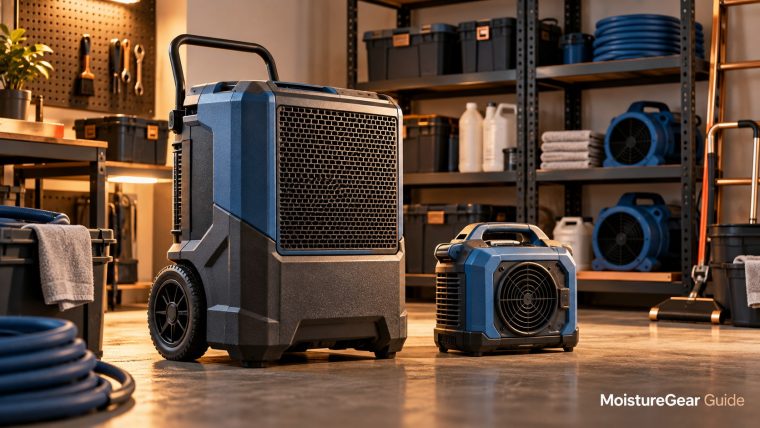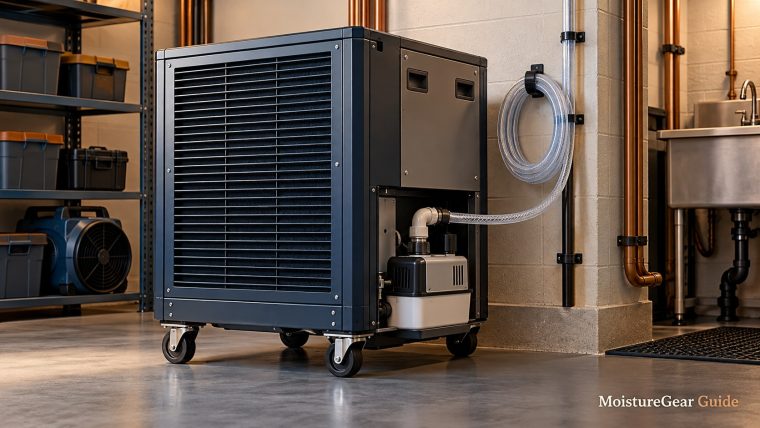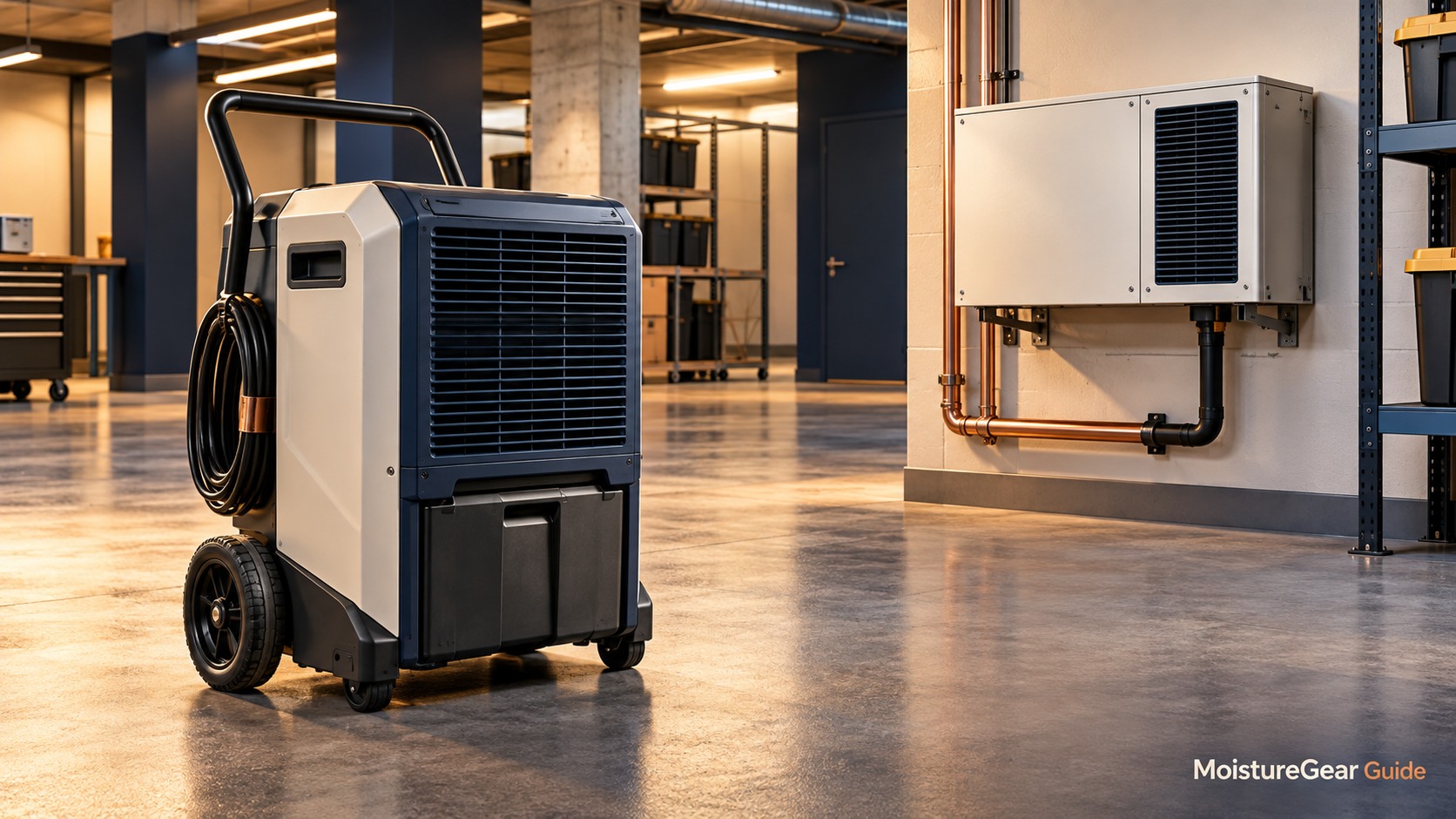
The best commercial dehumidifier for a storage room can be a poor choice for a restoration van. One job calls for steady humidity control in a predictable enclosure; the other demands repeated transport, rapid setup, accessible service, and useful drying data. Start by identifying which job you actually have. Then compare water-removal ratings at matching conditions, the drain arrangement, the route into the building, and the support available when the equipment needs attention.
This guide separates those decisions instead of treating every large condensate-removing machine as interchangeable. The recommendations are based on current manufacturer documentation and suitability for particular uses, rather than hands-on performance measurements. For the wider topic map, visit our commercial dehumidifier guides.
Match the equipment to its assignment
| Assignment | Useful starting point | Why it belongs on the shortlist | Main limitation |
|---|---|---|---|
| A permanent crawl-space or building-support installation | AlorAir Sentinel HDi90, built-in-pump version | Application-oriented layout and continuous drainage | Not designed around wheeled daily transport |
| A compact machine for repeated restoration deployment | Dri-Eaz Revolution LGR, current Command Hub version | Small cabinet and current job monitoring controls | Carrying and separate transport equipment still need planning |
| Compact restoration equipment with an optional connected version | AlorAir Storm LGR Extreme | Documented AHAM capacity and integrated condensate pump | App and non-app listings require careful identification |
| A wheeled unit for a professional equipment fleet | Dri-Eaz LGR 6000Li | Higher published AHAM capacity than Revolution and wheeled format | Heavier machine and larger transport requirement |
| Larger AHAM capacity with a stair-oriented handle | Phoenix DryMAX XL Pro | Published 135-pint AHAM rating and purpose-built transport features | Dealer purchase route and distinct product generations |
These are conditional recommendations. A large warehouse with frequent open loading doors, a swimming-pool room, or a process facility needs a load assessment and appropriate specialist equipment. Buying one of these models because a sales page mentions a similar room does not establish that it will control that building.

What our comparison includes
We compared exact product families using the manufacturers' current pages, available manuals, and specifications. We considered placement, transport, drainage, control features, and the implications of ownership. We did not measure extraction speed, noise, long-term reliability, energy consumption, or app uptime. Published specifications describe the manufacturer's claims under stated conditions, not results from an independent comparison laboratory.
There are several versions within these families. Current controls can differ from photographs in older retailer listings, and a change in refrigerant or component layout can mean a different manual. Keep the product label, purchase description, and supplied instructions together. Our shortlist intentionally avoids a numeric score that would imply tests we have not performed.
AlorAir Sentinel HDi90: consider it for an installed role
The built-in-pump Sentinel HDi90 manufacturer page lists 90 pints per day at 80°F and 60% relative humidity. That is a useful reference for comparison with other products rated at those same conditions. It does not mean an installed unit will collect 90 pints every day throughout the year.

The appeal here is the application. A unit placed beneath a building can remain in one position while its humidistat regulates operation and its pump sends condensate to a suitable drain. The owner needs access for filters, drainage inspections, and eventual removal, rather than a transport system for moving between jobs every morning. In a well-planned permanent installation, that distinction may be more valuable than a flashy control panel.
Choose this family when the enclosure is suitable for its intended use and a qualified installer has addressed incoming moisture, airflow, and drainage. Pay particular attention to whether the offer is the built-in-pump, duct-able, or Wi-Fi configuration. Those descriptions appear separately in AlorAir's catalog. They are not permission to assume every option includes the same accessories.
The tradeoff is jobsite mobility. A rectangular unit without an integrated stair-handling system can be awkward to move repeatedly through occupied buildings. If portable drying is the main assignment, look at the restoration models below first. Our HDi90 review covers its permanent-installation buying questions in greater detail.
Dri-Eaz Revolution LGR: compact equipment for a working fleet
The current Revolution LGR page identifies the machine as item 111995 and includes the Command Hub controller. Its published AHAM removal is 80 pints per day at 80°F/60% RH. The compact format makes it an interesting option when several machines must share a van or when the equipment has to pass through confined rooms.

The current controller gives access to job information and connected monitoring. For an owner with multiple properties or an operator coordinating several drying jobs, useful controls can reduce the friction of checking equipment status. They do not replace on-site inspection or moisture readings in building materials. Wireless access also depends on the actual controller generation, setup, network, and software.
The practical question is how the unit will move from vehicle to room. A smaller cabinet can be easier to fit through an access opening, but its published 63-pound weight is still a meaningful lifting load. Measure your access route and consider a suitable hand truck or another approved handling method. Do not translate "compact" into "safe for one person to carry upstairs."
Revolution is a stronger candidate for repeated compact deployment than for someone seeking a quiet appliance in an occupied office. We have no comparable independent noise data for this shortlist. A retailer offer with an older panel also needs clarification before purchase. Read our Revolution review for the generation check and a more detailed buying decision.
AlorAir Storm LGR Extreme: verify the exact connected option
AlorAir's current non-app Storm LGR Extreme page and Smart App Control page both publish 85 pints per day at 80°F/60% RH. The frequently advertised 180-pint number is measured at the hotter, much wetter condition of 90°F/90% RH. It should never be compared directly with another machine’s AHAM number.

This model belongs on a shortlist for a buyer who wants compact restoration-style equipment with a condensate pump and is willing to check the precise version. The connected version offers another way to see and control operation, while the non-app version avoids buying a feature that may not be useful at a location without dependable connectivity.
However, the name alone does not settle what is in the box. Ask the seller to identify the controller, the manufacture information, and the matching instructions. Historic documentation can describe a different generation. We have not independently verified the software's compatibility with every phone or its performance behind a basement wall. If remote monitoring is essential, test the actual equipment and network during the return period.
Storm is not a substitute for a complete restoration service. It removes water vapor from air and supports drying; it does not extract standing floodwater, disinfect contaminated materials, or determine whether a wall cavity is dry. Our Storm LGR Extreme review explains the purchase checks, and the LGR operating guide explains the refrigeration process.
Dri-Eaz LGR 6000Li: a wheeled alternative to smaller cabinets
The LGR 6000Li manufacturer page lists 100 pints per day at 80°F/60% RH and a 99-pound machine. Those two facts illustrate the tradeoff: higher published capacity than Revolution, accompanied by more equipment to transport. Its wheeled form and current Command Hub make it a candidate for repeated professional use where the route and vehicle can accommodate it.

A wheeled machine can make a long hallway simpler while still presenting challenges at stairs, thresholds, and loading height. Plan the entire route, including lifting into the vehicle. Assess tie-down points, available floor space, and how the drain hose and power cord will be carried. A good fleet purchase fits the workflow before it fits a specification table.
The higher AHAM figure also needs context. It indicates more removal at the reference condition, not a guaranteed proportional reduction in job duration. Different rooms, materials, airflow, and temperature can control how quickly moisture reaches the dehumidifier. Several separated rooms may benefit from multiple well-positioned units rather than one bigger unit left outside the main wet area.
This is a manufacturer benchmark and purchase candidate, not a promise of Amazon availability. If a marketplace listing does not establish the current model and an appropriate seller, obtain a dealer quote. Service access and replacement parts matter to commercial buyers who cannot wait indefinitely for a machine to return from repair.
Phoenix DryMAX XL Pro: larger capacity with transport priorities
The current Phoenix DryMAX XL Pro documentation and its A2L specification sheet publish 135 pints per day at 80°F/60% RH. The manufacturer’s transport features include large wheels and a handle designed for different moving positions. That makes it worth investigating when stairs and loading routines dominate the buying decision.

The model also has a documented condensate-pump arrangement. This can be particularly useful for temporary deployment where gravity drainage is unavailable. It remains important to read the matching manual rather than treating the pump as unlimited. A drain hose, approved destination, and orderly routing are part of the setup, not optional details after purchase.
Phoenix sells through distributors, so compare a complete dealer offer with other equipment quotes. Ask about the exact XL Pro generation, accessories, support, and connectivity requirements. XL, XL Pro, and XL Pro+ names should not be collapsed into one product. A Bluetooth feature also does not, by itself, establish remote internet access from another property.
For a small business, the higher capacity may be useful if the actual workload supports it. For a homeowner with one room and occasional dampness, the purchase can be unnecessarily specialized. A professional-looking cabinet cannot compensate for an unsuitable room or uncertain drainage, and its weight still requires safe handling.
Prepare a building brief before requesting equipment quotes
Give the supplier a description of the normal working day in the space. For a storage area, record whether loading doors open briefly or remain open for deliveries, whether stored goods arrive wet, and whether the room shares air with another part of the building. For a workshop, record any moisture-generating process without assuming a generic room dehumidifier is suitable for fumes, chemicals, or combustible dust. Those details affect both load and equipment suitability.
Include the enclosure layout rather than floor area alone. Two connected rooms with a wide opening behave differently from the same floor area divided by closed doors. Tall shelving, partitions, stored inventory, and service corridors can create air-distribution constraints. A supplier who knows those constraints can discuss placement or a more appropriate installation instead of selling a machine against one square-foot number.
Describe the target condition and the consequence of losing control. A general storage room, an archive, and a process area can have different requirements. Specialist contents or environmental tolerances may need professional design, multiple measurements, or equipment outside this shortlist. Do not assume a familiar humidity target suits every commercial use.
State whether the assignment is permanent, occasional, or urgent. That affects the value of installed controls, rental flexibility, transport features, and service backup. A short-term drying need can justify temporary equipment without implying that the same machine is the best permanent humidity system for the property.
Finally, record the usable power, drain destination, access opening, and maintenance route. If any of those are unresolved, tell the supplier rather than treating them as minor details to settle afterward. A complete quote should identify what the supplier assumes and what must be arranged by an installer or owner. Ask for the equipment selection reason in writing, with reference conditions and any limits relevant to the intended space.
This brief also gives competing suppliers the same problem to solve. Their answers become easier to compare because one has not priced a bare portable unit while another has priced an installed control system. The aim is a clear equipment assignment, not an impressive number detached from the building.
Capacity: make the comparison fair before making it large
A comparison table is only useful if each row uses the same test condition. Saturation figures are attractive because warm air at high relative humidity contains much more water than a cooler, drier room. A machine can therefore publish a much larger removal figure at saturation without becoming a different model.
Use the AHAM reference figures above as one common comparison point, then ask what the equipment does under the conditions you expect. A maintained storage room, a cool basement, and the later stages of structural drying are different operating environments. A low-temperature operating limit says where the manufacturer permits use; it is not a promise of the rated extraction volume at that limit.
Square-foot coverage is another rough filter rather than a load calculation. Room height, incoming outside air, wet materials, process moisture, and the target condition all matter. A modest sealed room can be harder to control than a larger dry enclosure if moisture keeps entering it. Read our LGR-versus-conventional comparison before paying extra for a technology label.
Define a drainage plan that can survive normal use
A commercial machine should not require someone to remember a bucket every few hours unless that is an intentional, supervised arrangement. Determine the destination, route, vertical rise, hose length, and exposure to traffic before ordering. Where an integrated pump is used, verify its limits in the instructions supplied with that particular unit.
An open container is not an unattended continuous drain. A hose can also be displaced by cleaners, deliveries, pets, or another tradesperson. Secure the termination and protect the route without obstructing an exit or creating a trip hazard. If freezing temperatures can affect the line or destination, the drainage arrangement needs appropriate planning.
For detailed pump buying criteria, use our commercial dehumidifiers with pumps guide. That guide focuses on drainage evidence, rather than repeating the entire product-selection process. A poor drain can stop a capable machine, so this part of the decision deserves the same attention as the water-removal rating.
Account for electrical supply, warmth, and occupied space
These products are powered appliances with compressor systems. An available outlet does not establish that a circuit is suitable for the combined load of drying equipment, lighting, and other appliances. Follow the exact manual and have an electrician address questionable circuits or any equipment affected by water. Avoid improvised power distribution to make a purchase work.
Dehumidification also adds heat to the room. Drying air feels different from cooling air because the refrigeration system rejects heat back into the discharge, and electrical input contributes additional heat. In a small occupied room, warmth and fan noise can become as important as capacity. A machine selected for a jobsite may be intrusive when left beside a reception desk all year.
Think about hours of operation, occupants, and service access. Where people work close to the unit, ask for meaningful sound information and inspect the installation layout. We do not rank this shortlist by quietness because published sound figures measured differently would not provide a fair comparison.
Price the ownership process, not only the box
Get a written quote that separates equipment, necessary accessories, delivery, installation, and ongoing supplies. For permanent control, installation can involve brackets, ducting, drainage, controls, and commissioning. For jobsite work, it can involve transport equipment, replacement filters, hoses, and a practical maintenance routine.
Warranty length is useful only alongside the coverage details. Find out which years include labor, which parts remain covered later, who arranges service, and who pays shipping or removal. AlorAir's current warranty page, for example, distinguishes early coverage from later refrigeration-system parts coverage. Keep the receipt and the terms applicable to the actual purchase date.
Consider downtime as a real business cost without inventing a failure rate. If one machine serves a critical building area, decide how humidity will be managed while it is unavailable. If you operate a fleet, ask whether the chosen service channel can support it. Our buy-or-rent guide helps evaluate intermittent use.
A drying appliance does not certify a restored building
After water damage, equipment selection comes after safety and the assessment of what happened. Floodwater may introduce contamination, and hidden moisture can remain in building assemblies. The EPA’s flood cleanup guidance explains why drying, material decisions, and appropriate cleanup belong together. Airborne humidity readings do not establish that flooring or a wall cavity has reached an acceptable condition.
For a planned commercial installation, the corresponding issue is source control. Repair leaks and address the conditions adding moisture before treating a larger dehumidifier as the solution. If the space involves unusual chemicals, processes, fire risks, or specialist environmental requirements, consult the manufacturer and an appropriate professional about suitability.
Questions to settle before purchase
Should every commercial buyer choose LGR? No. LGR is particularly relevant to restoration and drying at lower moisture levels. Permanent control can be better served by equipment designed around the building layout and installation. Our commercial-versus-residential guide explains which features justify the move to professional equipment.
Can one large unit serve several closed rooms? Not reliably without an airflow plan. Equipment capacity and access to moist air are separate questions. Room separation can make distribution more important than a larger headline rating.
What is the strongest final buying check? Ask for the exact model identification, matching manual, drain requirements, seller support, and an itemized offer. Choose the machine whose documented features solve your assignment, then verify the installation can support it.
Selected sources
- AlorAir Sentinel HDi90 built-in-pump specifications
- Dri-Eaz Revolution current specifications
- Dri-Eaz LGR 6000Li specifications
- Phoenix DryMAX XL Pro documentation
- EPA flood cleanup guidance

About the author
Davis Murphy
Davis Murphy writes about dehumidifiers, indoor humidity, and home moisture control at MoistureGear Guide. His articles explain how to compare equipment, understand capacity ratings, and plan for drainage and maintenance. He focuses on clear, practical guidance to help readers choose a dehumidifier suited to their space and needs.