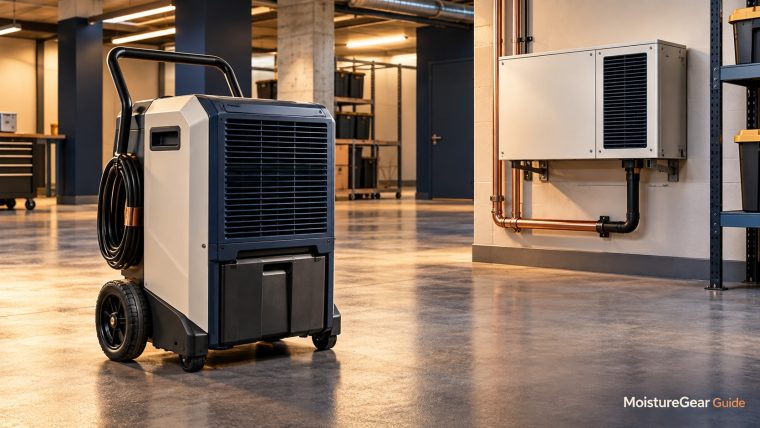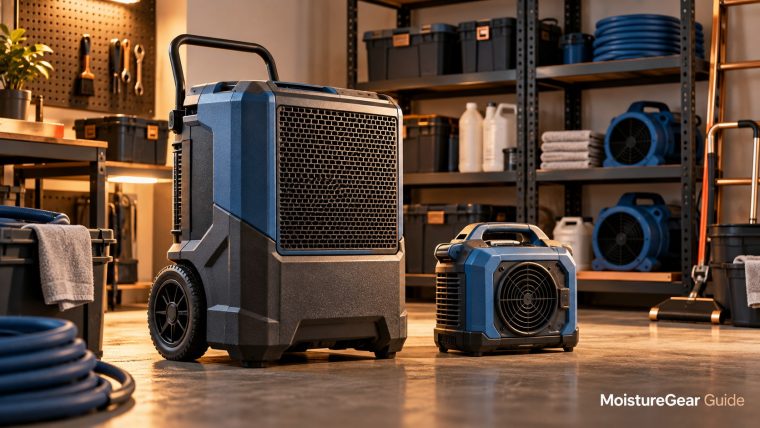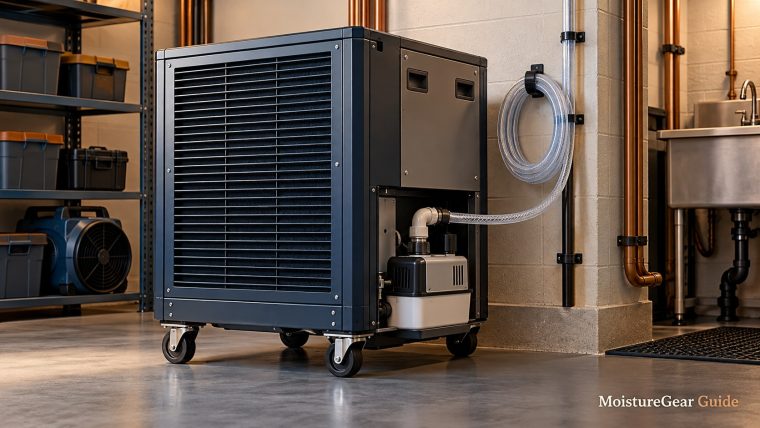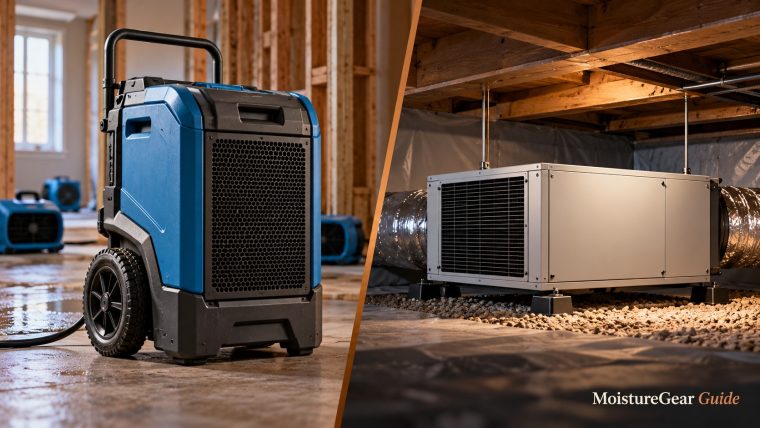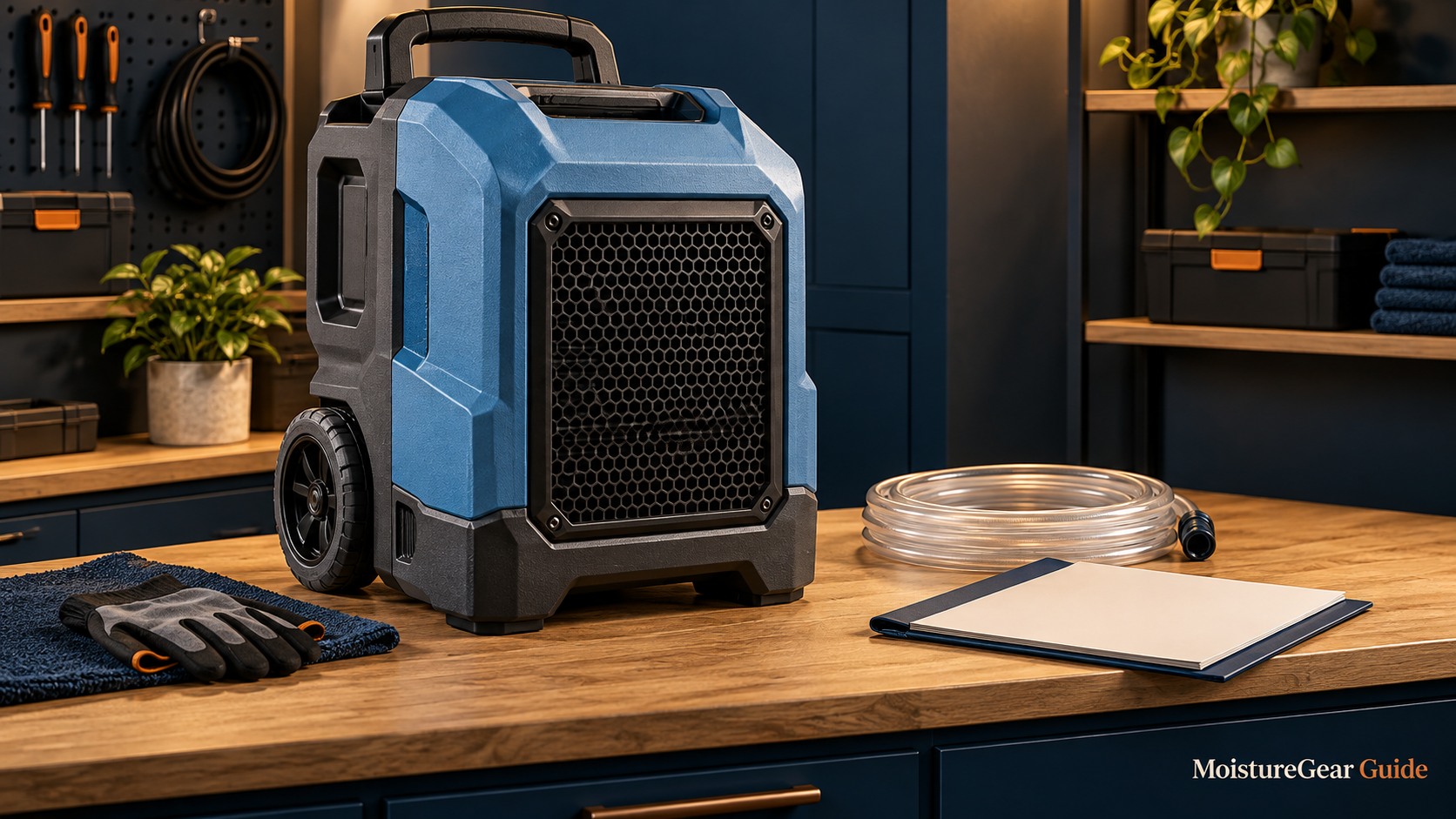
This AlorAir Storm LGR Extreme review examines a compact pump-equipped restoration dehumidifier whose biggest buying question is the exact version being supplied. The current manufacturer pages publish 85 pints per day at 80°F and 60% relative humidity, alongside a much larger saturation figure. Its suitability depends on the drying assignment, transport route, drainage, and service package—not simply on the largest number in a product title.
This is a research review of current published information, not a hands-on test. We have not measured extraction, noise, power consumption, durability, or app reliability. The aim is to help you identify the useful features and qualify the seller's offer. The commercial dehumidifier hub provides the wider topic map, and our LGR shortlist supplies comparable reference ratings for other equipment.
The current published specification snapshot

| Specification | Current manufacturer-page information | How to use it |
|---|---|---|
| Removal at AHAM condition | 85 pints/day at 80°F/60% RH | Compare only with removal at the same conditions |
| Removal at saturation | 180 pints/day at 90°F/90% RH | A separate hot, wet reference point, not normal-room output |
| Published airflow | 210 CFM | Equipment airflow, not proof of whole-room circulation |
| Drainage | Condensate pump | Qualify the route and limits with the matching instructions |
| Listed dimensions | 22.8 × 13.7 × 17.3 inches, L × W × H | Measure access and service space in addition to cabinet size |
| Filter | MERV-8 | Maintain the specified air path; not a mold-remediation system |
| Current page supply | 115 V, 60 Hz | Follow the delivered unit’s electrical instructions |
| Current page temperature range | 33.8–104°F | Permitted operating range, not a full-capacity promise throughout it |
These figures come from the current non-app product page. The Smart App Control page describes a connected option under the same family name. Historical documents and retailer offers can refer to earlier equipment. Confirm the data plate and supplied manual rather than applying every familiar Storm specification to every unit.
Where Storm makes sense
Storm is worth investigating when the buyer needs a compact machine for a defined drying role and wants automatic pumped condensate removal. A pump can make setup more practical when the intended drain is not lower than the appliance. The low cabinet format also deserves attention where equipment must pass through limited access or share space with other jobsite tools.
The most convincing purchase is one tied to an actual assignment: a property operator with a defined equipment routine, or a professional drying setup where the unit's documented role fits the plan. Its permanent use in a basement or other space should still be evaluated for controls, maintenance access, drainage, and the room's load.
A high-ticket restoration unit is less persuasive for an owner who only needs an ordinary room appliance and cannot identify a feature the simpler option lacks. A larger price and professional label do not make it automatically more comfortable in an occupied room. Our commercial-versus-residential guide explains the differences that can justify moving to this class.
Understand the 85-pint and 180-pint numbers
Both numbers describe reference extraction under particular air conditions. At 90°F and 90% RH, incoming air carries far more vapor than typical room air. The machine therefore has more available moisture to condense. Its saturation figure is not a forecast of daily collection in a cool basement or a partly dried room.
The 85-pint AHAM rating at 80°F/60% RH provides a useful point for comparing with another machine rated at that same condition. Even then, a five- or ten-pint difference does not establish the exact difference in time needed to dry a particular floor or wall assembly. Materials, room layout, temperature, and moisture entry affect the complete job.
Avoid using gallons collected on one day as proof that the unit is ideally sized. High collection might reflect a genuinely wet room, new vapor entering from outside, or a changing load. Low collection might reflect drying progress, a lower dew point, a drainage issue, or another operating condition. Our rating explanation shows why these numbers need their labels.
LGR describes a useful objective, not a guaranteed endpoint
Low-grain refrigerant equipment aims to maintain useful moisture removal as the air becomes drier. It remains refrigeration equipment, producing condensate at a cold surface and discharging warmed air. A technology label cannot tell you the final moisture condition of hidden materials.
Storm's LGR designation makes it relevant to restoration comparisons, but this review does not have independent low-grain testing that places it above or below competitors. The shared AHAM point is a documented reference. Claims about late-stage drying performance need their own evidence at stated conditions.
The LGR operating guide explains the process, including why relative humidity and water-vapor content are different. For the buyer, the practical question is whether available performance information matches the conditions expected during the work. A supplier familiar with the intended use should be able to discuss that rather than relying only on the saturation headline.
Treat the pump as a complete system
The current pages describe a built-in condensate pump, but the purchase decision still requires a drain plan. Identify the destination, route, elevation, and supervision before ordering. A pump can overcome a documented rise; it cannot make arbitrary hose lengths or every destination appropriate.
The linked historical Storm manual could not establish a matching current-model lift specification for this review. We therefore do not publish a numerical lift or hose-length guarantee. Obtain the manual for the actual supplied machine and have the seller confirm the proposed route. If the seller's answer references another Storm model, resolve that mismatch before paying.
Plan access to inspect the connection and line. A hose hidden under equipment or compressed by a doorway can interrupt drainage even if the refrigeration system is operating correctly. If a collection container is used, it needs active supervision. The commercial pump guide provides a route worksheet and explains the difference between vertical lift and tubing distance.
Compact dimensions are only the beginning of an access check
The cabinet measurements help screen an opening, but they do not include the working space needed around the machine. Account for fittings, hose bends, controls, filter access, and the route for eventual removal. A unit that barely fits through a hatch may still be impractical to maintain once placed behind obstructions.
For transport, consider how the machine moves from the delivery point to its operating position. A compact product can still require a substantial lift. Plan assistance or suitable handling equipment as appropriate, and use the manufacturer's transport requirements. Do not assume a shorter cabinet is an easy stair carry.
In a permanent placement, keep a path to the filter and drain. In temporary work, keep cords and hoses organized so the equipment does not obstruct normal movement. Product photos often show a clear open floor; real installations involve doors, furniture, utilities, and other equipment that can change the practical fit.
App and non-app versions need separate decisions
The connected Storm page describes Wi-Fi-based control and monitoring, with app selection tied to manufacture information. It also identifies a 2.4 GHz network requirement. That makes the equipment label and supplied connection guide more useful than a blanket statement that every Storm unit uses one particular app.

Ask whether the seller's actual unit is the app version. A shared family name, blue cabinet, or product photo does not settle it. Confirm phone compatibility, the intended network, and the functions you need. If the installation is below ground or behind dense construction, assess the signal where the unit will actually sit.
Remote viewing, remote control, and automatic fault alerts are different expectations. Specify which one matters to you and have the seller or manufacturer explain whether the exact system supplies it. Do not assume that seeing a humidity reading on a phone means every pump fault will notify you automatically. For a location without dependable connectivity, the non-app version may avoid paying for a feature you cannot use.
Read the temperature range without overinterpreting it
The current page lists a low-temperature operating range and automatic defrost. Those features are relevant to spaces that can become cool. They do not establish that the machine produces its 85-pint reference output near the lowest listed temperature.
As room air changes, the quantity of vapor available and the conditions needed for condensation change. Defrost can be a normal part of operation. If the intended location stays cold, ask for performance information under comparable conditions and consider whether the equipment class is appropriate.
Our cold-basement guide covers that application. For an unusual industrial or process environment, obtain a manufacturer suitability assessment. A broad operating range should not be interpreted as permission to use the machine in every environment between the two temperatures.
Airflow and filters: useful details with clear limits
Published process airflow describes air passing through the machine under the manufacturer's relevant conditions. It does not prove circulation across a divided building. The unit must have access to moist air, and closed doors or blocked paths can limit what it controls outside its immediate area.
The specified filter protects the intended air path and needs care appropriate to the actual instructions. Do not replace it with a more restrictive filter because a higher MERV number sounds better. Filter compatibility, airflow, and the manufacturer's requirements belong together.
Likewise, the presence of MERV-8 filtration does not turn Storm into a certified solution for contaminated air or existing mold. Drying and remediation serve different roles. The EPA flood cleanup guidance explains why contamination and affected materials require their own assessment before ordinary air-moving equipment is used.
Noise and warmth in an occupied building
This review has no independent sound measurement. Manufacturer sound figures without a fully comparable test arrangement cannot support a quietness ranking against competitors. If noise matters, evaluate the intended position and ask for useful information about the actual operating setting.
A temporary jobsite machine can be reasonable while a room is unoccupied and intrusive when left beside people working or sleeping. Placement near a hard corner, resonant floor, or room opening can also change the experience. Consider the equipment's assignment rather than expecting a restoration unit to behave like a silent comfort appliance.
Warm discharge is normal for refrigerant dehumidification. The refrigeration circuit returns heat to the outgoing air, and electrical consumption adds heat to the space. That can support drying but also increase the room's cooling demand. An installed use should account for this as part of the building's comfort and moisture plan.
Operating expense cannot be read from the capacity headline
Water removal and electricity consumption are linked to the actual environment and operating time. A nominal capacity does not give the monthly bill. A machine may cycle in a controlled room and run much more during an initial drying assignment. The local energy rate also changes the cost.
Use the exact unit's appropriate power information or safe, suitable measurement to create a labeled estimate. Do not simply multiply volts by an advertised amp number and call that a guaranteed real-power reading. The electricity-cost guide provides the calculation structure and explains how run time affects it.
Include filters, tubing, maintenance, delivery, and handling in the purchase comparison. If the equipment is important to a property business, include the practical process during downtime. Those costs can be more consequential than a small difference between machine-only offers.
What the current warranty banner does and does not mean
AlorAir's current warranty page announces an upgraded limited warranty for qualifying purchases, with early coverage distinguished from later refrigeration-system parts coverage. The headline six-year period does not mean that every component, labor charge, or shipping expense remains covered for six years.
Read the complete terms that apply to the actual purchase date and seller. Check proof-of-purchase, registration, service, shipping, and exclusions. Ask how an internal pump issue is handled after the early coverage period, and who pays for transporting the equipment when service is needed.
This review does not use the warranty length as evidence of measured reliability. It is a contractual support question. Keep a copy of the terms with the receipt and equipment identification. Our warranty and authorized-seller guide helps organize those checks.
Budget for the work around the machine
A useful Storm offer includes more than a cabinet price. Determine whether the proposed placement requires approved drainage accessories, handling equipment, additional monitoring, or installation work. Include those items before comparing it with a portable appliance or a dealer-supplied restoration package.
For a property business, assign the ordinary inspection process. Somebody needs to check the filter, external hose, connection, and controller status as permitted by the instructions. If nobody will visit the equipment, resolve the supervision requirement rather than assuming an app or pump eliminates it.
For a permanent location, consider the cost of reaching the machine for service. A difficult underfloor position can make a minor component issue expensive to address. Design an accessible installation at the beginning instead of accepting a barely fitting position because the unit's length seems convenient.
For intermittent use, establish where the machine will be stored and how its condition will be checked before the next assignment. Ownership can be useful when the need is recurring, but it is a poor substitute for an unresolved building leak or a vague emergency-preparedness plan. These surrounding responsibilities determine whether the compact pump-equipped feature set is useful in practice.
Buying Storm rather than a permanent-control unit
Compare Storm with the Sentinel family by intended use, not only rated removal. A unit kept in an installed crawl-space role has different priorities from equipment that is transported between drying assignments. Service clearance, compatible controls, approved duct arrangements, and a permanent drain can outweigh a slightly different reference capacity.
Our Storm-versus-HDi90 comparison separates those roles. If the requirement is simply “a powerful dehumidifier beneath the building,” pause and define the installation. That phrase does not settle which model family fits the airflow or maintenance plan.
For a one-off water-damage event, ownership may be unnecessary. Equipment rental and appropriate professional services can provide access without committing to storage, later maintenance, and repair responsibilities. The buy-or-rent guide addresses that decision without assuming a machine completes restoration by itself.
Inspect the delivered unit and preserve its identity
On arrival, check the model label, controller, accessories, and any visible shipping damage before relying on the equipment. Photograph the identification plate and keep the packaging until the offer has been verified. Follow the supplied startup and transport instructions rather than borrowing a delay or orientation requirement from another brand.
If you selected the app version, establish the required connection while a seller mismatch is still easy to correct. If drainage influenced the purchase, confirm the approved route and connection under the actual instructions. Record serial numbers and service contacts in one place so future support can identify the unit promptly.
A research review can screen candidates, but these delivery checks qualify your particular purchase. The strongest reason to buy Storm is that its documented features solve your job and the supplied package can be verified. Its compact pump-equipped role is meaningful; a title containing a large pint number is not enough on its own.
Selected sources
- AlorAir Storm LGR Extreme non-app specifications
- AlorAir Storm LGR Extreme Smart App Control specifications
- AlorAir current warranty terms
- EPA flood cleanup and drying guidance

About the author
Davis Murphy
Davis Murphy writes about dehumidifiers, indoor humidity, and home moisture control at MoistureGear Guide. His articles explain how to compare equipment, understand capacity ratings, and plan for drainage and maintenance. He focuses on clear, practical guidance to help readers choose a dehumidifier suited to their space and needs.