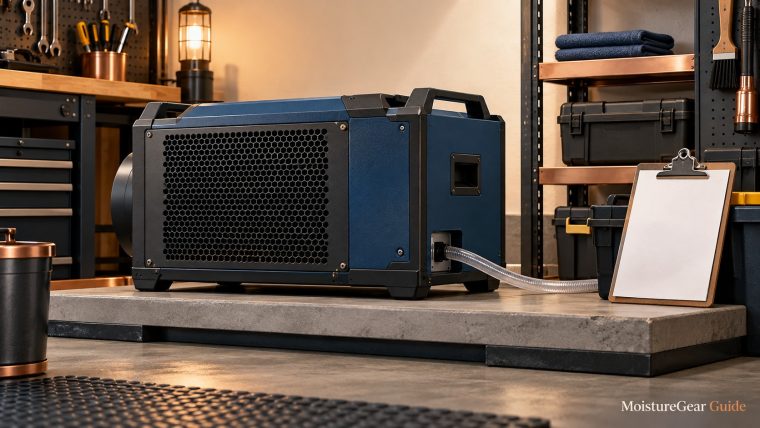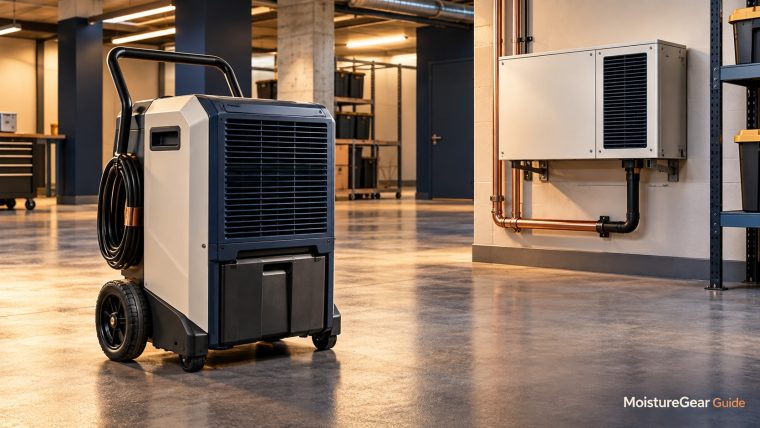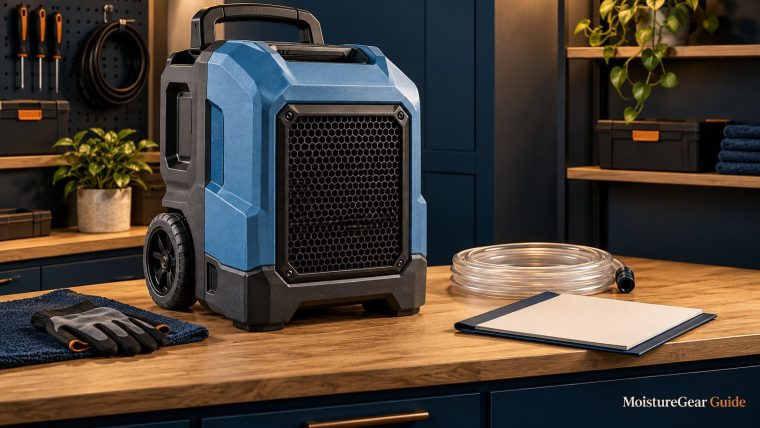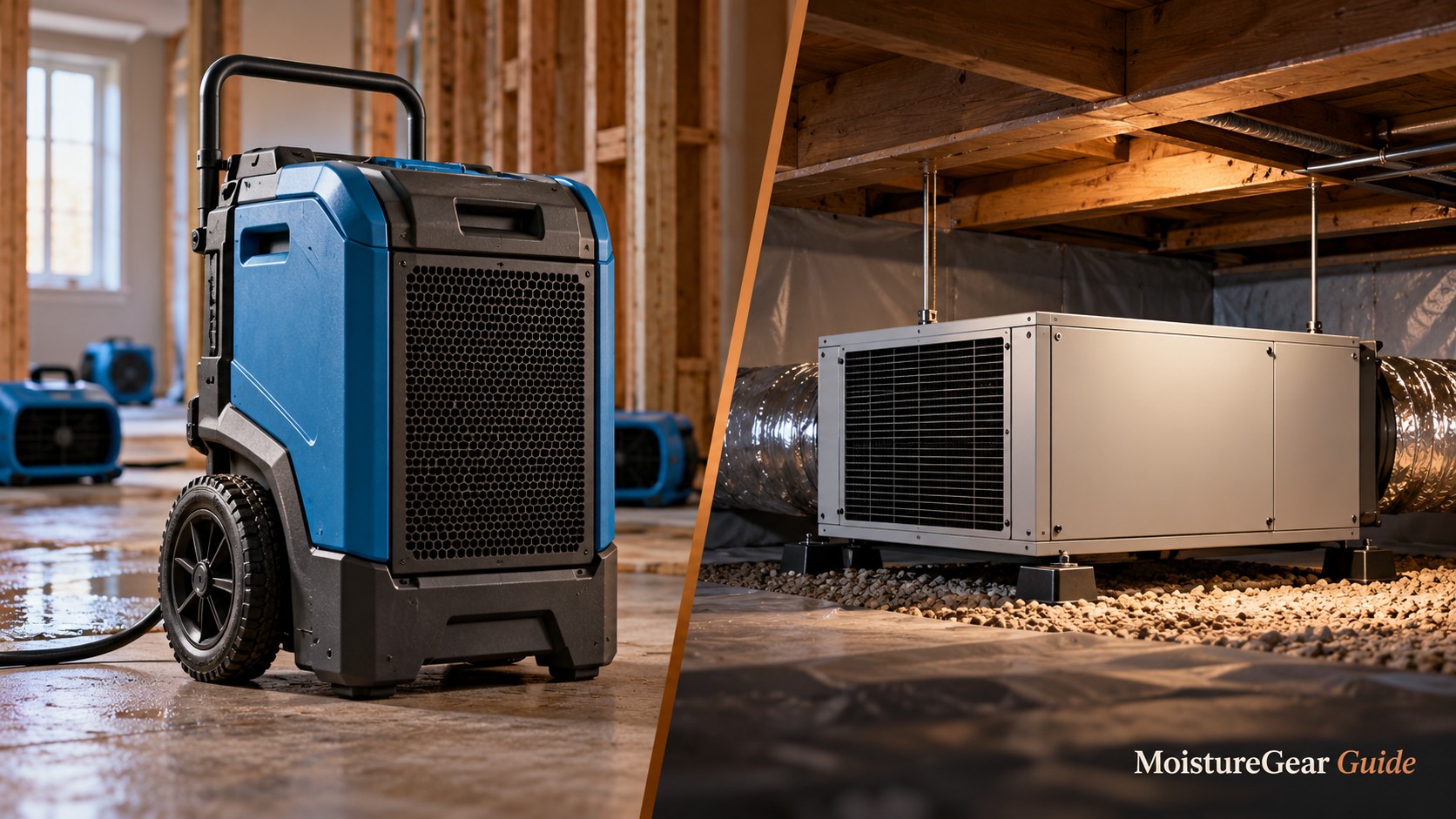
This AlorAir Storm LGR Extreme vs Sentinel HDi90 comparison is most useful when you first separate portable drying from an installed humidity-control role. Storm is marketed as compact LGR restoration equipment, while Sentinel HDi90 is offered in crawl-space and basement configurations. Their current reference capacities are close enough that the intended placement, controls, drainage, and supplied version can matter more than a small difference in the pint figure.
We compared current official product pages and available documentation. We did not run either unit in a controlled trial or measure drying speed, noise, power use, reliability, or software performance. For the larger equipment landscape, visit the commercial dehumidifier hub. For individual buying questions, our Storm review and HDi90 review provide separate research assessments.
Keep the exact configurations visible


| Comparison point | Storm LGR Extreme | Sentinel HDi90, built-in-pump page |
|---|---|---|
| Main official positioning | Compact restoration and drying equipment; LGR family | Crawl-space and basement humidity control |
| Current AHAM removal | 85 pints/day at 80°F/60% RH | 90 pints/day at 80°F/60% RH |
| Current published airflow | 210 CFM | 210 CFM |
| Current page cabinet dimensions | 22.8 × 13.7 × 17.3 inches, L × W × H | 23.2 × 15.2 × 17.7 inches, L × W × H |
| Drainage on compared pages | Condensate pump | Pump drainage |
| Options requiring identification | App and non-app listings | Built-in-pump, duct-able, and Wi-Fi descriptions appear separately |
| Evidence absent from this review | Independent extraction, noise, durability, and energy tests | The same independent tests |
The Storm non-app page, Storm app page, and HDi90 built-in-pump page were checked for this comparison. Historical documentation can differ. The table describes the current pages rather than certifying every retailer listing bearing these names.
The capacity difference is smaller than many titles suggest
At the shared AHAM condition, the current reference comparison is 85 against 90 pints per day. That does not establish a dramatic performance gap. It also does not prove that HDi90 completes a particular drying job sooner, because the reference point is only one environment and neither unit has been tested independently here.
Product titles may also use saturation capacities. Those larger numbers come from hotter, much wetter test air. Comparing one unit's saturation number with the other's AHAM rating is an invalid shortcut. The label beside the number is part of the specification, not fine print that can be ignored.
If you expect a room to be cool or to reach low vapor content during drying, ask for relevant performance information rather than extending the AHAM result to those conditions. Our saturation-versus-AHAM guide explains the difference, and the LGR comparison explains why late-stage performance needs its own evidence.
Why Storm can be the stronger starting point for mobile drying
Storm's restoration-oriented positioning makes it a logical candidate when a unit will be deployed for temporary drying assignments. The buyer should care about setup, compact storage, hose organization, controls, and access for inspection after each job. Those practical questions are different from choosing a cabinet that stays beneath one building.
A property operator moving a unit between a utility room, a vacant apartment, and a small commercial space needs a repeatable transport and shutdown routine. The machine must be compatible with the drying plan at each location. An integrated pump can be useful, but the route needs qualification every time the equipment moves.
Storm's LGR designation also gives a reason to investigate its behavior in drier conditions. This comparison cannot quantify that advantage against HDi90. It identifies the design category and intended use, then leaves claims of low-grain superiority to relevant testing or manufacturer evidence. A familiar technology name should not be turned into an invented head-to-head result.
Why HDi90 can be the stronger starting point for an installed role
The built-in-pump HDi90 is positioned for crawl-space and basement work. A permanent installation can be organized around humidity control, service access, a protected drain, and controls appropriate to the building. The requirement is steady management of an enclosure, rather than repeated packing and deployment between addresses.
That favors application-specific planning. If the moisture source has been addressed and the unit suits the enclosure, a fixed location can make inspections predictable. The installer can route condensate, allow filter access, and explain the control arrangement before the machine becomes difficult to reach.
However, installing a product beneath a building does not make maintenance optional. A poor location can leave the owner unable to inspect the connection or remove a filter. If the site cannot provide service clearance and a suitable route out later, a cabinet that physically fits may still be the wrong choice. Use the crawl-space placement guide to think through those constraints.
Two buying scenarios expose the real difference
Imagine a facilities owner who wants to keep one well-defined underfloor enclosure controlled throughout the humid season. The useful questions are the incoming moisture load, the target condition, airflow around foundations or divisions, drainage, and accessibility. HDi90 deserves a first look because that is close to its marketed role. Storm should enter the comparison only if its documented installation and controls meet the same needs.
Now imagine an operator who needs equipment for intermittent professional drying under an appropriate assessment. Storage in a vehicle, reaching different rooms, a clear shutdown process, and useful operating information become central. Storm deserves early attention because its product family is built around that assignment. HDi90's slightly higher reference rating is not enough to erase the working differences.
These are decision examples, not reports from our own tests or claims that one product is prohibited from every other use. The manufacturer's allowed installation and the actual environment decide suitability. Starting with the assignment simply prevents a capacity table from doing work it cannot do.
The drain requirement does not disappear with either choice
Both compared product pages describe pump drainage. That establishes the type of drainage on those pages, not an unlimited lift or permission to extend tubing however convenient. Obtain the manual matching the actual supplied generation and confirm the proposed route before purchase.
Specify the destination, vertical rise, total hose path, and how the end will be secured. A permanent route needs protection and ongoing access. A temporary route needs clear inspection and should not interfere with doors, exits, or normal site activity. A container can only work with an appropriate supervision plan.
We have not published numerical pump-rise guarantees for these current versions because matching current documentation could not resolve those figures with sufficient confidence. Our commercial pump guide shows what to request from the seller. If one offer cannot supply those answers, that is a practical disadvantage worth considering before checkout.
Small cabinet differences can matter at a hatch
The current Storm and HDi90 dimensions are close, but a constrained opening does not care whether the difference seems small on paper. Measure the narrowest point along the route, not only the final floor area. Account for fittings, handles, turning space, and any limits on the orientation during transport.
Then measure the service envelope. Space needed to remove a filter, access controls, check drainage, and eventually extract the equipment can exceed its bare cabinet dimensions. Do not set the machine where the drain connection is pressed against an obstruction simply to make it fit.
For repeated movement, consider the entire route from delivery vehicle to room. Both products still involve substantial handling. Use suitable assistance or equipment and follow the exact transport requirements. A comparison of lengths and widths is useful for fit; it is not a safe-lifting assessment or evidence that one person can carry either machine on stairs.
Treat optional controls as separate configurations
Storm's connected page describes an app arrangement with network and manufacture-date considerations. HDi90 also appears in separately described configurations, including Wi-Fi and duct-able versions. Do not assume those options are interchangeable add-ons included in the basic offer.
If connectivity matters, identify the exact panel, app, network requirements, and functions you need. A connected unit in a location with poor signal may not provide the oversight you expected. A controller that can be viewed remotely also does not automatically provide every kind of alarm or notification.
For an installed HDi90, remote control or room sensing may affect how the system is managed, but the proper arrangement depends on the specific model and allowed accessories. Ask for written confirmation of compatibility and inclusion. For a mobile Storm, a simpler non-app package can be sensible when remote functions will not be used or the jobsites do not have dependable connectivity.
Ducting has to follow the actual unit’s instructions
A seller's statement that a family is "ductable" should lead to questions about the exact configuration, approved collars, permitted duct arrangement, and necessary clearance. AlorAir lists HDi90 descriptions separately, and Storm pages mention ducting options. Neither observation makes every arbitrary connection appropriate.
Ducting changes resistance and circulation. An equipment airflow figure measured under one arrangement cannot be assumed to remain unchanged with a long or restrictive added path. An installer should establish the allowed layout and ensure the unit can circulate the air it needs to control.
For a building divided into areas, ducting may be useful when it is designed appropriately. It does not turn a portable unit into a whole-house installation by placing a hose near an existing return. Our ducted-versus-standalone guide explains the broader airflow choice and why the installation must match the manufacturer requirements.
Published temperature limits are not a head-to-head cold-room test
Current pages provide operating ranges that include cool conditions. A permitted minimum tells the owner where the manufacturer allows use; it does not show full rated extraction at that temperature. At lower temperatures, the available moisture and the refrigeration/defrost balance change.
Neither product is declared the better cold-space performer here because we do not have a controlled comparative curve covering the same conditions and generations. If the room normally stays cool, ask the manufacturer or supplier for information at that operating point.
The same principle applies to low-grain conditions. Storm's technology designation is relevant, but it is not a substitute for data describing the actual operating environment. Our cold-basement article helps frame the application questions without pretending that a lower minimum temperature proves higher useful capacity.
Running cost needs operating data, not a pint shortcut
An equipment capacity figure cannot produce a reliable electricity bill. Demand changes with temperature, humidity, compressor operation, fan behavior, and the time spent maintaining the target. The actual load entering the room matters as much as the machine's nominal size.
If you compare electrical specifications, match the exact unit and the conditions stated. Do not turn an amp figure into an unqualified wattage claim, and do not infer that the unit with higher reference capacity must cost less to operate. A correctly controlled installation may cycle while an enclosure with continuous moisture entry keeps either machine busy.
Use our running-cost guide to create a labeled estimate and improve it with suitable measured consumption where appropriate. Include delivery, drainage, accessories, maintenance, and service in the purchase calculation. These costs are more meaningful than an unsupported claim that one of the two products will pay for itself in a fixed period.
Noise, warmth, and the room around the machine
This comparison does not rank the two products for noise. The manufacturer descriptions do not provide a controlled, independent comparison in the same room and setting. Placement, resonance, distance, and the operating mode can all affect the experience.
A permanent unit beneath a building may transmit sound differently from a portable unit beside a working area. Ask how the actual location will affect people, then address placement and installation within the permitted arrangement. Do not promise silence from a cabinet measurement or a review written in another building.
Both machines remove moisture through refrigeration and discharge warmed air. That warmth can be relevant to a drying assignment and to comfort in an occupied room. Include it in the building discussion rather than expecting either product to serve as a cooling appliance.
Compare support on the complete offer
AlorAir's current warranty page distinguishes early full coverage from later refrigeration-system parts coverage for qualifying non-whole-house purchases. A headline warranty period is therefore not a complete comparison of pump, labor, freight, and removal costs.
Ask how the seller's relationship affects warranty eligibility, which documents are needed, and who arranges service. If a unit is installed in a difficult location, removal and reinstallation can matter. If the equipment moves between jobs, downtime can matter. Neither model receives an invented reliability score in this review.
Keep the receipt, exact product identification, seller confirmation, and relevant terms together. Our warranty guide explains the checks. The preferable offer may be the one with clearer support and the right configuration even when its equipment price is higher.
When neither model should be the immediate answer
If a building still has a leak or unaddressed water entry, diagnose and correct the source. A dehumidifier can manage vapor within its role, but it does not repair drainage defects, stop a pipe leak, or make contaminated materials safe. An ongoing source can also make equipment selection look like a capacity problem when it is really a building problem.
After significant water damage, establish safe electrical conditions and obtain appropriate assessment of the water source and affected materials. The EPA’s cleanup guidance explains why equipment is only one part of the response. Ordinary room-air humidity does not establish that hidden materials are ready to finish.
A one-time job may also favor rental and professional assistance over purchase. Our buy-or-rent comparison covers that question. Neither Storm nor HDi90 should be bought simply because a damp event creates urgency and the listing promises a large pint number.
Reconsider the choice if the assignment changes
A machine selected for one role should be reassessed before it is moved into another. A permanent installation becoming temporary drying equipment raises new handling, supervision, and drain questions. A restoration purchase left beneath a building raises different concerns about controls, access, and allowed installation.
Do not assume that an existing pump route or accessory package remains appropriate after relocation. Preserve the matching manual, identify the new enclosure, and qualify the new arrangement. The equipment label still tells you what machine you have; it does not approve every subsequent use.
This also matters when a property grows or its use changes. More inventory, closed-off rooms, longer door-opening periods, or a new moisture-generating activity can alter the load without changing the floor dimensions. Compare the revised assignment with the product's documented role, and obtain an appropriate assessment if the new requirement is uncertain. The original buying decision should be a record you can revisit, not a permanent assumption about every future building condition.
A practical choice between them
Start with HDi90 when the assignment is an application-specific installed humidity-control system and the exact configuration fits the design. Start with Storm when compact restoration-oriented deployment is central and its documented features fit the drying plan. Then qualify the model version, access, drainage, controls, and support in the seller's actual offer.
If the purchase-specific details are clearer for one option, that clarity can be more valuable than a small difference at a reference capacity point. Choose the configuration that solves the assignment and can be installed, operated, and serviced correctly.
Selected sources
- AlorAir Storm LGR Extreme non-app page
- AlorAir Storm LGR Extreme app page
- AlorAir Sentinel HDi90 built-in-pump page
- AlorAir current warranty information
- EPA flood cleanup guidance

About the author
Davis Murphy
Davis Murphy writes about dehumidifiers, indoor humidity, and home moisture control at MoistureGear Guide. His articles explain how to compare equipment, understand capacity ratings, and plan for drainage and maintenance. He focuses on clear, practical guidance to help readers choose a dehumidifier suited to their space and needs.