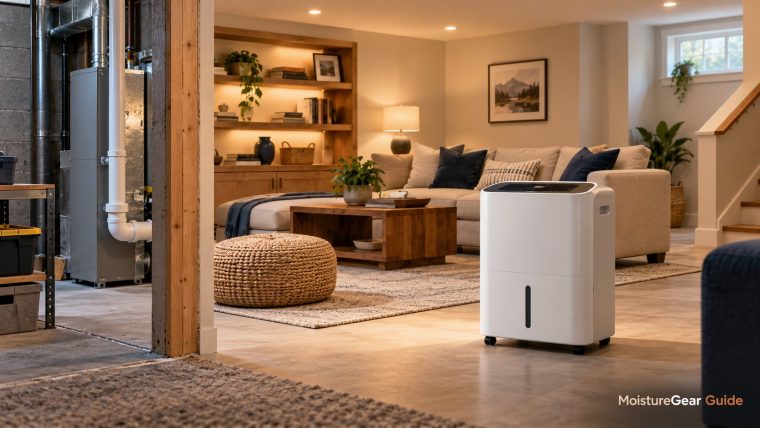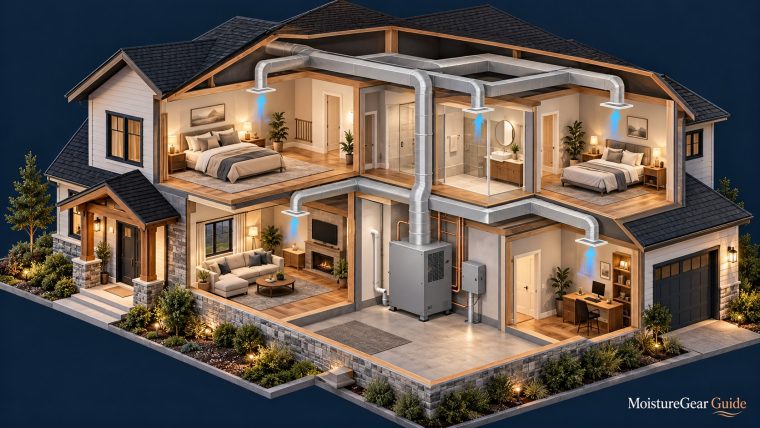
A whole house vs portable dehumidifier comparison should begin with where the humidity problem occurs. If one basement room stays damp while the occupied floors remain comfortable, a portable appliance may be sufficient. If several rooms need reliable moisture control through the humid season, a professionally designed whole-house system deserves consideration. The larger purchase is justified by the job it solves, not by a belief that permanent equipment is automatically better.
The two approaches also ask different things of their owner. A portable unit can be purchased and moved readily, but someone must manage its placement, drainage, filter, and settings. Central equipment shifts much of that work into an installation project, while leaving maintenance and monitoring to the homeowner. Understanding that difference prevents both unnecessary spending and a cheap purchase that becomes a daily chore.
What the labels actually mean
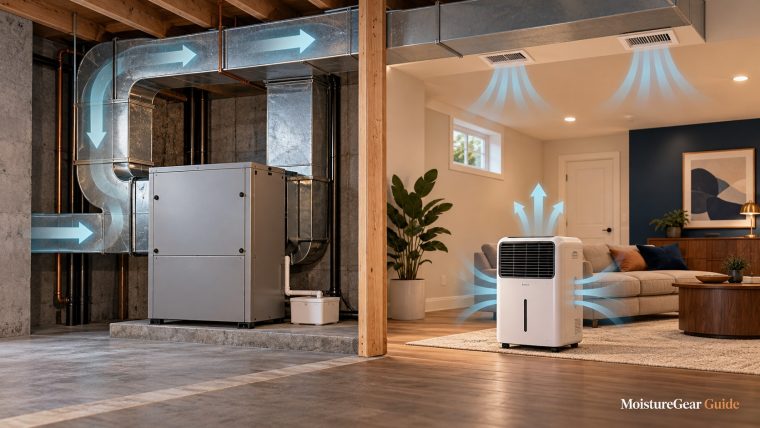
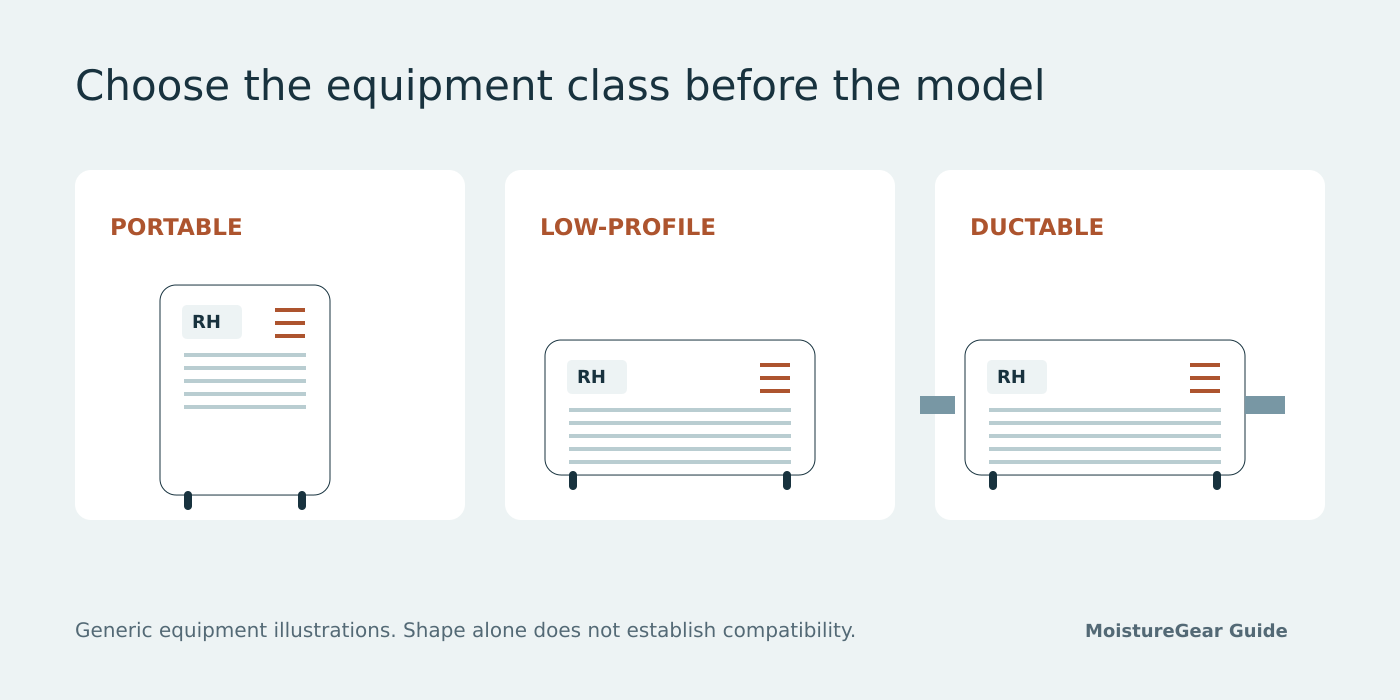
Portable dehumidifiers generally operate within the space they dry, taking in room air and returning warmer, drier air to that same space. Whole-home equipment is designed to operate with ducts that collect and distribute air. ENERGY STAR’s definitions distinguish the categories by how they are intended to operate, rather than by cabinet size or price alone.
A heavy dehumidifier placed in a basement is not necessarily controlling the whole home. It may be a permanent standalone installation serving that basement. Conversely, equipment with dedicated return and supply grilles can serve multiple connected areas without sharing every part of the central air-conditioning duct system.
This article compares the ownership choice: a room appliance or a planned central solution. The separate ducted versus standalone guide examines airflow layouts, including ways to use permanent equipment without integrating it into existing HVAC ducts.
There are also exceptions within the portable market. Some units support a hose, some have an integrated pump, and others rely on a removable bucket. Features must be verified on the exact model rather than assumed from the word “portable.”
The choice at a glance
| Your situation | Start by considering | Reason |
|---|---|---|
| One accessible room is consistently damp | Portable unit or permanent standalone unit | Direct treatment may solve the defined problem |
| High humidity appears across several rooms | Whole-house assessment | Distribution and control become as important as capacity |
| You rent and cannot modify ducts | Portable unit | Reversible placement fits the ownership constraint |
| You travel frequently | Reliable automatic drainage and monitoring | A bucket that fills while you are away interrupts drying |
| The house uses room-by-room cooling | Dedicated duct proposal or room units | There may be no usable central ducts |
| A foundation leak is active | Moisture-source investigation first | Equipment alone does not fix water entry |
These are starting points, not automatic purchase rules. A compact house with an open layout can behave differently from one with many closed rooms. A basement separated from the occupied floors may need its own solution even after a central unit is installed.
When a portable unit makes sense
A portable appliance is often the most proportionate answer to a localized issue. Suppose humidity is elevated in an unfinished basement but ordinary upstairs readings remain reasonable. Placing an appropriately sized unit in the affected area avoids buying duct work to serve rooms that do not need treatment.
It also makes sense when the ownership horizon is short. A renter or someone planning to move may prefer equipment that can come along. The purchase is easier to reverse, and a different location can be tried if the first location does not distribute air well.
Portable equipment lets you learn something about the problem too. Tracking room temperature, relative humidity, and operation after a placement change can reveal whether one open area responds well while a closed office stays damp. That observation helps distinguish a limited circulation issue from a larger moisture load.
The limits should remain clear. A successful trial in one room does not establish the required whole-house capacity. The first days of drying can involve moisture released from furnishings and building materials, and a short dry-weather trial may not represent the wet season. Treat the appliance as a practical solution or useful observation tool, not a substitute for a site-specific central design.
Our basement buying guide covers room and permanent options without assuming that the most expensive machine is necessary.
When a whole-house system is worth investigating
A central system becomes more compelling when humidity remains high throughout the occupied house, particularly during weather that does not demand much cooling. The thermostat may be satisfied while moisture continues to enter through ventilation and normal activities.
The Department of Energy discusses this mismatch in its hot-humid HVAC research. Reducing a home’s cooling load does not necessarily reduce its moisture load in the same proportion. That helps explain why a comfortable indoor temperature can coexist with an uncomfortable level of dampness.
Whole-house dehumidification allows humidity control to be planned independently of a call for cooling. The system still needs suitable equipment capacity and distribution. A dehumidifier connected to central ducts will not automatically solve closed-room airflow or a disconnected basement.
The strongest case is a recurring, documented problem across served rooms, combined with a workable installation location, drainage route, and support plan. An installer should explain the proposed humidity-control strategy in ordinary language: where air enters, where drier air leaves, which fans operate, and where humidity is sensed.
See the whole-house equipment shortlist after those system requirements are clear.
Compare capacity without mixing test conditions
Portable and central models often carry different kinds of capacity labels. A 50-pint room unit and an 80-pint central unit should not be compared as if both numbers were measured in the same room.
ENERGY STAR’s testing explanation describes the cooler temperature used for current portable testing and why newer capacities can look smaller than older figures. Central equipment is a separate class. Manufacturer pages may also publish warm-condition ratings for their whole-house products.
A defensible comparison records the measurement conditions beside each figure. If those differ, consult the appropriate performance information rather than multiplying one capacity by an assumed conversion factor.
Actual removal will vary with inlet air conditions and the humidity target. A unit rated at relatively warm, humid conditions does not remove its headline capacity from cool air already close to the desired setpoint. That is ordinary operating behavior, not necessarily a defect.
For a permanent installation, the contractor should size the equipment against the site's moisture load. For a room appliance, use category-appropriate sizing guidance and the model's allowed temperature range. The whole-house sizing article explains what information goes into the broader assessment.
One unit versus several: look at the workload
Several portable appliances can be a reasonable choice when rooms are separate and no duct route is practical. They can also create a collection of small tasks: cleaning multiple filters, checking several hoses, setting different controls, and remembering which unit is off because its bucket filled.
Central equipment reduces the number of machines in occupied rooms, but it concentrates dependency in one installation. If that unit needs service, the served area loses its dedicated moisture control. The practical comparison is therefore the complete operating arrangement, not merely the sum of pint ratings.
Consider how you use the rooms. A utility room may tolerate compressor and fan noise; a bedroom used for sleep may not. Moving a portable appliance into the hallway can reduce its nuisance while weakening treatment of a closed room. A properly designed duct system can locate machinery elsewhere, although grilles and ducts can still transmit sound.
Do not assume the central solution is silent. Request noise information for the proposed installation and avoid comparing ratings obtained under unspecified conditions. The noise you experience depends on the equipment, support, air velocity, barriers, and location.
Drainage can decide the ownership choice
A bucket arrangement is simple to understand, but it requires attendance. Once the bucket fills and the appliance stops, the drying job pauses. How often that happens depends on bucket capacity and the water actually being collected.
A hose reduces the emptying task only if the drain arrangement is dependable. Gravity drainage needs an appropriate downhill route and an approved destination. A pump can overcome an elevation problem, but it also needs maintenance, power, and protection against overflow.
Whole-house systems commonly use a permanent drain or an accessory pump. They should be designed so that a blockage is noticed and handled before water damages a finished surface. An attic installation has different consequences from one on a suitable basement floor.
A portable model with a pump may therefore fit an unattended basement better than a bucket model with otherwise impressive specifications. A central installation with poor drainage can be worse to own than either. Compare the complete condensate path using our gravity versus pump guide.
Do not improvise a drain connection merely because a sink or sump is nearby. The installer should verify the destination and local requirements.
Purchase price is only one part of the budget
Portable equipment usually has a smaller initial project scope because it does not require central duct work. That does not establish a universal operating-cost advantage. Multiple appliances may run many hours, while a larger installed unit may follow a different duty cycle.
A whole-house proposal should itemize equipment, controls, ducts, mounting, drainage, electrical work, and commissioning. A cabinet sold online may exclude several of those items. Compare the complete quote with the complete portable arrangement, including any pump or practical monitoring accessories.
There can be costs associated with appearance and floor space as well. A room unit occupies a usable area and may require a visible hose. A central unit can be located in a mechanical area, but creating service access in a finished home may be expensive.
Do not justify a project with an assumed percentage reduction in air-conditioning bills. Drier air may change how you choose to operate cooling, but that does not provide a guaranteed net saving. The electricity-cost guide uses power, runtime, and your local rate to build an explicit estimate.
For purchase and installation budgeting, use the whole-house cost worksheet approach instead of a single national installed-price claim.
Installation and warranty responsibilities differ
A portable appliance normally leaves the owner responsible for routine placement and operation according to its instructions. A central system asks an installer to make design choices that affect performance. Ask about support before sourcing the equipment separately.
Some contractors prefer to supply and install the unit together. Others will install owner-supplied equipment under a clearly defined scope. Neither arrangement should be assumed. A lower online price loses its appeal if no local contractor will support the exact product or the purchase route complicates warranty coverage.
The manufacturer's warranty is also distinct from the contractor's labor warranty and the seller's return policy. Replacement parts might be covered while removal, shipping, or reinstallation are not. The applicable terms can vary by product family and purchase date.
Preserve invoices, model and serial information, the installer’s details, and the matching manual. The warranty and authorized-seller guide describes the questions to ask before deciding that a prominent warranty length settles the comparison.
For central equipment, arrange commissioning and a follow-up performance discussion. The installation should be handed over as a working humidity-control system, not simply as a plugged-in cabinet.
Measure rooms before choosing the larger system
Place humidity sensors where they can observe normal room conditions, away from a dehumidifier outlet, direct sun, or a temporary moisture source. Record temperature with relative humidity; a change in temperature can move the RH reading even without adding or removing water vapor.
Compare the affected room with at least one ordinary occupied area. In a multi-level home, include locations on each level and note whether doors are open or closed. Record recurring peaks, not just a convenient snapshot.
A brief shower-related rise that settles is different from a hallway and bedrooms remaining damp for long periods. A cool basement can also show a higher RH reading than a warmer room with similar water vapor content. Those observations make the contractor’s assessment more informative.
The EPA guide recommends keeping indoor humidity below 60% and, where possible, around 30–50%. The suitable target for a particular building should also account for climate, temperature, materials, and comfort. Do not respond to every high reading by selecting the lowest available setting.
Three examples that change the recommendation
A rental apartment with one damp utility area: Begin with the moisture source and landlord responsibilities. If an appliance is appropriate, a portable unit with allowed placement and a manageable drain or bucket routine suits the limited authority to modify the home. A whole-house installation is unlikely to be the first decision.
An occupied house that is cool but clammy across several rooms: Document readings and have the cooling system, ventilation, and enclosure considered. If recurring vapor load remains, central dehumidification may address a problem that room appliances would treat only in pieces.
A house with a damp basement and dry upstairs rooms: Avoid interpreting “whole-house capable” as a requirement to connect the basement unit to every room. A dedicated basement installation may be sufficient, while foundation drainage or moisture-source work remains a separate project.
These examples are decision illustrations, not test results or descriptions of actual customer homes. Their value is showing why the geography of the moisture problem matters.
What happens after installation
Portable owners should check that the unit can circulate air, the filter is accessible, and the bucket or drain arrangement performs as expected. Compare humidity in the room over several ordinary operating days and note changes in temperature.
Central owners should receive control instructions, maintenance information, and an explanation of the served spaces. Verify that drainage protection, if included, was tested, and ask which readings will indicate acceptable performance during humid weather.
If one room remains damp while others improve, report that pattern rather than simply lowering the setting. It could reflect air distribution, a local moisture source, or a measurement issue. If the entire served area remains high, record runtime and relevant conditions so the installer can investigate the design and equipment.
A good ownership plan includes easy access to the drain and filter, a clear service contact, and enough monitoring to recognize changes. You do not need an elaborate smart-home system to notice a hose leak or persistent humidity in a closed bedroom.
Which approach should you choose?
Choose a portable dehumidifier when its treatment area matches the problem and its day-to-day tasks fit your routine. Choose a whole-house assessment when humidity is widespread, recurring, and better addressed through a planned distribution system.
A permanent standalone unit can occupy the middle ground: robust equipment serving one basement or enclosure without a complete central retrofit. That option is often overlooked when the discussion is framed as a contest between cheap appliances and expensive whole-house systems.
Use the whole-house hub to compare layouts, capacity, costs, and models once the treatment area is defined. The right answer should explain what the equipment will accomplish in your home, how condensate will leave, and who will keep the installation working.
Selected sources
- ENERGY STAR product categories and efficiency criteria
- ENERGY STAR testing and capacity guidance
- DOE advanced HVAC humidity-control research
- EPA moisture-control guidance
About the author
Davis Murphy
Davis Murphy writes about dehumidifiers, indoor humidity, and home moisture control at MoistureGear Guide. His articles explain how to compare equipment, understand capacity ratings, and plan for drainage and maintenance. He focuses on clear, practical guidance to help readers choose a dehumidifier suited to their space and needs.