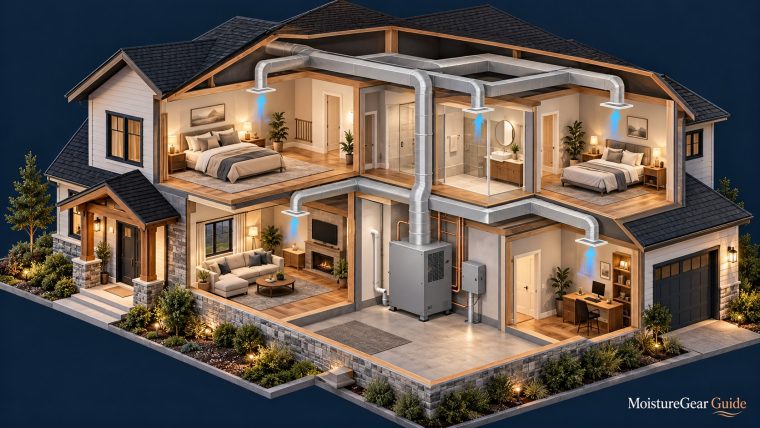
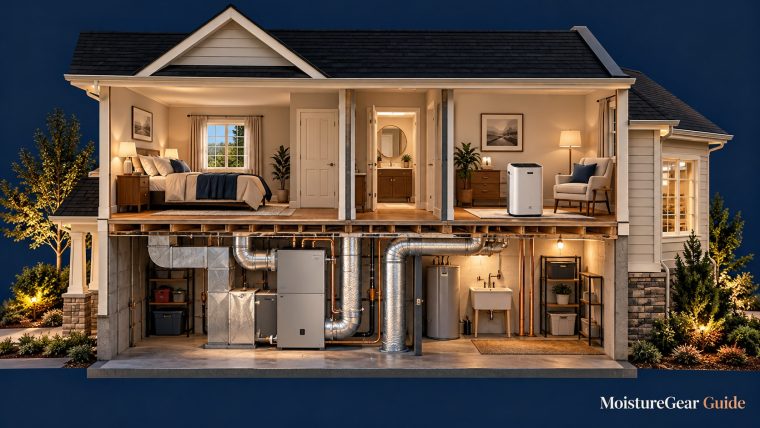
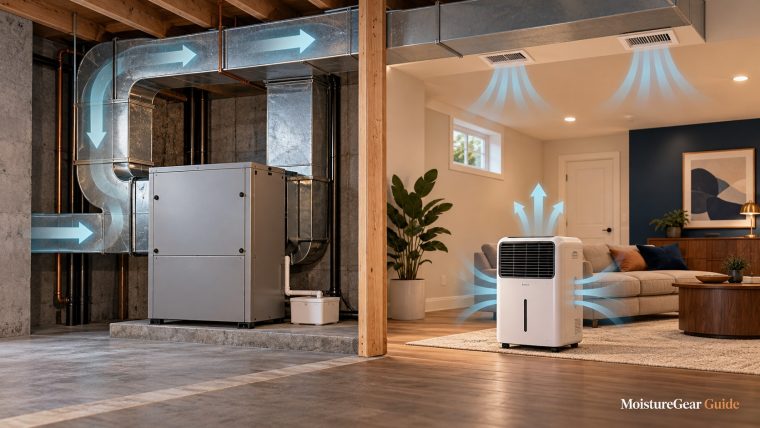
Whole house dehumidifier cost includes more than the price of the cabinet. The equipment, controller, duct work, condensate route, electrical supply, installation labor, and commissioning all belong in the initial budget. Electricity, filter care, and service belong in the ownership budget. An online equipment price can be useful, but it cannot tell you what a working system will cost in your particular home.
The best way to compare offers is to separate those expenses and ask each contractor to price the same scope. This guide uses a dated manufacturer price as context and clearly labeled arithmetic examples for planning. The example numbers are not national averages or promises of what an installer will charge.
An equipment-price example, with its limits
On October 13, 2026, AlorAir's Sentinel WHD120 manufacturer page displayed an equipment sale price of $1,699. That is a snapshot of one whole-house product on one manufacturer’s site. It does not establish the Amazon price, the price tomorrow, or the installed cost of that model.
The listing also illustrates why model names need scrutiny: “WHD120” is the product-family name rather than a guarantee of 120 pints per day under every condition. Select the equipment by its matching documentation and application requirements before using its price in the budget.
Other manufacturers may direct homeowners to professionals rather than display a simple equipment checkout price. A contractor-supplied AprilAire or Santa Fe proposal may include design, accessories, delivery, and support responsibilities. Ask for those inclusions instead of assuming every difference from an online listing is an equipment markup.
Use our whole-house shortlist to identify the relevant equipment class. This article explains how to budget once that shortlist is consistent with the space being served.
Build the budget in separate layers
| Budget layer | What to identify | Why a missing item matters |
|---|---|---|
| Equipment | Exact model, generation, controller, included accessories | Similar names can describe different configurations |
| Air distribution | Ducts, grilles, dampers, insulation, sealing | A cabinet without an air path cannot serve the intended rooms |
| Drainage | Pipe or hose, pump if needed, destination, protection | A low equipment price can omit the complete condensate arrangement |
| Power and controls | Outlet or circuit work, control wiring, interface setup | Existing electrical and thermostat arrangements may not fit |
| Labor and commissioning | Mounting, connections, checks, owner handover | A installed cabinet is not the same as a verified system |
| Ownership | Electricity, approved filters, inspection, service | Initial price does not represent the whole expenditure |
This framework works for a central retrofit, a new build, or a permanent standalone installation. The amounts change with the project, but the questions remain useful.
Equipment bundles: compare the actual boxes
A dehumidifier can be quoted alone or bundled with a controller, hanging kit, pump, or duct accessories. Those combinations are not interchangeable. Start by requesting the manufacturer's model number for every significant item.
For example, Santa Fe's Ultra98 and Ultra120 documentation describes an external control requirement. An equipment-only offer that excludes the control cannot be compared directly with a proposal including the selected controller and its installation. Similarly, a Wi-Fi model does not eliminate the need for a properly designed air path or suitable drainage.
A supplied duct collar is not installed duct work. A barbed drain fitting is not a complete condensate line. A power cord is not proof that the proposed location has the appropriate electrical supply. Clarifying these distinctions early prevents the project from expanding through small unquoted additions.
Check whether delivery, tax, difficult access, and removal of existing equipment are included. Ask who handles damage found when the box is opened and whether the installer wants the shipment inspected before the scheduled visit.
The ducted versus standalone article can help define which installation components are relevant rather than paying for a central arrangement you do not need.
Why installation prices vary so much
An accessible mechanical room with a suitable drain and short permitted duct route creates a different job from a finished house where grilles, wall openings, and longer duct runs must be added. Cabinet price may be similar while labor and materials differ greatly.
Access affects more than the time required to carry the machine. A narrow hatch, a difficult attic route, or the need for a support platform can change the mounting design and future service costs. The contractor should consider how the unit will be removed as well as how it will be installed.
Existing HVAC conditions can also affect scope. The selected integration arrangement may require additional dampers, a control interface, or changes to avoid recirculating dehumidified air directly back into the inlet. Existing ducts may need attention before the new equipment can perform as intended.
Drainage adds another site-specific component. A nearby appropriate drain can make a gravity arrangement straightforward. A destination above the outlet can require a pump and tubing, plus an overflow-protection strategy suited to the installation location.
Finally, local labor rates, permitting, electrical requirements, and the contractor's support offering vary. A universal installed-price band conceals these differences. Ask for two or three itemized proposals for the same design scope when practical.
A transparent project-budget example
The following is an arithmetic exercise, not a market quotation. It shows how to avoid treating the cabinet price as the project total.
| Hypothetical item | Planning amount |
|---|---|
| Dehumidifier equipment | $1,800 |
| Controls and installation materials | $500 |
| Drainage and mounting materials | $250 |
| Installation and commissioning labor | $1,200 |
| Initial subtotal | $3,750 |
| Illustrative 10% contingency | $375 |
| Planning total before tax or excluded work | $4,125 |
Every amount in this table is an assumed input. A real quote could be higher or lower, could include tax, or could combine several rows. The purpose is to make the scope visible and make the arithmetic inspectable.
Replace the equipment line with the exact offered price and replace the other lines with itemized local quotes. Use a contingency only for genuinely uncertain scope; it is not a license to accept vague proposals. If electrical work or finishing repairs are excluded, give them separate lines rather than pretending the contingency covers everything.
You can make the same worksheet for a portable or standalone alternative. Our whole-house versus portable comparison explains when the simpler ownership arrangement may be sufficient.
Questions that make proposals comparable
Ask each contractor to identify the space being controlled and the expected humidity-control strategy. Is the unit drying one basement, taking air from living rooms, or serving multiple zones? Two quotes describing different treatment areas are not competing offers for the same result.
Request the model and document revision used for sizing. A generic statement that the equipment “covers” the floor area is less informative than an explanation of moisture load, airflow, and operating conditions. The sizing guide gives you the site information to prepare.
Ask whether the central HVAC blower runs during dehumidification, whether outdoor-air ventilation is included, and where the controlling humidity measurement comes from. Those choices affect both performance and electricity consumption.
Then ask about commissioning and follow-up. The proposal should state who verifies drainage, controls, airflow, and any protective switches. Clarify whether a return visit to assess persistent humidity is included or charged separately.
The contractor should also distinguish equipment warranty handling from labor coverage. Request the process for a fault in year one and for a fault after the installer’s labor warranty ends. Written answers are easier to compare than broad assurances.
Running cost: start with watts and hours
A simple electricity estimate is:
Monthly electricity cost = input watts ÷ 1,000 × operating hours per day × days in the month × price per kWh.
For an explicitly assumed 700-watt input, eight hours of daily operation, a 30-day month, and an illustrative electricity rate of $0.18/kWh, the estimate is 168 kWh and $30.24 for that operating mode.
If the same assumed unit runs 16 hours per day, the estimate doubles to 336 kWh and $60.48. These are examples of arithmetic, not predictions of a particular product's real consumption.
Runtime is the large unknown. It changes with humidity setpoint, weather, moisture entry, occupancy, and initial drying. Some energy is used during sampling, standby, or fan-only operation, so a compressor-hours estimate may not include every mode.
Use published watts measured under identified conditions or actual measurements where appropriate. Multiplying nominal volts by current does not necessarily give the same value as measured real power. The electricity-cost guide covers how to use defensible inputs.
Include the central blower when the design requires it
A central installation can operate another fan in addition to the dehumidifier's own blower. Whether that happens depends on the duct arrangement and control design.
Ask the installer to explain the fan sequence and identify a reasonable energy input for the proposed operating mode. Do not silently add an assumed fixed blower load to every system, and do not ignore it when the design depends on extended central fan operation.
The same attention applies to ventilation. Bringing outdoor air into the home can add moisture under humid conditions, which affects the amount of dehumidification needed. A ventilation function is useful only when it is designed for the home's air-quality requirements and climate; it is not free drying.
ENERGY STAR’s whole-home guidance emphasizes correct sizing, installation, and enclosure performance. That supports budgeting for a system rather than making cost claims from an isolated appliance specification.
An efficient cabinet placed in a poorly designed installation can still create a disappointing ownership bill. Establishing the airflow and controls is therefore a cost decision as well as a performance decision.
Initial drying is different from steady operation
When a damp house first receives dehumidification, the system may run longer while air and moisture-holding materials move toward the new conditions. It would be misleading to use that first period as the only estimate of a normal month.
The reverse mistake is using a mild, dry week to predict peak-season consumption. Record enough context to distinguish startup, ordinary operation, and unusually humid weather. Note indoor temperature and RH along with runtime.
AprilAire's owner FAQ discusses extended initial operation as materials release moisture. That explanation does not mean constant operation should always be ignored. If humidity remains high or behavior changes abruptly, the system needs review.
A useful operating record includes the target setting, observed readings in representative rooms, changes in occupancy, and any periods when drainage or filters needed attention. This helps the contractor assess whether the workload is expected.
Avoid estimating water removal from the amount you think the drain “should” discharge. A rated capacity is conditional, and collection during a particular day reflects that day's inlet conditions and operation.
Maintenance costs and avoidable service visits
Maintenance expense includes the owner's time as well as replacement parts. A washable filter still needs access and appropriate cleaning. A disposable filter needs the correct replacement, and a more restrictive substitute can change airflow.
Plan an accessible route to the filter and drain at the installation stage. The cost of moving shelving or opening a sealed panel every time maintenance is required should not be treated as normal ownership.
Use the specific manual to establish owner tasks and professional service tasks. Drain inspection and approved filter care may be ordinary maintenance; opening electrical or refrigeration components is not a routine homeowner cost-saving measure.
Keep product identification and support information near the equipment or with the household records. If service is needed, being able to provide the exact model, serial number, symptoms, and installation date can avoid unnecessary confusion.
A paid maintenance visit should have a stated scope. Ask whether it includes drainage inspection, filter service, controls, and performance observations. An inexpensive visit that does not examine the relevant parts of your installation may not provide the value you expect.
Warranty coverage is not the same as a zero-cost repair
A warranty can cover a defective component while excluding the labor and access costs required to repair the installed system. Shipping, removal, and reinstallation can matter when equipment is large and difficult to move.
AlorAir's published warranty policy has a separate whole-house section rather than using the same wording for every dehumidifier. Other manufacturers also describe eligibility and exclusions in product-specific terms. Read the applicable policy for the purchase date and model.
Current promotional copy and an older specification sheet may use different warranty lengths. That is a reason to obtain the current terms, not a reason to select whichever wording is more favorable. Ask the manufacturer to confirm coverage for the seller and supplied unit.
The installer may offer its own labor warranty or service arrangement. Request it separately and record when it starts. Our authorized-seller and warranty guide explains the distinctions that affect the financial result.
Can a whole-house system pay for itself?
There is no general payback period that can be calculated from the equipment price alone. The value may be improved humidity control, less manual work, or protection of a space whose moisture problem has been properly addressed.
A claim that a dehumidifier will lower cooling costs enough to cover itself needs actual assumptions about cooling operation, fan energy, dehumidifier consumption, and the before-and-after system. This guide does not make that promise.
If you want a financial comparison, calculate annual equipment operating cost for each proposed arrangement using the same humidity objective. Include multiple portable units, central fans where required, and maintenance. Keep purchase cost separate from annual operating cost.
Also identify the consequence of interruptions. A bucket that fills during travel or a difficult drain inspection can make a low purchase price inconvenient. Those practical issues do not justify any price at all, but they belong in a realistic ownership decision.
Your next step
Gather room humidity observations, confirm the moisture source, and ask for an itemized proposal describing the exact served spaces. Use the dated equipment example only as context; obtain current prices and local installation terms before committing.
A sound budget explains where the money goes and what the completed system will do. The whole-house dehumidifier hub connects the sizing, layout, product, and ownership guides so those decisions can be made together.
Selected sources
- AlorAir Sentinel WHD120, equipment-price snapshot checked October 13, 2026
- ENERGY STAR whole-home buying guidance
- AprilAire owner FAQs
- AlorAir product warranty policy
About the author
Davis Murphy
Davis Murphy writes about dehumidifiers, indoor humidity, and home moisture control at MoistureGear Guide. His articles explain how to compare equipment, understand capacity ratings, and plan for drainage and maintenance. He focuses on clear, practical guidance to help readers choose a dehumidifier suited to their space and needs.