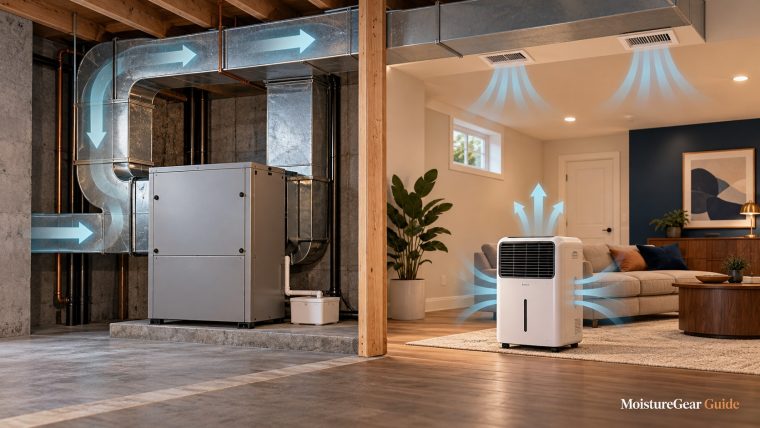
The best whole house dehumidifier is the one that removes your home's moisture load through an airflow system that actually reaches the rooms you want to dry. A high pint rating helps only when the rating conditions, duct design, drainage, and control location fit the installation. For many buyers, the most useful shortlist starts with AprilAire's E080 and E100 families and Santa Fe's Ultra series, then narrows according to the installer’s assessment rather than an advertised square-foot limit.
A central moisture-control system is a substantial purchase. The cabinet is only part of it: duct connections, a humidistat, condensate handling, electrical work, commissioning, and future access can decide whether an apparently good deal makes sense. This guide compares documented features and explains the buying decisions that often receive too little attention.
How we selected these options: This is a research buying guide based on manufacturer-authored specifications and installation documentation checked in October 2026. We have not measured these products in a test home. Recommendations below identify suitable applications; they do not claim independently tested drying speed, sound, reliability, or savings.
Start with these four installation questions
Before choosing a brand, write down the space you expect the dehumidifier to serve. A sealed crawl space, one basement, and the occupied rooms of an entire house are different jobs. Equipment sold for several applications can perform each job only with the appropriate placement and air path.
Next, establish whether the problem is recurring water vapor or an unresolved liquid-water source. Moisture after showers or humid-weather ventilation is a different buying problem from a leaking foundation. A dehumidifier can control air humidity while a leak continues, but that does not mean the building problem is resolved. The EPA moisture guidance treats correcting the moisture source as a separate priority.
Third, decide where condensate will go. Most central equipment does not include a collection bucket intended for daily emptying. A gravity outlet needs a suitable drainage arrangement; water that must rise to its destination needs an appropriately selected pump. A pump is an accessory on some models and part of the machine on others. That distinction changes both purchase cost and service planning.
Finally, ask who will install and support the equipment. A seller, an installer, and a manufacturer have different responsibilities. Confirm that the installer is willing to work with the exact model you plan to purchase and that the purchase route satisfies its warranty requirements. Our whole-house cost guide provides a quote checklist you can use before ordering.

A practical shortlist
| Option | Why it belongs on the shortlist | Main buying reservation |
|---|---|---|
| AprilAire E080 / E080W | Compact cabinet family for installations with a documented moderate moisture load; W version adds connected control | Confirm actual version, rating sheet, and warranty terms |
| AprilAire E100 / E100W | Additional published capacity within the same nominal cabinet footprint as E080 | Higher capacity does not cure a poor return or supply path |
| Santa Fe Ultra98, current R454B version | Dedicated whole-house ventilation model with external control and MERV 13 filtration | Budget for controls and verify current versus legacy documentation |
| Santa Fe Ultra120, current R454B version | Higher-capacity alternative within the Ultra series | Cabinet, filter access, duct resistance, and accessories need careful planning |
The table is a shortlist, not a universal ranking. A model can be the sensible choice in one home and an unnecessary expense in another. Compare the relevant capacities in the following sections, then use the sizing guide to organize the site information your contractor needs.
AprilAire E080 family: for a defined load without buying excess capacity
The E080 is a reasonable starting point when an installer has established that its available moisture removal will meet the design load. It has a built-in humidity control and a washable filter, making it a different ownership proposition from a room unit that depends on someone emptying a bucket. Both ducted and suitable standalone applications appear in AprilAire documentation.
The manufacturer-authored E080 specification sheet, revision October 2025, reports 80 pints per day at 80°F and 60% relative humidity, and 65 pints per day at 73°F and 60% RH. The latter number helps explain why a product marketed as an 80-pint unit should not be assumed to remove 80 pints every day in ordinary indoor conditions. Capacity is a laboratory reference, not a promise for every room temperature.
The E080W adds built-in Wi-Fi and integration with AprilAire's Healthy Air app. Connected control can be valuable when the unit sits somewhere inconvenient to visit, but it should come after the airflow and drain design. A phone display cannot tell you that every bedroom has a good return path.
For installation drawings and exact current details, use the E080 manufacturer specification sheet and the official E080W product page. The sheet is a manufacturer publication hosted by a distributor. Check the revision against the unit supplied.
AprilAire E100 family: when the load justifies the step up
The E100 is worth considering when the E080's capacity margin is insufficient under the conditions your home will actually present. The current non-W E100 specification sheet gives 100 pints per day at 80°F/60% RH and 85 pints per day at 73°F/60% RH. That is a useful comparison with the E080 because both sheets supply values at the same two temperature and humidity points.
Both non-W models are listed with the same nominal cabinet dimensions, so the higher-capacity choice may avoid a change in cabinet footprint. It still requires a fresh check of duct performance, operating current, handling, clearances, and installed configuration. “Same size” is not permission to substitute equipment without review.
The E100W is the connected alternative. Avoid treating every listing containing “E100” as interchangeable. Casters, hardwiring, accessories, Wi-Fi, and revisions can differ. The manufacturer's current E100 specification sheet and E100W page provide separate references. Our E080 versus E100 comparison explains the capacity decision in more detail.
Santa Fe Ultra98: for a planned ventilation and humidity system
The current Ultra98 is a whole-house ventilating dehumidifier with an external control requirement and a MERV 13 filter. It deserves consideration when humidity control is being designed alongside outdoor-air ventilation rather than added as an isolated appliance. The relevant question is whether your contractor wants its available control and duct arrangement for the project.
Do not infer the exact pint capacity from the “98” name. Santa Fe's current product information reports 100 pints per day at 80°F/60% RH and 71.4 pints per day at 73°F/60% RH. The manufacturer offers documents for both R454B and older R410A versions. A search result for an older Ultra-Aire model may therefore contain different figures.
For this selection, use the current Ultra98 page and the matching refrigerant-specific manual. Ask whether the quoted package includes the desired wall control, ventilation damper, duct collars, and condensate solution. The filter rating is a documented feature, but it does not by itself establish better room humidity or an independent air-cleaning result.
Santa Fe Ultra120: additional capacity with a larger installation envelope
Santa Fe's current R454B Ultra120 data sheet reports 118 pints per day at 80°F/60% RH and 88 pints per day at 73°F/60% RH. This makes it an alternative to discuss when a smaller central unit lacks margin. Its part name does not mean it always removes exactly 120 pints in a house.
The Ultra120 also requires an external control and provides a ventilation connection. Its installation planning deserves particular attention in a finished retrofit. Think about the complete cabinet-and-duct envelope, not simply the length printed on a shop page. The filter needs to come out, the drain must be accessible, and the unit may eventually need to leave through the same opening used to install it.
The R454B Ultra120 data sheet is the appropriate reference for this version. Older documents may give different capacities. If a contractor specifies the Ultra120, ask for the document revision and model identification on the quote.
Why AlorAir needs a separate model-by-model check
AlorAir sells several Sentinel lines, including HDi90 products used in crawl spaces and basements and a separate WHD range marketed for whole-house installations. These should not be collapsed into a single “AlorAir commercial dehumidifier” alternative.
The HDi90's published maximum rating under very warm, wet saturation conditions is not directly comparable with a central unit's rating at a lower temperature. A ductable cabinet is also not automatically a complete central HVAC solution. Confirm the allowed duct arrangement, external controls, pressure limits, and drainage on the exact supplied variant.
The Sentinel WHD100 page provides a separate whole-house reference, but the model name and its displayed rating table require careful reading. We would ask an installer to resolve the supplied version and performance documentation before placing it above the more fully documented options in this shortlist.
For brand and model-family context, read AprilAire versus AlorAir. For a crawl-space pump application rather than central distribution, the HDi90 research review is the relevant starting point.
Compare water removal at the same conditions
A capacity comparison needs three labels: the pint figure, the inlet temperature, and the inlet relative humidity. Without those labels, a larger number may simply describe a wetter test environment.
Use the current non-W AprilAire sheets and current Santa Fe sheets to compare the stated reference points. Do not substitute a portable unit's DOE rating at a cooler test temperature into the same column and interpret the difference as a direct measure of performance. ENERGY STAR explains the capacity-test changes and the distinction between portable and whole-home equipment.
Your installer also needs performance at the intended operating conditions. A house maintained cooler than the published rating point may present a different load and different available removal. An aggressively low humidity target also changes the problem. The headline figure is most useful as an initial comparison, followed by a model-specific assessment.
That is why a recommendation based solely on floor area is weak. Air leakage, ventilation, occupancy, indoor moisture generation, ceiling height, and the behavior of the cooling system all matter. Two homes with the same floor plan can require different equipment.
Ducting determines how much of the house benefits
A central dehumidifier needs both a collection path and a delivery path. The inlet must receive air representative of the areas being controlled, and the outlet must distribute drier air without immediately feeding it back into the inlet.
There are several possible arrangements, including dedicated grilles and integration with existing HVAC ducts. Their suitability depends on the manufacturer's instructions and the existing system. Do not select a return-to-return arrangement because a generic diagram looks easy; fan operation and pressure relationships must be reviewed.
Doors can change the result. A closed bedroom with no adequate return route can stay wetter than the hallway, even while the central humidistat reports that its target has been reached. Include closed-door observations in the installation brief rather than assuming a stronger compressor solves every isolated room.
Short duct runs are not necessarily good duct runs either. Tight bends, undersized grilles, collapsed flexible duct, and loaded filters can increase resistance. A contractor should check installed airflow and static pressure against the selected equipment's limits. The ducted versus standalone guide examines these layout tradeoffs without conflating them with the portable-versus-permanent decision.
Drainage deserves the same attention as air distribution
Plan the drain before deciding the final cabinet location. Gravity drainage requires an arrangement consistent with the particular manual and local requirements. A condensate pump can solve an elevation problem, but it adds a reservoir, tubing, power needs, and a failure point.
A floor drain that is geographically close may still be unusable if the hose cannot run as required or the destination is inappropriate. Similarly, a pump's advertised maximum lift does not tell you that every long route will work at the flow you need. Confirm the complete route and the pump's performance information.
An attic or finished-space installation warrants special attention to overflow consequences. Ask the installer what happens if the line blocks or the pump stops, which protective components are included, and how the shutdown function will be tested. The plan should be specific enough that you can point to the protected area and identify the alert or switch.
See gravity drainage versus pumps for the broader drainage decision. The correct answer is usually a dependable, serviceable arrangement rather than the most elaborate accessory package.
What to put in an installation quote
A useful proposal names the precise dehumidifier, controller, mounting arrangement, drain parts, duct materials, and scope of electrical work. It identifies which rooms are served and whether the HVAC fan operates during dehumidification.
The proposal should also state what commissioning includes. At minimum, you want the installer to verify the applicable airflow, operation of the controls, drainage, and any overflow protection. Ask for an explanation of how performance will be assessed during humid conditions after the initial visit.
Do not compare an equipment-only Amazon listing with a completed installation quote and call the difference a markup. One includes a machine; the other may include design, labor, accessories, warranty handling, and return visits. Equally, a high installed price is not evidence of a good design. Request the scope and compare like with like.
When considering an online purchase, send the exact listing and model number to the installer first. Agreement on installation and support is more useful than a general promise that the brand is familiar.
Ongoing ownership: filters, power, and service access
A dehumidifier used throughout the humid season needs an owner maintenance plan. Keep the approved filter clean or replace it as directed, inspect accessible drain components, and record unusual changes in operating behavior. Avoid substituting a more restrictive filter unless the manufacturer approves it.
Electricity consumption depends on power draw and actual runtime, with additional energy possible when a central blower is used. A higher nominal capacity does not automatically mean a higher monthly bill or a lower one. It may run differently, and the home's moisture load determines how much work is needed.
Use the electricity-cost calculator with explicit assumptions, then replace the assumptions with measured data where practical. Include fan-only operation if it is part of the installation. Do not rely on an unqualified claim that the new system will pay for itself through air-conditioning savings.
Service access is part of ownership too. A unit installed behind fixed shelving or tight framing can make a simple filter task difficult. Preserve space around removable panels and consider how a future replacement will be moved. The cheapest cabinet can become an expensive installation if routine tasks require disassembly of the room.
Choose according to your actual buying scenario
If humidity is elevated throughout a centrally conditioned home, begin with a whole-house load assessment and compare the AprilAire and Santa Fe options in the required capacity range. Request matching product generations and a written air-distribution plan.
If the problem is one basement, a permanent standalone installation may be enough. Central ducts are not required just to justify a high-ticket purchase. Compare that approach with the basement buying guide and whole-house versus portable options.
If connected monitoring matters because the equipment will be inaccessible, consider an AprilAire W model after verifying wireless coverage and the installation itself. If ventilation is part of the project, include the required controls and outdoor-air load in the shortlist rather than buying a dehumidifier and deciding the ventilation afterward.
If you have no confirmed installer or an unresolved water-entry problem, postpone the product order. The most valuable next purchase may be an assessment, not a larger machine.
Check the delivery and handling plan
A central dehumidifier is awkward equipment to return once it has been installed. Confirm who receives the shipment, checks for transport damage, and verifies the supplied model before the installer arrives. Photograph the label and retain the packaging until the condition and configuration are clear.
If the route includes an attic hatch or narrow stairs, discuss handling before delivery day. The machine's weight, shape, and permitted orientation matter together. An installer who knows the access route can plan supports and assistance rather than discovering that the purchase cannot reach its intended location.
Before you place the order
Keep a copy of the proposed model's current specification sheet, the supplied manual, the listing or quote, and the seller's identity. Confirm the accessories included and the warranty process for that purchase route. Our warranty guide explains why a prominent year count is not a complete coverage description.
A good selection ends with a coherent system: capacity suitable for the moisture load, a documented path through the served rooms, appropriate condensate handling, controls that measure useful air, and practical support. Use the whole-house dehumidifier hub to work through those decisions in that order.
Selected sources
- AprilAire E080 specification sheet, October 2025
- AprilAire E100 specification sheet, July 2025
- Santa Fe Ultra98 official specifications
- Santa Fe Ultra120 R454B data sheet
- ENERGY STAR dehumidifier guidance
About the author
Davis Murphy
Davis Murphy writes about dehumidifiers, indoor humidity, and home moisture control at MoistureGear Guide. His articles explain how to compare equipment, understand capacity ratings, and plan for drainage and maintenance. He focuses on clear, practical guidance to help readers choose a dehumidifier suited to their space and needs.