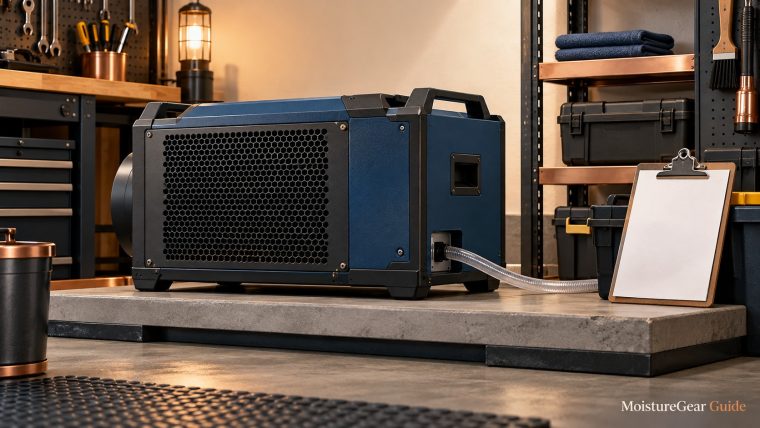
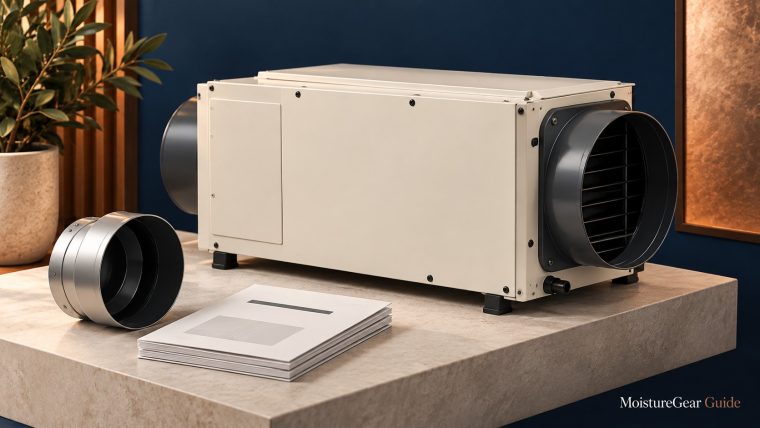
An AprilAire vs AlorAir dehumidifier comparison is useful only after the intended installation is clear. AprilAire's E-series includes permanent equipment for whole homes, basements, and sealed crawl spaces. AlorAir's Sentinel catalog includes separate crawl-space and basement products as well as WHD whole-house models. Those product families overlap in some applications, but they should not be compared as if every cabinet offers the same controls, drainage, and central-system compatibility.
The sensible question is which exact model and supported installation provide the better fit for your moisture problem. This research comparison uses manufacturer information checked in October 2026. It does not claim independently measured drying speed, reliability, noise, or long-term service performance for either brand.
Start by choosing the job
There are at least three distinct buying scenarios in this comparison.
A central whole-home project needs air distribution, controls, and capacity suitable for the occupied rooms. Compare AprilAire E-series central options with AlorAir’s actual WHD line, subject to the installer’s verification of the supplied model and allowed layout.
A permanent basement or crawl-space installation may use equipment without a complete central retrofit. Pump configuration, temperature requirements, access, and the degree of enclosure can matter more than a whole-house marketing label.
A temporary drying job is another category. A product that can be carried to a wet room is not necessarily the most appropriate cabinet for an unattended permanent installation, and dehumidification alone does not establish complete water-damage restoration.
The whole-house hub and crawl-space hub keep those decisions separate. Define the objective before letting a brand comparison dictate the system.
Model families that deserve individual attention
| Family | Role in this comparison | What to verify |
|---|---|---|
| AprilAire E080 / E100 | Permanent capacity tiers with built-in controls and documented installation options | Current versus older specifications and chosen duct arrangement |
| AprilAire E080W / E100W | Connected versions for buyers who want app access | Exact W suffix, current sheet, wireless coverage, warranty |
| AlorAir Sentinel HDi90 variants | Crawl-space and basement equipment with pump and ductable configurations | Exact listing, pump configuration, manual, allowed ducts |
| AlorAir Sentinel WHD100 / WHD120 | Separate whole-house product family | Matching performance data, controller, connection design, complete package |
The table identifies relevant families. It is not a claim that one row directly replaces another without design review.
AlorAir's HDi90 ductable page and WHD120 page make the family distinction important. AprilAire’s E080 and E100 information provides separate capacity tiers.
Capacity figures need conditions, not just a brand column
Some AlorAir products advertise a maximum saturation figure alongside a capacity at AHAM conditions. The saturation figure describes a much warmer, wetter reference environment and should not be placed beside a cooler whole-home figure as a direct comparison.
For the HDi90 ductable page, the stated AHAM reference is 80°F and 60% RH. Its larger maximum is listed at 90°F and 90% RH. Those are different operating points for the same product.
Current AprilAire E080 and E100 specification sheets also provide more than one reference temperature. They allow comparison at matching points within that pair, but they do not eliminate the need to assess capacity at the site's actual conditions.
AlorAir's WHD product names should not be read as precise daily output guarantees. The WHD120 page identifies an AHAM capacity different from the number in its name and separately describes a whole-house DOE figure.
The ratings guide and saturation comparison explain these labels. Every numerical comparison should show the conditions and exact variant beside the amount.
AprilAire’s strongest case: a planned permanent system
The E080 and E100 offer documented options for central integration and dedicated ducts, as well as appropriate standalone applications. They are useful candidates when an installer wants to design permanent moisture control around those options.
Current non-W specification sheets describe built-in humidity controls, washable filters, and permanent drain connections. The connected W products add app-related features.
This does not establish a universal service advantage or superior reliability. It means the products have a clear permanent-system role that can be discussed using model-specific drawings and data.
The E100 is the capacity step up from the E080, with a different blower curve despite a similar nominal cabinet footprint. An installer should choose between them according to the assessed load and air route.
Our E080 review, E100 review, and direct comparison provide a closer look at that family.
AlorAir’s strongest case depends on the Sentinel family
The HDi90 deserves consideration for a below-grade installation where its exact pump and application features fit the project. A built-in pump can simplify the equipment package when an appropriate condensate route needs lift, although it still requires attention to tubing, power, service, and failure protection.
That is not the same as saying every Sentinel unit is a central whole-house replacement. A ductable variant may support useful air routing without offering the same central controls or installation design as the WHD line.
The separate WHD range is the relevant AlorAir family for a true whole-house proposal. Obtain the actual model documentation and a contractor’s assessment of the permitted duct arrangement. Product-page airflow figures without clear pressure conditions are not enough to approve a demanding duct design.
AlorAir may provide an attractive equipment offer, but price should be evaluated after matching the job and accessories. A lower cabinet price can be meaningful; it can also exclude parts or labor included in another proposal.
The HDi90 research review is the correct next step for that below-grade model rather than treating its largest headline number as the whole-house comparison.
A close central-capacity comparison can shift attention to the package
For a central project, the current non-W E100 and AlorAir WHD120 are a more relevant pair to investigate than an E100 compared with an unrelated saturation headline. Their manufacturer pages identify broadly similar whole-house capacity tiers, although the products still need matching detailed documentation.
When two candidates can meet the assessed load, the decision may move to the controller, allowable duct arrangement, filtration, drainage accessories, installation price, and support process. That is a useful outcome of capacity matching: it prevents a large headline from overwhelming the ownership questions.
Ask the installer to prepare a short list of what each package includes and what must be added. If a model's blower data or installation manual does not explain the intended route clearly enough, resolve that gap before using a lower equipment price as the deciding factor.
A fair comparison can end without a universal brand winner while still identifying a clear choice for one documented installation.
Pump configuration can change the practical winner
AprilAire E080 and E100 products use a permanent drain outlet with an accessory pump when the project requires one. Do not assume the standard cabinet contains a condensate pump.
AlorAir has separate gravity and pump products, and HDi90 pages distinguish variants. Check the exact equipment and box contents. A Wi-Fi product, a ductable product, and a built-in-pump product should not be merged into one assumed configuration.
For a basement with an appropriate lower drain, a gravity setup may be simpler to maintain. For a suitable destination above the equipment, an integrated or external pump may be necessary. Neither arrangement is categorically more dependable without model and installation evidence.
An external pump can be separately accessible or replaceable, while an integrated design changes the service arrangement. The right choice depends on the supplied model, approved route, protective measures, and owner access.
Our gravity-versus-pump guide explains why the complete water path deserves as much attention as the compressor rating.
Ducting and controls determine whole-house suitability
A central-system proposal should show the inlet source and outlet destination, along with the fan and control sequence. Ask each contractor to explain operation during a humidity call when heating and cooling are idle.
A cabinet with collars or an available duct kit is not by itself evidence that a particular HVAC connection is permitted. The manufacturer’s instructions must support the proposed arrangement.
For either brand, the system must avoid treating a small air loop while isolated rooms remain wet. Closed bedroom doors, separate floors, and a basement outside the main return network are practical distribution questions.
Ask where the humidity measurement originates and which controller calls for operation. An app gives access to a value; it does not establish that the measured value represents every room.
The ducted versus standalone article helps compare those layouts. Use the same served-area objective for both brands rather than comparing one basement setup with one central installation.
Current versions need a paper trail
AprilAire's current non-W E080 and E100 sheets specify R32, while an older E100 sheet lists R410A and different electrical information. The W suffix identifies connected control features; it is not a reliable shortcut for the only R32 version.
AlorAir also has multiple similarly named versions and document links. A retailer may show photographs, a description, or an uploaded manual for a related model rather than the exact unit supplied.
Save the seller’s model description, ask for the label and matching manual, and have the installer review that information. If the documents conflict, obtain clarification rather than selecting favorable values from several sources.
This is especially important for drainage limits and installation directions. A pump hose length or temperature minimum from one Sentinel variant should not be transferred to another automatically.
The primary source for the supplied machine should be a coherent set: product label, manual revision, specification sheet, and written purchase configuration.
Noise and reliability require evidence beyond specifications
Either brand can publish sound information, but a fair noise ranking requires comparable measurement conditions. A ducted rating, an unspecified sound-pressure level, and a user's impression are not equivalent evidence.
Location, distance to occupied rooms, barriers, mounting, and airflow all affect the experienced result. Ask the installer about the planned arrangement instead of making a brand-wide quietness claim.
Reliability claims deserve similar restraint. A corrosion-resistant coil description or a long warranty is not an independently measured failure rate. Owner reviews can raise questions to investigate, but they do not supply a controlled brand comparison.
This guide therefore assesses documented configuration and buying fit. It does not describe either brand as proven longer-lasting, fault-free, or quieter everywhere.
If a seller promises unusually strong performance, ask for the matching test conditions, actual model, and evidence. Specific support is more useful than a general statement that the product is commercial-grade.
Electricity comparisons need the same operating objective
Compare energy used to maintain the same served-space humidity target, not only the largest pint figure or operating current.
A manufacturer may publish an energy factor under a particular test point. Another may display a figure from a different test condition or a different efficiency metric. Those values need labeling before comparison.
Runtime also changes with the incoming moisture load. A lower-capacity model that cannot meet the target and a higher-capacity model that can are not completing the same task.
Where the design operates another fan, include that fan's consumption. Where ventilation is part of the project, include its effect on the moisture load.
The electricity-cost guide uses explicit watt and runtime assumptions. It is a better basis for ownership planning than an unsupported claim that one brand always saves a fixed percentage.
Warranty terms differ by family and purchase date
AlorAir's published warranty policy describes an upgrade effective for qualifying orders in 2026 and separates whole-house coverage from other dehumidifier coverage. The prominently advertised year count is therefore not a sufficient summary for every Sentinel product.
For non-whole-house models, the page describes broader early coverage and later refrigeration-component coverage. Its whole-house section has different wording and excludes several installed-system expenses.
AprilAire's model and revision documents also need matching. Current W promotional descriptions and older PDF warranty descriptions can differ. Request the terms governing the unit and purchase route you are considering.
Ask each manufacturer to confirm the relevant seller and identify what happens if the installed machine needs diagnosis, removal, freight, repair labor, and reinstallation. Do not assume all those costs are covered.
Our authorized-seller and warranty guide provides a purchase checklist. No Amazon search result can establish warranty eligibility by itself.
Local support can be more useful than brand-level assumptions
Before buying owner-supplied equipment, contact the contractor who will install it. Confirm that they support the exact model and intended layout, not just that they recognize the brand.
Ask who will handle a fault. Some projects may be serviced by the original installer; others may require manufacturer authorization or a separate service arrangement.
For a pump model, ask how pump service is handled and whether the installation leaves practical access. For a central model, ask how controls and duct performance will be assessed if rooms remain damp.
Keep those answers in the budget. A discounted machine with uncertain local installation or warranty handling can be inconvenient, while a more expensive proposal may include useful support. The scope must be visible to determine whether the difference is justified.
The whole-house cost guide separates equipment, accessories, labor, commissioning, and ongoing expenses.
Three scenarios that sharpen the comparison
A sealed crawl space needs a pump: Compare the exact HDi90 variant with a suitably specified permanent alternative including its external pump. Evaluate clearance, inlet conditions, drain route, service access, and the full package. A central whole-house feature set may be unnecessary for this job.
An occupied home needs humidity control across rooms: Compare AprilAire’s relevant capacity tier with AlorAir’s actual WHD model. Have the installer identify the air path, control location, pressure limits, and sizing rationale. Do not substitute the HDi90 saturation number for a central-design assessment.
A basement can drain by gravity: The least elaborate suitable drainage arrangement may be preferable to an integrated pump. Compare equipment sized for the space and avoid buying central accessories if they do not solve a room-distribution problem.
These are planning examples, not results from customer installations or independent product tests. Each demonstrates why the job determines the relevant family.
What to confirm before ordering
Obtain the exact model and version, a matching manual, the complete accessory list, and current purchase price. Have the installer approve that configuration and name the served area.
Confirm the seller and warranty route with the relevant manufacturer. Record the drain and control plan, and make sure routine maintenance will be practical.
Choose the better-supported model for your application after those checks. A useful AprilAire-versus-AlorAir decision names the actual equipment, its installation, and its tradeoffs; it does not assign a winner to an entire brand from one prominent specification.
Selected sources
- Current AprilAire E080 manufacturer sheet
- Current AprilAire E100 manufacturer sheet
- AlorAir Sentinel HDi90 ductable specifications
- AlorAir Sentinel WHD120 product information
- AlorAir current warranty policy
About the author
Davis Murphy
Davis Murphy writes about dehumidifiers, indoor humidity, and home moisture control at MoistureGear Guide. His articles explain how to compare equipment, understand capacity ratings, and plan for drainage and maintenance. He focuses on clear, practical guidance to help readers choose a dehumidifier suited to their space and needs.