This AprilAire E080 review examines whether the model's documented capacity and installation options fit your home, basement, or sealed crawl space. The E080 is worth considering when you want a permanent drain connection and a humidity-control system designed around a defined space. Its appeal is a compact cabinet with useful installation flexibility; its main limitation is that neither the headline capacity nor the coverage claim can establish the right size for your building.
The review focuses on the current non-W E080 specification sheet dated October 2025, checked against AprilAire's product information in October 2026. It also explains the E080W connected version so shoppers can identify what is actually in a listing. We have not tested either model independently; comments about suitability are reasoned buying assessments rather than measured performance findings.
The short assessment
The E080 belongs on a shortlist for a moderate assessed moisture load where the installer can provide suitable airflow, drainage, and access. It is particularly useful to compare with the E100 because the current non-W models share a nominal cabinet footprint while offering different capacity and blower performance.
It is a weaker choice when a buyer expects one unducted basement machine to reach every bedroom without a planned air route. It is also inappropriate to size it by an unresolved water-entry problem or an advertised maximum floor area alone.
The E080W can be more convenient when remote control and alerts are important. That convenience does not change the need for a site assessment, a serviceable condensate arrangement, and appropriate connections.
Read the whole-house buying guide for the wider shortlist and the E080 versus E100 comparison for the most direct capacity step-up.
Current E080 specifications worth checking
| Item | Current non-W E080 manufacturer specification |
|---|---|
| Water removal | 80 pints/day at 80°F/60% RH; 65 at 73°F/60% RH |
| Supply | 120 VAC, single phase, 60 Hz |
| Published current draw | 4.8 A at the stated 80°F/60% RH, zero-ESP test point |
| Nominal cabinet | 14 in wide × 15 in high × 26 in long, with stated exclusions |
| Unit weight | 63 lb |
| Filter | Washable MERV 8, part 5881 |
| Refrigerant in this revision | R32 |
| Inlet conditions for dehumidification | 50°F–104°F, with minimum 40°F dew point |
| Drain | 3/4-inch MNPT threaded connection; relevant fittings described in the sheet |
The source is AprilAire's October 2025 E080 specification sheet, hosted by a distributor. Dimensions exclude items such as feet, duct collars, and filter-door projections as noted in the drawing. Match the supplied unit and manual to that revision before making a final installation plan.
What an 80-pint designation means in practice
The E080's capacity changes with inlet conditions. The same sheet's two stated test points are useful because they show a lower removal figure at the cooler reference temperature.
That does not mean the unit becomes defective below its headline test temperature. It means capacity is conditional. A cooler basement or a home already approaching the target RH can present less removable moisture than the rating environment.
Do not expect ten gallons of water every day simply because the warm-condition rating converts to that volume. If the served space is at its target, the unit should not need to collect its maximum daily capacity.
Nor should a large saturation figure from a different product be used to dismiss the E080 as smaller without checking the conditions. Our rating-standards guide explains the comparison problem.
The useful buying question is whether the E080 can meet the home's assessed load at the conditions it will see. That is why the nominal pint name belongs beside a sizing discussion, not in place of one.
E080 and E080W: separate the control choice from the capacity choice
AprilAire's official E080W page describes built-in Wi-Fi, Bluetooth pairing, and compatibility with the Healthy Air app. The non-W E080 should not be assumed to have those connected features.
The E080W may be convenient in a crawl space, mechanical room, or other location where checking the control regularly is inconvenient. Remote visibility can make it easier to notice alerts and change a setting without visiting the cabinet.
However, the W suffix should not be used as a shorthand for “the R32 version.” The current non-W E080 sheet also specifies R32. Older documents and old stock can contain different details, so the actual model and revision still matter.
A listing that uses one model in its title and another in its images needs clarification before purchase. Check the label on the proposed shipment, the included control interface, and the warranty document rather than treating the photographs as proof of a particular configuration.
If you prefer simple local control and the installer supports it, the non-W model remains a distinct option. If you need connected operation, verify the actual W model and wireless coverage where it will be installed.
Compact cabinet, larger service envelope
The E080's nominal cabinet dimensions make it attractive when installation space is limited. The usable installation envelope is larger than that simple box.
Duct collars extend the machine, ducts need a permitted bend and connection arrangement, and the drain connection must remain accessible. The filter also needs space to be removed. Supports and feet change the overall height.
Measure the entire route into the location, not only the final landing space. A cabinet that fits a mechanical shelf may not pass through the hatch or around the staircase turn leading to it.
Consider future removal as well. If a finished wall, permanent storage rack, or other equipment will be installed after the dehumidifier, preserve a realistic replacement route.
The whole-house cost article explains why access and mounting can change the installed budget even when the cabinet price looks competitive. These are product-fit considerations, not minor installation details.
Ducted operation requires more than the included collars
The E080 is documented for several installation arrangements, including integration with HVAC ducts and dedicated grilles. Those options give an installer flexibility, but they do not establish compatibility with every existing system.
The inlet needs a useful source of air from the area being controlled. The discharge needs a route that returns drier air to that area without immediately looping it back to the inlet.
An unducted setup may fit an open basement or suitable enclosure. A whole-home application requires a planned distribution system. The same machine can serve different jobs, but only when the layout matches the objective.
Ask the installer which arrangement is being proposed and how operation changes when the central HVAC system is not heating or cooling. This is especially important when the dehumidifier’s fan and the central blower interact.
Our ducted versus standalone guide explains these arrangements and the questions that make a proposal concrete.
The E080’s blower curve is a real selection constraint
The current E080 sheet provides airflow at several external static-pressure points. Its available flow falls as the connected system becomes more restrictive.
That is relevant to a finished-home retrofit because filters, grilles, duct length, and bends all contribute resistance. A machine that fits the space may not provide the desired installed airflow through an ambitious duct route.
The contractor should check the proposed layout against the product's blower information and relevant manual limits. Do not accept an improvised long duct extension merely because its diameter appears to match the collar.
Likewise, avoid adding a more restrictive filter in an attempt to improve air cleaning without manufacturer approval. A documented MERV rating is part of the selected airflow system, not an invitation to substitute any filter that fits.
The E100's blower capability differs, which is another reason the capacity upgrade needs design review rather than a quick cabinet swap. The E100 review discusses that model’s role in the same decision.
Gravity drainage is the standard starting point
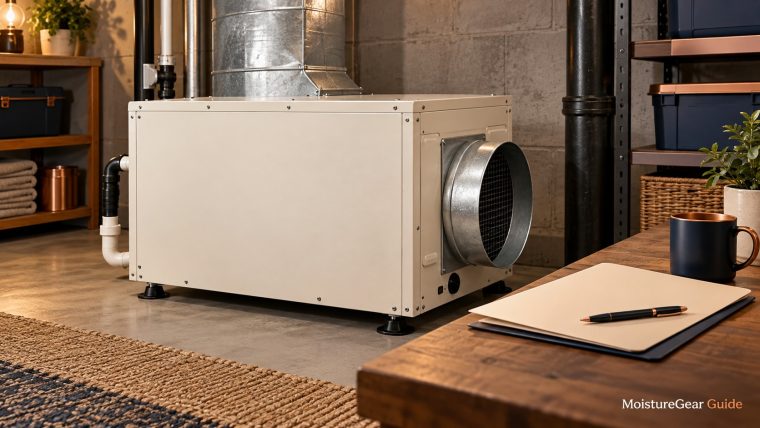
The E080 uses a drain connection rather than a daily collection bucket. That is a useful feature for a permanent moisture-control arrangement, provided the outlet is connected appropriately.
An integrated pump should not be assumed. If water must rise to the disposal destination, the project needs an appropriate accessory pump and a complete tubing route. A bundle that includes a pump is different from an equipment-only listing.
The drain installation must follow the current manual and local requirements. Do not copy trap, hose, or elevation instructions from an older model simply because the cabinet looks familiar.
Ask about protection against a blockage or pump failure, especially when leakage could damage an attic floor or finished ceiling. The protective components and their test should be part of commissioning.
The gravity versus pump guide is useful when deciding whether the unit’s location creates an unnecessary condensate complication.
Temperature limits deserve careful interpretation
The E080's stated inlet range tells you where dehumidification is permitted for that product revision. It does not tell you that removal at the lower end equals the warm-condition rating.
The minimum dew-point condition is important too. Air can be within the allowed temperature range while offering little practical water removal as it approaches dry conditions.
A cold basement therefore requires more thought than checking one minimum temperature number. Discuss the expected room temperature, humidity target, and relevant available capacity with the installer.
For a very cold space, do not assume the E080 is the correct choice because it is marketed for basements. Use the cold-basement guide to compare the application and the current model requirements.
Avoid operating equipment outside its stated conditions or trying to force continuous removal by lowering the setpoint. If the unit seems ineffective, record inlet conditions before drawing a conclusion about capacity or faults.
Power, runtime, and the ownership bill
The published current draw identifies a particular test condition. It should not be converted casually into a precise monthly bill by multiplying nominal volts and amps.
Real energy consumption depends on operating mode, conditions, runtime, and the installation. A design that operates the central blower can add another component to the total.
Use a measured or appropriately published real-power input and an explicit runtime assumption. Then record actual operation during normal and peak humid periods. Our electricity-cost guide provides the calculation framework.
A smaller model is not always the cheaper one to run if it struggles extensively against the load. A larger model is not automatically cheaper either. The useful comparison is energy required to maintain the same intended humidity objective in the same building.
Do not justify the E080 with a claimed universal payback from reduced air-conditioning bills. This review makes no independently measured savings claim.
Control behavior and room measurements
The E080's built-in control samples air and calls for dehumidification according to the selected mode and humidity setting. The air it sees should represent the treatment objective.
For an unducted basement installation, that may be the surrounding basement air. For a ducted whole-home installation, the intake route and any external control must be chosen accordingly.
An app or display reading cannot confirm uniform RH in every room. Use appropriately placed independent sensors in representative locations and note temperature at the same time.
If a bedroom stays damp while the return area reaches the target, report that specific pattern to the installer. It is more useful than continually reducing the setpoint. Air distribution or a local source may need attention.
AprilAire's owner FAQs discuss controls and extended operation after initial installation. Use the actual owner’s manual for the supplied unit to understand its sequence and indicators.
Maintenance: make ordinary tasks practical
The current E080 uses a washable filter. That reduces the need for recurring disposable replacements, but it does not make the machine maintenance-free.
Follow the matching manual for inspection and cleaning. Keep access to the filter doors and drain arrangement unobstructed, and do not assume that spraying a cleaner into the cabinet is an approved task.
A drain problem can interrupt performance even when the compressor and blower operate normally. Periodic accessible inspection is therefore part of the ownership plan.
At handover, ask the installer to identify which tasks the owner should perform and which require service. Keep the manual and product information where they will be available when a change in operation occurs.
This review does not provide electrical, refrigeration, or internal repair instructions. The goal is selecting a product you can maintain sensibly, not turning a permanent installation into a repair project.
Warranty and seller questions before an online purchase
Current AprilAire promotional warranty wording and older documentation are not identical across every version. Treat the actual applicable terms as a purchase question.
Ask the manufacturer or seller to identify coverage for the exact model, purchase date, and purchase route. Determine whether the installation must satisfy particular requirements and what costs are excluded.
Ask the installer separately about labor coverage and willingness to handle an owner-supplied unit. Buying equipment online before finding an installer can leave those responsibilities unclear.
Keep a dated copy of the listing, seller information, invoice, unit label, and manual. A search link does not establish seller authorization or warranty eligibility.
The warranty guide explains why a year count does not describe the full financial protection.
Decide what you expect connected monitoring to tell you
For an E080W purchase, distinguish remote control of the equipment from monitoring every room. The app's connection to the machine is useful, but additional room readings may still be necessary to assess distribution.
Check wireless coverage at the proposed cabinet location before making app access a deciding feature. A signal that works upstairs does not establish the same coverage beside equipment in a basement or crawl space.
Ask the installer how the owner will check normal operation locally and what information will be available remotely. Keep those instructions with the manual. A clear monitoring plan makes the connected version more useful while preserving an ordinary way to inspect the drain, filter, and actual served space.
Who should shortlist the E080?
Consider it if a load assessment supports its capacity, you have a workable drainage route, and the installer can provide the intended air distribution. Its compact nominal cabinet can be useful where space is limited, provided the service envelope also fits.
Consider the E080W when connected control is valuable and you can verify the supplied configuration. Do not pay for remote features while leaving airflow, drainage, or seller support unresolved.
Compare the E100 when the E080's documented capacity or blower performance is insufficient. Compare alternative brands when their model-specific installation and support offering better fit the project.
Use the whole-house hub to place that choice in the full system decision. The E080 is a credible permanent option for the right load; it is not a universal answer to every damp house.
Selected sources
- AprilAire E080 manufacturer specification sheet, October 2025
- Official AprilAire E080 product page
- Official AprilAire E080W product page
- AprilAire owner FAQs
- ENERGY STAR capacity guidance
About the author
Davis Murphy
Davis Murphy writes about dehumidifiers, indoor humidity, and home moisture control at MoistureGear Guide. His articles explain how to compare equipment, understand capacity ratings, and plan for drainage and maintenance. He focuses on clear, practical guidance to help readers choose a dehumidifier suited to their space and needs.