This AprilAire E100 review is for buyers deciding whether additional capacity is worth paying for in a permanent dehumidification system. The E100 makes the strongest case when a professional assessment shows that a smaller unit lacks moisture-removal margin or the proposed duct arrangement benefits from its blower performance. It is less convincing as an upgrade chosen merely because a house is damp somewhere or because a larger model number seems safer.
There is another decision hidden in the name: current E100 documentation, older E100 stock, and the connected E100W are not identical configurations. This research review identifies those differences before assessing installation and ownership. It draws on manufacturer-authored documents retrieved in October 2026 and does not claim hands-on testing.
Why the E100 is more than an E080 with a new badge
The current non-W E100 sheet reports greater water-removal capacity than the E080 at matching published inlet conditions. It also shows a different blower curve. Those changes can matter independently.
If the assessed moisture load is too large for the smaller unit, added capacity helps address that gap. If a proposed duct route is too restrictive for the smaller model, the installer must review airflow, resistance, and limits; a larger blower may be relevant, but a badly designed duct route still needs correction.
The nominal cabinet footprint is similar to the E080, which can make the comparison attractive where installation space is constrained. That does not make the two models drop-in equivalents. Electrical requirements, operating behavior, connection design, and commissioning still require verification.
Our E080 versus E100 comparison keeps that pair together. This review concentrates on the E100 itself and the purchase details that can change what you receive.
Verified current non-W E100 reference points
| Specification | July 2025 manufacturer sheet |
|---|---|
| Capacity at 80°F/60% RH | 100 pints per day |
| Capacity at 73°F/60% RH | 85 pints per day |
| Supply | 120 VAC, single phase, 60 Hz |
| Current draw at stated warm test point | 6.7 A |
| Dry-coil airflow at zero external static pressure | 280 CFM |
| Dry-coil airflow at 0.2 in. w.c. | 245 CFM |
| Dry-coil airflow at 0.4 in. w.c. | 210 CFM |
| Refrigerant | R32 |
| Filter | Washable MERV 8 |
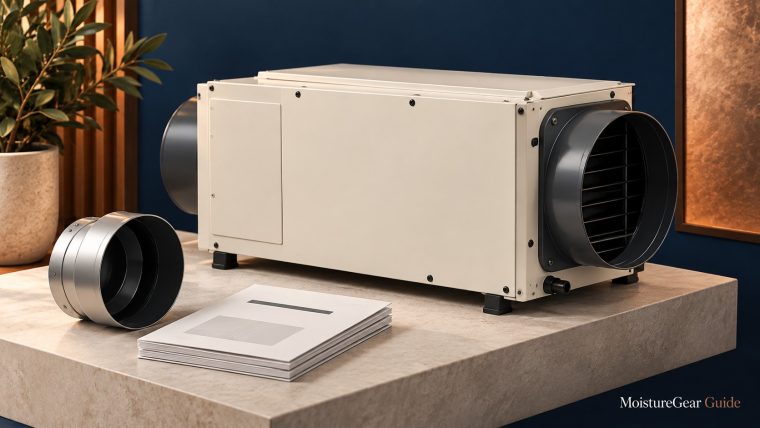
| Nominal cabinet dimensions | 14 in W × 15 in H × 26 in L, with exclusions |
| Unit weight | 64 lb |
The source is the current E100 specification sheet, a primary AprilAire publication hosted by a distributor. The airflow figures describe the stated dry-coil test conditions. They are not a measurement of airflow in your home.
Legacy E100 specifications can look deceptively current
An older manufacturer E100 sheet remains available online and may appear in search results or retailer downloads. The February 2021 version lists R410A and a different current figure from the current July 2025 R32 sheet.
That is not evidence that all non-W E100 units still use R410A. It is evidence that a familiar model name can span document revisions. A retailer may also use an old PDF for a newer shipment.
Before ordering, request the exact model, the relevant generation, and the manual supplied with the unit. If the seller cannot explain a mismatch between the listing and the product label, seek clarification from the manufacturer rather than assembling a blended specification table yourself.
The legacy E100 sheet is useful for identifying older specifications. It should not be used as the current model’s electrical or refrigerant reference.
This also matters when replacing an existing unit. Record its label and installation details rather than assuming the latest equipment shares every characteristic with the machine already installed.
What the extra pint capacity buys you
The E100's higher capacity is useful when it addresses a documented load shortfall. That could be a larger served area, a different moisture-entry pattern, a planned ventilation load, or a design requiring more removal at the relevant indoor conditions.
It does not buy an automatic improvement in every room. The cabinet can dry only air that reaches it. A wet bedroom with a poor return route can remain a problem even while a powerful dehumidifier satisfies its own sensing point.
The warm-condition figure should not be interpreted as daily collection in a normally conditioned home. Actual condensate production changes with inlet conditions, target RH, and operation. Once the target is met, high water collection is not the objective.
Likewise, the cooler published capacity is still a reference point rather than a guaranteed household result. Ask the installer how the available removal is being assessed at the intended indoor temperature and humidity target.
The whole-house sizing guide prepares that conversation. It is more useful than assigning the E100 to every home above a convenient floor-area threshold.
Blower performance can affect the model decision
The E100's published airflow declines as external static pressure rises. Even a stronger blower needs a reasonable duct design.
The installer should consider the complete air path: intake grille, ducts, bends, filter, dampers, and discharge grille or HVAC connection. A high free-air value alone cannot justify any length of duct.
The specified airflow may affect how the equipment interacts with the HVAC system. A return-to-supply layout and a dedicated-grille layout can create different demands. Controls and fan sequencing need to follow the actual installation instructions.
During commissioning, ask which measurements confirm that the installed system falls within the equipment's requirements. If the quote contains no airflow or pressure assessment, the model's blower data may not have been meaningfully applied.
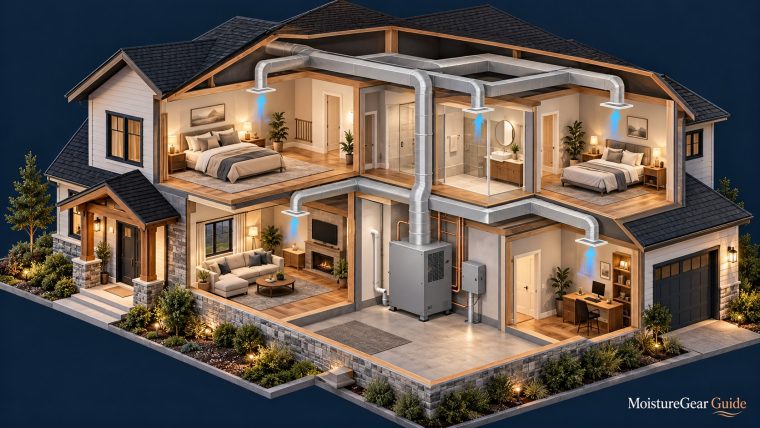
Read ducted versus standalone layouts before deciding that central duct connections are necessary. In an open basement, permanent unducted operation may be the more proportionate design.
E100, E100C, E100H, and E100W need separate checks
AprilAire's E100 family includes configurations described with different suffixes. Current non-W documentation distinguishes standard power-cord units, caster configurations, and hardwired versions. The W model has connected control features.
A suffix can therefore change practical handling and installation. A unit on casters is not identical to a fixed unit with leveling feet. A hardwired configuration requires a different electrical arrangement from one supplied with a cord.
The official E100W page describes built-in Wi-Fi, Bluetooth pairing, and Healthy Air app use. Do not transfer every electrical and blower figure from a non-W sheet to the W model without matching documentation.
Choose the suffix deliberately. If you want remote alerts, select and verify the connected product. If the machine will be fixed in a mechanical area, do not pay for a caster package simply because the listing is easier to find.
The product label, included manual, and itemized invoice should all tell a consistent story. A photograph showing a phone screen or wheels is not enough.
Drainage is an installation, not just a fitting
The E100 provides a permanent condensate connection rather than a routine emptying bucket. The selected project still needs an appropriate route from that outlet to a permitted destination.
An external pump may be needed when the route cannot work by gravity. The pump, power, discharge tubing, and protection should be identified in the proposal; an integrated pump should not be assumed from the E100 model name.
Included drain tubing can vary by configuration. A seller that supplies the cabinet and a fitting may not supply the complete line you need. Ask for the box contents and the installation materials separately.
A concealed installation deserves particular care because leakage can be difficult to notice. Ask which accessible points you will inspect and what happens if the drain blocks.
The drainage guide explains gravity and pump tradeoffs. Avoid treating an accessory pump as an effortless way to place the machine anywhere in the house.
Electrical selection: use the supplied model’s requirements
The current non-W E100 specification gives a supply and a current figure under identified conditions. Those are product data, not instructions to choose a household circuit by eye.
An installer or electrician should confirm the electrical arrangement required by the supplied equipment and applicable local rules. A suitable-looking receptacle near the proposed location is not the complete verification.
For a hardwired configuration, the installation should explicitly identify that scope. A standard corded model and a hardwired variant should not be merged in a shopping comparison.
Do not calculate exact energy consumption solely from nominal volts multiplied by the stated current. Real power, operating conditions, fan behavior, and runtime determine the ownership bill.
The electricity-cost guide gives a transparent calculation approach. Ask whether the central HVAC fan is part of dehumidification operation so its energy is considered where relevant.
Cold air, dry air, and what “not collecting much water” means
The current E100 sheet lists an inlet operating range for dehumidification and a minimum dew-point condition. Those limits describe permissible operation, not uniform output throughout the range.
Cooler inlet air can result in less water removal. Air already close to the setpoint can also produce less condensate. Low collection therefore needs context before being interpreted as a fault.
Record room temperature, RH, the setting, and whether the unit is operating or sampling. If the served rooms are at the intended humidity, less water in the drain may be ordinary behavior.
If the rooms remain wet while collection appears low, provide those observations to the installer. The investigation can then consider airflow, inlet conditions, sensing, drainage, and equipment rather than assuming the refrigerant circuit is defective.
Internal electrical or sealed-system troubleshooting belongs to qualified service. This review does not recommend defeating protective controls or opening the unit to force a drying cycle.
Warm discharge and occupied-space comfort
The E100 uses a refrigeration process to condense moisture and then reheats the air before discharge. Some warmth at the outlet is part of normal drying, not room air conditioning.
Placement and grille selection should account for that discharge. An outlet aimed directly at a sofa or work position can be uncomfortable even if the humidity result is useful.
In a central installation, the discharge mixes into the selected distribution path. Its perceived effect depends on the rest of the system’s operation and the room layout. Do not assume that ducting guarantees an imperceptible temperature change.
For an unducted basement application, locate the unit with clear air movement and consider how the area is used. Keeping machinery away from a quiet office can be useful, but enclosing it without a planned airflow route undermines treatment.
The whole-house versus portable comparison discusses the space and comfort tradeoffs of different ownership arrangements.
Maintenance should be planned before installation
A washable filter still needs appropriate cleaning, and the drain still needs attention. AprilAire's owner FAQ identifies filter and drain care among the required owner maintenance topics.
Ask the installer to show the filter access and accessible drain inspection points. If those tasks are difficult on day one, they are unlikely to become easier when storage and other equipment fill the room.
Use only the maintenance method in the supplied manual. Do not assume an aftermarket coil spray or a different filter medium is appropriate because the machine is marketed as professional-grade.
Keep a simple record of cleaning and unusual operation. A change in runtime, repeated errors, or moisture appearing near the equipment is more informative when you can identify what changed and when.
Service access also affects long-term value. A higher-capacity model installed behind permanent obstacles can cost more to support than one with a sensible maintenance envelope.
Warranty wording and total ownership cost
The current non-W specification sheet and W-model promotional material use different warranty descriptions. Do not assume a long promotional year count covers all installed-system expenses.
Ask which document governs the exact supplied unit and purchase date. Confirm the seller route, any installation conditions, and responsibility for diagnosis, removal, shipping, labor, and reinstallation.
If the installer supplies the equipment, clarify the labor warranty separately. If you supply it, confirm the contractor will install and support that exact product before ordering.
Our warranty guide explains how manufacturer coverage differs from seller returns and installation labor coverage. The cost guide places those responsibilities in the budget.
The E100's value should be assessed as a completed supported installation. An equipment discount does not compensate for a missing controller, poor access, or an unresolved warranty process.
A replacement purchase deserves its own inspection
If an existing E100 is being replaced, do not assume the old layout should be duplicated unchanged. A previous system may have had unresolved distribution, access, or drainage weaknesses.
Record whether the old unit achieved the desired room humidity, where it was noisy, and whether maintenance was practical. Those observations can guide a better replacement project.
The new equipment’s refrigerant, electrical data, controls, and included accessories may differ from the older model. Match the replacement quote to current documentation and the supplied product label.
Ask whether the old drain, support, and duct connections remain appropriate. Reusing parts can be reasonable when verified; reuse should not be automatic simply because the nominal cabinet dimensions are familiar.
A replacement is also a chance to define a useful performance check. Agree on which rooms will be monitored and how the installer will respond if the original symptoms persist.
A larger unit does not automatically add another zone
The E100's additional capacity can support a broader assessed load, but a separate enclosure requires a deliberate air path and control strategy. A basement that is outside the main house's circulation may need different treatment from upstairs rooms.
If a quote describes several zones, ask which spaces can call for dehumidification, which dampers or controls are involved, and which installation instructions support the arrangement. Extra capacity alone is not zoning hardware.
This matters when a replacement project grows in scope. Adding an upstairs humidity objective to an existing basement installation is a system change, even if the E100 already sits in a convenient location. Have the contractor assess the new load and distribution rather than extending a duct and assuming the original controls remain appropriate. Document the expanded treatment area in the final proposal.
The buying decision
Shortlist the E100 when its documented capacity and blower performance answer a specific design requirement. Compare the E080 if the smaller unit can meet the same objective without unnecessary expense.
Choose the connected E100W only after confirming the exact package and matching data. Preserve the distinction between current non-W specifications, older stock, and W-model features throughout the purchase.
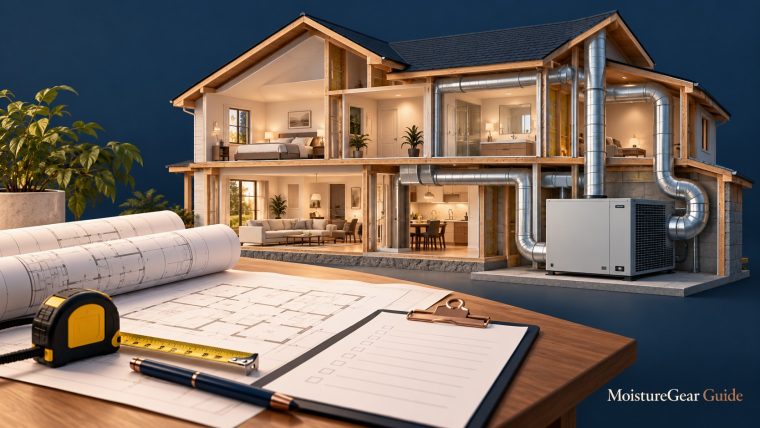
Then assess the complete installation: served spaces, controls, duct route, condensate handling, power, access, and support. The whole-house hub connects those decisions so a larger model becomes a justified choice rather than a guess.
Selected sources
- Current AprilAire E100 manufacturer sheet, July 2025
- Legacy AprilAire E100 manufacturer sheet, February 2021
- Official AprilAire E100W product page
- AprilAire owner FAQs
About the author
Davis Murphy
Davis Murphy writes about dehumidifiers, indoor humidity, and home moisture control at MoistureGear Guide. His articles explain how to compare equipment, understand capacity ratings, and plan for drainage and maintenance. He focuses on clear, practical guidance to help readers choose a dehumidifier suited to their space and needs.