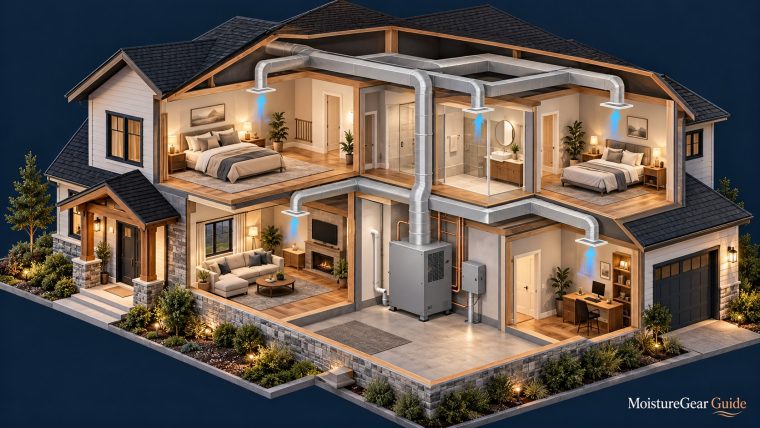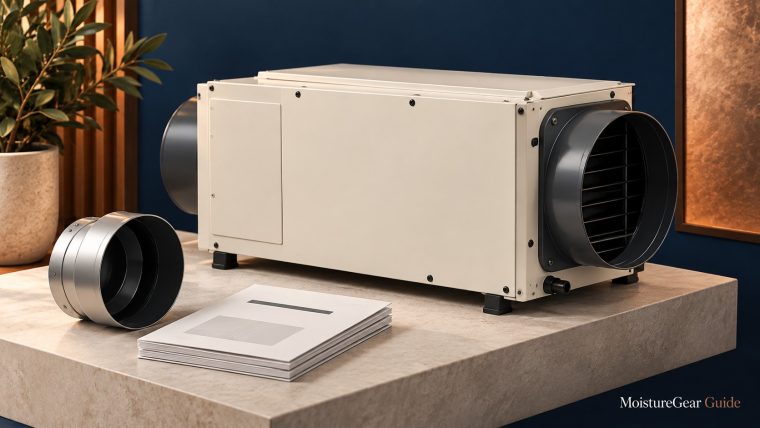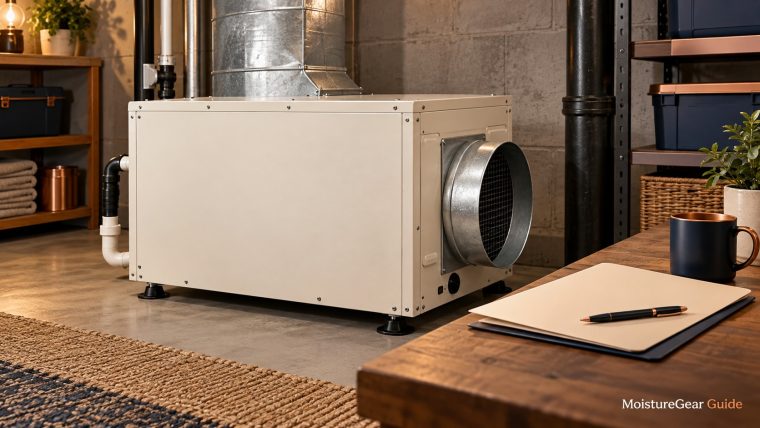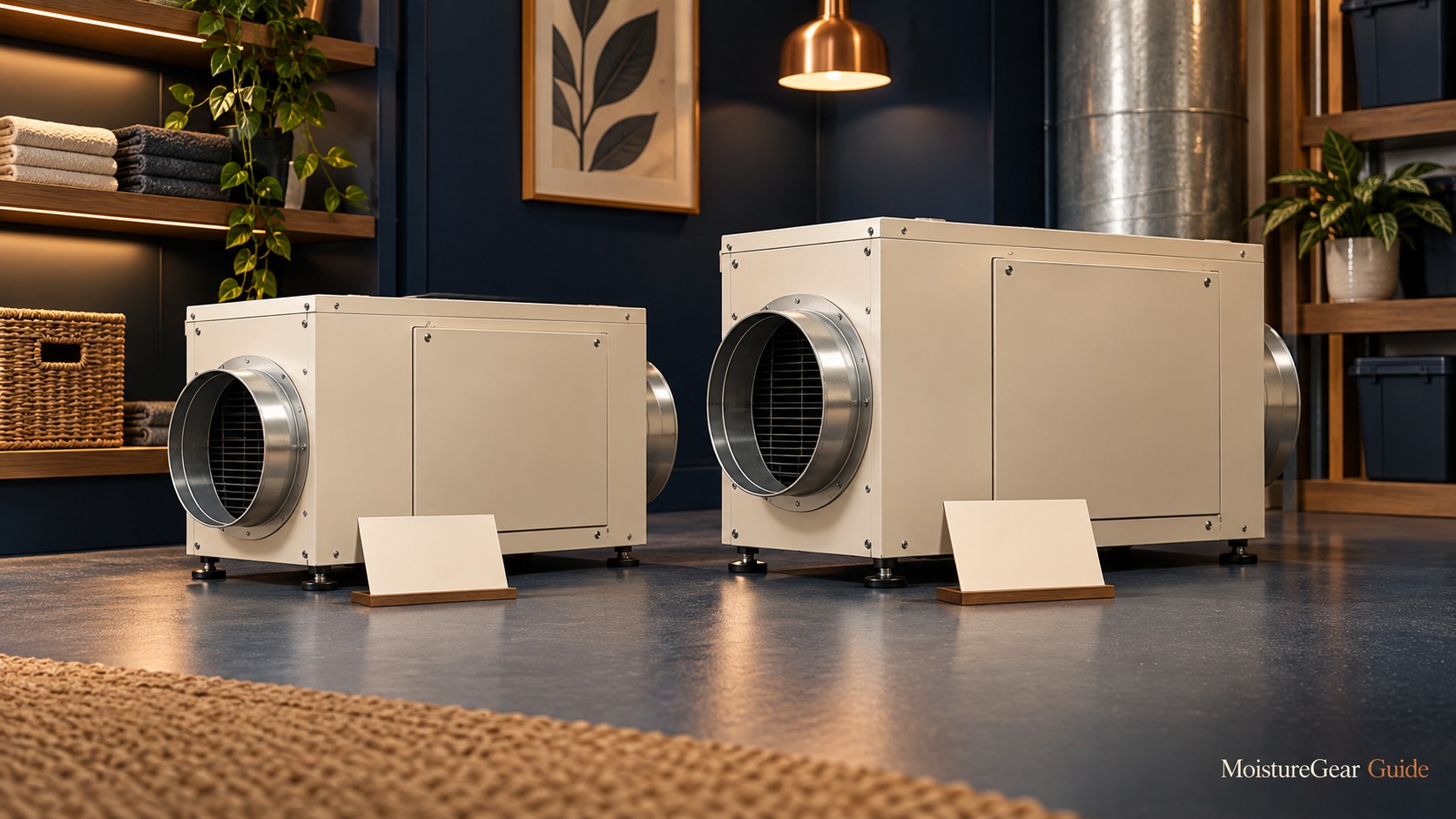
The AprilAire E080 vs E100 decision comes down to whether the E100's additional published capacity and blower performance solve a need in your installation. Both current non-W models use the same nominal cabinet dimensions, so choosing the larger model is not mainly a question of finding more floor space. It is a question of moisture load, duct resistance, power, and the complete installed price.
For a fair comparison, this guide uses AprilAire's current non-W manufacturer sheets: October 2025 for the E080 and July 2025 for the E100. The connected E080W and E100W remain separate configurations. We have not tested the products; this comparison interprets documented specifications and shows how to use them in a purchasing decision.
The differences you can verify
| Item | E080, current non-W | E100, current non-W |
|---|---|---|
| Capacity at 80°F/60% RH | 80 pints/day | 100 pints/day |
| Capacity at 73°F/60% RH | 65 pints/day | 85 pints/day |
| Dry-coil airflow at zero ESP | 185 CFM | 280 CFM |
| Dry-coil airflow at 0.2 in. w.c. | 135 CFM | 245 CFM |
| Dry-coil airflow at 0.4 in. w.c. | 85 CFM | 210 CFM |
| Published operating current at warm test point | 4.8 A | 6.7 A |
| Unit weight | 63 lb | 64 lb |
| Nominal cabinet W × H × L | 14 × 15 × 26 in | 14 × 15 × 26 in |
| Current-sheet refrigerant | R32 | R32 |
| Specified filter | Washable MERV 8 | Washable MERV 8 |
Use the current E080 sheet and current E100 sheet to verify the supplied equipment. Both are manufacturer-authored documents hosted by a distributor. Their dimension exclusions and measurement conditions are part of the specifications.
Twenty additional rated pints is meaningful, but conditional
At each of the two matching capacity reference points, the E100's stated removal exceeds the E080's by 20 pints per day. That is a useful difference when the smaller unit lacks capacity for the assessed moisture load.
The percentage difference changes with the reference point because the starting capacities differ. More importantly, neither reference point describes every indoor condition. Do not translate the table into a guarantee that the E100 will finish every household drying job a fixed percentage sooner.
If the incoming load is within the E080's available removal and the system is well designed, the additional E100 capacity may not provide a noticeable benefit worth the added installed cost. If the load exceeds what the E080 can manage, choosing it solely to save purchase money can produce a poor result.
Ask the installer to state which inlet conditions and humidity objective informed the recommendation. An explanation that names the load and available performance is more useful than “your house is large.”
Use the whole-house sizing guide to prepare that information.
Airflow may separate the models even when the load is similar
The blower figures show an important second difference. At the stated dry-coil pressure points, the E100 maintains more airflow than the E080.
This can matter in a retrofit where the dehumidifier must work through ducts, grilles, and dampers. It is still not a license to connect any duct route to the E100. The proposed design needs to remain within the equipment's permitted installation and resistance limits.
A restricted route can reduce useful performance in either model. Increasing pint capacity does not correct an undersized grille, collapsed duct, or badly located return path.
The contractor should select the machine and duct layout together. If the E100 is recommended mainly for airflow, ask what part of the route creates the requirement and whether a better layout changes the model choice.
Our ducted versus standalone guide explains why a permanent unducted or independent ducted arrangement can be appropriate even when central integration was the initial idea.
Identical nominal cabinets do not mean identical installed footprints
The table's dimensions describe the cabinet under the sheet's stated exclusions. They are not the total space required for installation and service.
Duct collars extend the equipment, supports or feet affect height, and filter-door access adds working space. The drain outlet also needs an accessible connection. Those factors matter equally for either model.
The route into the space needs verification as well. Hatches, stairs, doorways, and turns may be more restrictive than the final location. Plan future removal before closing in the installation.
Similar size can make the E100 a practical alternative where the E080 already fits, but the electrical supply and airflow design still need review. Do not substitute a model after the proposal is finalized without involving the installer.
If space is the controlling constraint, ask for an installation-envelope drawing or clear measurements. A cabinet-only dimension copied from a shopping page is not sufficient.
When the E080 is the more sensible purchase
The E080 is a strong candidate when its documented available capacity meets the assessed load and its blower fits the planned air route. That is a substantive reason to choose the smaller model.
It can also suit a permanent standalone installation serving a defined basement or enclosure, provided that the area is open enough for useful circulation and the operating conditions are appropriate.
Choosing the E080 may leave more of the budget for drainage protection, proper ducts, or useful monitoring. Those items can improve ownership more than capacity that the building does not need.
However, avoid buying the smaller machine because an advertised floor-area claim appears to cover the house. Such claims are not a substitute for assessing ventilation, leakage, occupancy, temperature, and distribution.
Read the E080 research review if that model appears to fit. It examines the version choice and the practical installation requirements in more detail.
When the E100 earns the additional cost
The E100 deserves preference when its added capacity addresses a documented shortfall under the expected conditions. The same applies when its blower performance is relevant to a compliant, well-designed duct route.
A planned change can also justify the step up. If the final design includes additional served rooms or a defined ventilation load, size the equipment for that completed system rather than an incomplete first stage.
Do not treat vague future-proofing as a requirement to buy the largest available unit. Identify the actual future change and whether the system can reach the new area.
The higher-capacity choice should also fit the electrical arrangement, drainage design, and support plan. The cabinet similarity is convenient, but it does not erase those checks.
The E100 review describes current and legacy model details so the recommendation is tied to the unit being supplied rather than the familiar name alone.
W models: decide connected control separately
AprilAire's W models add built-in connected features described on the E080W page and E100W page. That is a separate decision from moving up a capacity tier.
A homeowner may reasonably prefer the smaller capacity with Wi-Fi rather than the larger capacity without it if the assessed load supports the smaller unit and remote access is valuable. Another owner may prefer straightforward local control with the higher capacity needed by the site.
Do not assume the W suffix simply identifies the newer refrigerant. The current non-W sheets also list R32. Different revisions and stock can exist, so the product label and document revision remain necessary.
For a W-to-W technical comparison, obtain the matching W-model sheets. This non-W table should not be silently reused for electrical or blower values on connected models.
Check that a listing's title, images, supplied suffix, and warranty terms agree. The added convenience is worthwhile only when the promised configuration is actually delivered.
Drainage costs may be more important than the capacity price difference
Both model families use permanent condensate connections; a built-in collection bucket is not the ownership arrangement. A suitable gravity route or an accessory pump must be part of the installation.
The cabinet-price difference is therefore only one line in the budget. If moving the equipment to another location requires a pump, longer tubing, additional protection, or difficult access, those changes can outweigh the apparent savings.
A pump bundle should name the accessory, describe its route, and identify overflow protection. A drain fitting in the box does not establish that all required components are included.
The gravity versus pump guide helps choose the arrangement. Match the actual installation manual rather than copying a setup from an older product video.
Ask whether either model changes the selected drain or mounting design. If not, compare capacity and equipment cost within the same installation scope.
Compare electricity with the same humidity objective
The current E100 sheet lists a higher current draw at its stated rating point, but that alone does not establish the monthly cost difference. Runtime and actual power consumption also matter.
If the E080 runs extensively without holding the desired humidity while the E100 can meet the load, a simple comparison of nameplate figures misses the result. If both models meet the load, their duty cycles and total installation energy still need context.
A central fan may operate alongside either unit depending on the design. That energy belongs in a complete estimate where applicable.
Use the electricity-cost guide to calculate explicit scenarios with defensible watts, operating hours, and your tariff. Avoid converting current draw into a precise bill without accounting for real power and modes.
This comparison makes no measured savings claim for either model. The goal is choosing suitable equipment, then monitoring the completed system rather than promising that the larger unit is cheaper or the smaller one always is.
Read the efficiency row as carefully as the capacity row
The current non-W sheets list energy factor at two reference points. At 80°F/60% RH, the E080 sheet gives 2.8 liters per kWh and the E100 gives 2.6. At 73°F/60% RH, both sheets give 2.35 liters per kWh. These are the published sheet metrics at those conditions, not a complete installed-system energy assessment.
A buyer could select only the warm-point efficiency row and miss the larger model's useful capacity. Another could select only the larger pint number and ignore the metric entirely. Read capacity, efficiency, and conditions together.
Do not relabel these sheet values as independently measured ENERGY STAR integrated energy factor. That metric has its own defined procedure. Ask whether the quoted configuration appears in the relevant current certification listing before treating an older badge as present qualification. A contractor can help identify the relevant certified information for the supplied product.
The purchase decision should still use the assessed load and complete system. A laboratory efficiency reference does not account for a different duct layout, an additional central fan, or the runtime needed in your particular house.
Do not make a noise choice from unmatched ratings
Manufacturers and retailers may publish sound information, but numbers measured under different circumstances cannot support a confident ranking.
The experience in a house depends on where the unit sits, the mounting, duct and grille arrangement, distance to occupied rooms, and whether vibration travels into nearby surfaces.
Both models should therefore be discussed in the context of the proposed location. A machine behind a quiet office deserves different planning from one in an unfinished mechanical area.
Ask the installer about the layout and any approved measures for reducing nuisance. Avoid an improvised enclosure that reduces airflow or blocks access.
If noise is the deciding factor, seek comparable manufacturer information for the exact configurations or a relevant installed demonstration. Do not assume that the lower-capacity model is inaudible or that a larger unit will be disruptive everywhere.
Warranty and support must be included in the price comparison
Quotes should identify the purchase route and who handles a warranty fault. A contractor-supplied installation and an owner-supplied online purchase can allocate responsibilities differently.
Current promotional wording and older documents may not describe identical coverage. Obtain the actual terms for the supplied model, generation, and purchase date.
The manufacturer’s product warranty is separate from labor coverage. Removal, shipping, diagnosis, and reinstallation can remain expenses even when a defective part qualifies for coverage.
Ask whether the installer supports the exact unit you intend to purchase and whether the seller meets applicable requirements. A product found through an Amazon search is not automatically an authorized purchase route.
Use the warranty guide before deciding that one offer is better solely because its listing uses a longer year count.
A fair quote comparison
Have both proposals describe the same served area, humidity objective, duct layout, controls, drainage, mounting, electrical scope, and commissioning. Otherwise, the totals may not be comparable.
If one contractor recommends the E080 and another the E100, ask each for the sizing and airflow rationale. The difference might reflect a distinct load assessment, a different duct design, or a different assumption about ventilation.
Compare the assumptions before comparing brand familiarity or sales language. One proposal may rely on rooms remaining open while the other includes return pathways suited to closed doors.
The whole-house cost guide provides a budget framework so accessories and labor do not disappear behind an equipment subtotal.
A justified recommendation should remain understandable after the salesperson leaves: this model meets this requirement through this layout, with these important assumptions.
After commissioning, assess the rooms rather than the pint name
Monitor temperature and RH in representative locations once the system is operating normally. Include the rooms that created the original concern and observe them under ordinary door positions.
Initial operation may be longer while the building dries, and a mild-weather week may not demonstrate peak-season performance. Keep those conditions in the record.
If one room remains elevated, report the pattern to the installer rather than immediately regretting the smaller model. If all served rooms remain elevated, record settings, runtime, weather, and any drainage or filter issues so the cause can be investigated.
The AprilAire owner FAQ supplies useful operating context, while the matching manual controls the actual settings and maintenance.
Successful commissioning means the chosen system performs its intended job. It does not require collecting the rated maximum quantity of water every day.
Which one should you buy?
Choose the E080 when its capacity and airflow are sufficient for the assessed application. Choose the E100 when the documented extra performance answers a load or installation requirement.
Choose a W version when connected control is valuable, then verify the matching technical and warranty information. Keep legacy and current stock separate throughout the purchase.
The whole-house hub connects this comparison with sizing, installation layouts, and ownership costs. The better model is the one that fits a well-defined system objective, not the one with the higher number on the cabinet.
Selected sources
- Current E080 manufacturer specification, October 2025
- Current E100 manufacturer specification, July 2025
- Official E080W features
- Official E100W features
- AprilAire operating FAQs
About the author
Davis Murphy
Davis Murphy writes about dehumidifiers, indoor humidity, and home moisture control at MoistureGear Guide. His articles explain how to compare equipment, understand capacity ratings, and plan for drainage and maintenance. He focuses on clear, practical guidance to help readers choose a dehumidifier suited to their space and needs.