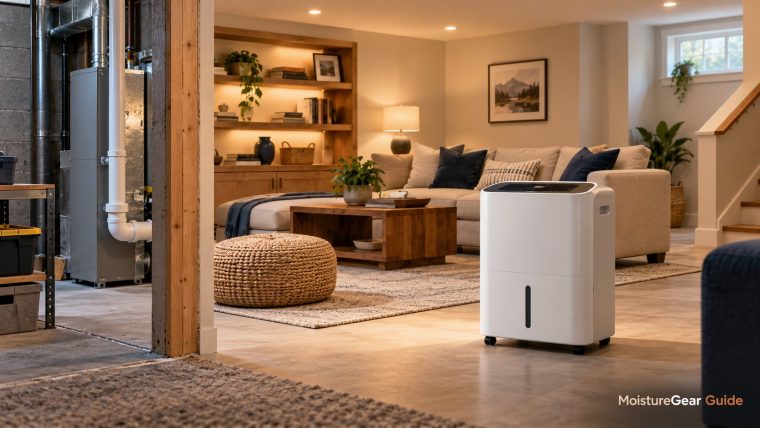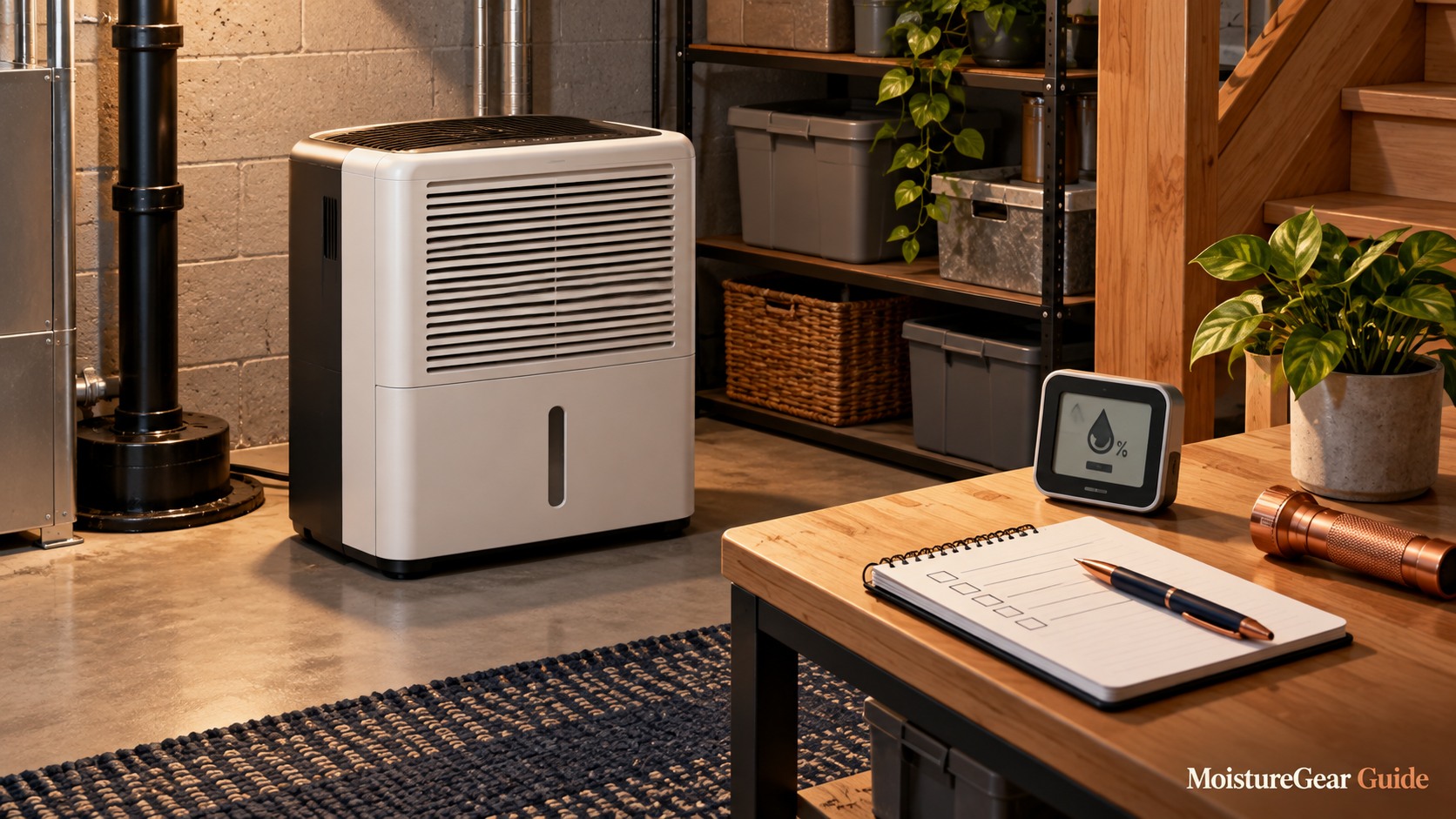
A basement dehumidifier running constantly is not automatically broken or too small. It may be recovering from an initial damp period, responding to a continuing moisture load, or operating in a mode that does not stop at the ordinary humidity target. What matters is whether the intended space is improving, which parts of the machine are operating, and whether water disposal and airflow are working as designed.
Start with the controls and a room humidity trend before ordering a replacement. A running fan is not proof that the compressor has been collecting water without interruption, and a low appliance display is not proof that a separate room is dry.
This guide covers safe observation and maintenance checks. It does not diagnose refrigerant faults or provide electrical repairs. Use the basement dehumidifier hub for the wider equipment and installation plan.
First define what you mean by “running”
Listen and look at the control indicators according to the owner's manual. Is the fan operating, is the compressor indicated, or is the machine in defrost? A pump cycle is another separate event.
Some equipment continues fan operation under particular conditions to circulate or sample air. Other controls stop the fan with drying. The intended behavior is model-specific, so a video of another appliance is not a reliable explanation.
Automatic defrost can also involve a fan running while active refrigeration pauses. The Danby DDR050BJP2WDB manual describes that distinction for its operation.
Record the actual symptom. “Fan audible all evening, room falls toward the target” is different from “compressor appears active all day, room stays elevated, little water collected.”
That more precise description will help you select the next check and will be useful if you contact support.
A quick way to organize the evidence
| Observation | Check first | What it does not prove |
|---|---|---|
| Humidity steadily falls during initial operation | Initial recovery and target | An immediate need for larger equipment |
| Display is near target but fan remains audible | Manual’s fan and sensing behavior | Continuous compressor operation |
| Humidity stays high and lots of water is collected | Incoming moisture and connected load | That every collected pint reflects normal air humidity alone |
| Humidity stays high with little collection | Temperature, mode, airflow, and manual troubleshooting | A particular refrigerant fault |
| Appliance area is dry, another room is damp | Doors, air paths, sensor placement | That capacity is the only limitation |
| Repeated full-water or pump warnings | Drainage and supplied instructions | That ordinary dehumidification settings will solve disposal |
Use the table to prioritize observations. Several problems can coexist, and no row replaces the manual or a service assessment.
Check one: the operating mode
Look for continuous, comfort, smart, laundry, or other named modes. Read how your model defines them rather than assuming every setting follows the same humidity target.
A continuous mode may deliberately request ongoing drying. An automatic mode may adjust behavior according to temperature or another control rule. A timer can change operation once without acting as a recurring daily schedule.
If you intended ordinary humidity control, select the documented mode and a suitable target. Then observe the room rather than repeatedly changing several controls at once.
App and local settings should be checked together on connected appliances. A remote schedule or another household member's setting can explain operation you did not expect.
Keep a note of the final mode and target. Without that record, it is easy to confuse a new operating request with a change in the appliance's ability to dry.
Check two: whether the target is unnecessarily low
Trying to hold a basement at the lowest available setpoint can lead to prolonged operation, especially during humid weather or in a cooler space. It does not necessarily reveal a malfunction.
The EPA’s guidance recommends indoor humidity below 60%, ideally 30–50% when possible. The practical target should also consider cold surfaces and the room’s use.
For many basements, a setting around 45–50% is a useful starting point for evaluation. That is not a universal prescription or a guarantee that all materials remain dry.
Compare the target with a representative independent meter. The appliance's sensor, display, and cycling behavior do not produce an identical room number every moment.
If the room is already within an appropriate range and surfaces are dry, ask what additional benefit you expect from forcing a much lower percentage. If surfaces remain wet, investigate the local conditions rather than assuming the answer is always a lower setpoint.
Check three: allow for an initial recovery period
A newly installed machine may be drying moisture from stored materials and surfaces as well as the room air. After a prolonged humid period, progress can take longer than a short trial suggests.
The Midea Cube manufacturer’s guide includes initial-use guidance and troubleshooting related to allowing time for moisture removal. Follow the instructions for your own unit rather than borrowing a universal number of hours.
Look for a trend at the same locations under comparable conditions. A downward trend with continuing collection is different from no improvement despite correct setup.
Weather and activity can complicate that trend. A storm, open exterior window, laundry session, or change in air-conditioning use may add load during the evaluation.
Do not apply a waiting period to active water damage or contamination that needs prompt attention. Routine humidity recovery and restoration after a leak are different situations.
Check four: inspect the permitted air path
Turn off and disconnect the appliance as required before user maintenance. Check the accessible filter according to the manual, and clean or replace it using the specified procedure.
Look for furniture, curtains, boxes, or stored items blocking the inlet or discharge. Required clearance is not just room for the cabinet itself.
An appliance squeezed into a recess can repeatedly treat its nearby air while the main basement remains damp. A filter filled by dusty work can also interfere with normal operation.
Do not remove a required filter to increase airflow or use cleaning chemicals that the manufacturer has not specified. The equipment should operate in its intended configuration.
Our placement guide explains air paths and service space. A location correction may be more useful than changing a capacity number.
Check five: consider the coldest operating conditions
Measure temperature near the intake and compare it with the exact model's permitted range. The reading upstairs or beside warm discharge is not a substitute.
Cool conditions can reduce useful moisture removal and increase the importance of defrost behavior. A low-temperature label does not mean the machine produces its rated output at the minimum.
ENERGY STAR’s buying guidance highlights lower-temperature suitability and frosting as practical considerations. Our cold-basement guide separates the operating limit from available capacity.
If temperature falls outside the range, stop treating continued operation as a capacity test. Follow the manual and ask for appropriate application advice.
Do not bypass temperature controls, chip ice away, open refrigerant components, or force operation with an improvised heater. Those actions do not establish that the unit is suitable for the basement.
Check six: find the continuing moisture source
An appliance can function normally yet face a load that never lets it catch up. Consider open exterior windows, frequent indoor drying, a displaced dryer exhaust, a bathroom source, and ongoing building moisture.
Look at rain response. New wetness at a wall, floor joint, or window well deserves investigation even if the machine collects water successfully.
University of Minnesota Extension explains why source correction belongs at the center of basement moisture management. Dehumidification alone does not repair runoff, seepage, or plumbing.
Also consider humid summer air meeting cold surfaces. The summer-humidity article helps distinguish those conditions from other sources.
Record when the appliance's workload increases. A pattern associated with laundry points toward a different correction from a pattern following every storm. That evidence is more useful than assuming the equipment is tired or inefficient.
Check seven: compare the appliance location with the troublesome room
If the local display falls but another room stays elevated, the equipment may not be receiving representative air.
Observe internal doors and storage barriers. A closed office, bedroom, or crowded bay can be separated from the appliance even though the whole basement falls inside its advertised coverage area.
Place independent meters in the relevant rooms, following their instructions. Avoid the immediate warm discharge, which can influence a nearby relative-humidity reading.
Do not move the machine constantly without tracking the result. Choose an arrangement, record normal door positions, and observe how the useful spaces respond.
A divided layout may require better air distribution or an appropriate permanent installation. The finished versus unfinished comparison explains why room divisions change the decision.
Check eight: make sure water disposal is completing its job
Drainage trouble can interrupt drying or create faults that are mistaken for ordinary prolonged operation. Look for full-water indications, pump warnings, an incorrectly fitted bucket, or water where it should not be.
For gravity drainage, inspect the route for rises, kinks, and obstructions. Use the intended connection and make sure the receiving point remains available.
For an integrated pump, check the documented pickup, bucket, reservoir, and mode requirements. A hose attached to the wrong outlet will not behave as a pump route.
Never bypass a full-water switch or leave an improvised open container as an unattended solution. If there is water near electrical components, follow safe shutdown and the manufacturer's support instructions.
The pump-not-draining guide gives further safe checks. If the disposal route is incomplete, improve that arrangement before judging whether the appliance has enough drying capacity.
Check nine: assess capacity after the basic checks
Only after mode, target, temperature, maintenance, sources, distribution, and drainage have been reviewed does continuous operation become stronger evidence of insufficient practical capacity.
Even then, use the room trend and actual application. Advertised floor-area coverage is broad guidance, not a guarantee for every basement.
ENERGY STAR explains why capacity figures depend on test conditions. An older 70-pint label and a newer 50-pint portable label should not be compared without their rating context.
The basement sizing worksheet helps organize measurements for a supplier or installer. Ask which load and operating conditions support a recommendation for larger equipment.
Do not replace a functioning portable solely because the new model has a larger saturation number. The capacity needs to be comparable and the installation needs to address the actual constraint.
A controlled observation period
Change one practical variable at a time when it is safe and appropriate. For example, correct an obstructed air path, choose the intended humidity-control mode, or manage an unnecessary exterior opening.
Keep the representative meters in the same positions. Record the target, temperature, humidity, activities, weather, and any full-water interruption.
Observe both progress and usability. Does the main room improve? Does the isolated room remain elevated? Is the water route functioning? Does the appliance operate within its manual's range?
This approach avoids confusing several simultaneous changes with proof that one correction solved the problem. It also creates useful information if progress remains poor.
Do not postpone a needed leak repair or professional assessment in order to complete an experiment. The observation period is for ordinary equipment/application questions, not continuing water damage.
What long runtime means for electricity cost
More compressor operation generally contributes to energy use, but an audible fan alone does not reveal the appliance's total consumption. Pump cycles, standby behavior, modes, and actual power draw all matter.
Use appropriate measured energy information where possible and permitted. Otherwise label the power and operating-hour assumptions clearly.
Our electricity-cost guide provides a calculation method. Avoid treating a universal monthly amount as your bill or assuming the rated current equals continuous running watts.
Correcting unnecessary moisture sources or an unrealistic target can be worthwhile. That is a reason to assess the application, not a promise of a particular savings percentage.
If the appliance controls the basement under a persistent legitimate load, substantial runtime can be part of doing the job. The question is whether the total setup is suitable and whether another arrangement would provide a justified improvement.
Compare energy information without creating another guess
If you use an appropriate plug-in energy meter with a portable appliance, follow both devices' electrical ratings and instructions. Measuring energy over an ordinary period can be more useful than multiplying a momentary reading by every hour in the month.
Keep the moisture and weather notes for that period. A measurement during initial recovery or unusually muggy weather should not automatically become a year-round estimate.
For hardwired or installed equipment, ask the installer about a suitable measurement method. Do not open electrical panels or alter wiring to obtain a reading. The aim is a clearer ownership estimate, not another diagnostic shortcut.
When to contact support or an installer
Use the manufacturer's service route for persistent error codes, abnormal sounds, visible damage, electrical concerns, or continued failure after the permitted user checks.
Provide the exact model and serial information, operating mode, target, measured temperature, humidity trend, and water-disposal arrangement. Include photographs of placement and any displayed code.
Do not identify a sealed-system fault from low collection alone. Low moisture availability, cold air, airflow problems, and control conditions can also affect collection.
An installer may be more useful than appliance service if the machine works correctly but cannot reach separated rooms or the load is outside a reasonable portable application. A building professional may be needed when active water intrusion dominates.
The strongest next decision comes from the evidence you have gathered. Constant sound is a symptom to describe; humidity progress, operating conditions, and source control explain what the basement actually needs.
Selected sources
- Danby DDR050BJP2WDB operation and troubleshooting
- Midea Cube operation, setup, and user checks
- ENERGY STAR: capacity, temperature, and placement
- EPA: indoor humidity and moisture sources
- University of Minnesota Extension: source correction

About the author
Davis Murphy
Davis Murphy writes about dehumidifiers, indoor humidity, and home moisture control at MoistureGear Guide. His articles explain how to compare equipment, understand capacity ratings, and plan for drainage and maintenance. He focuses on clear, practical guidance to help readers choose a dehumidifier suited to their space and needs.