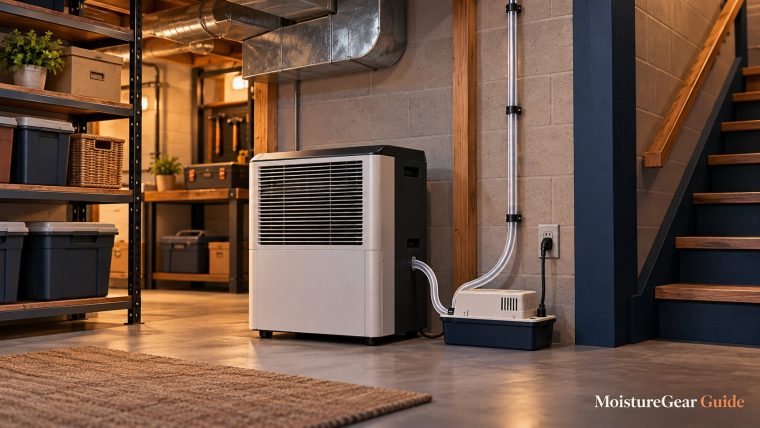
Deciding where to put a dehumidifier in your basement means balancing the air path, water route, electrical supply, and maintenance access. The middle of the floor is not automatically best, and the nearest drain is not automatically useful. A good location lets the appliance treat the rooms you actually want to dry while remaining stable, accessible, and within its owner's manual requirements.
For an open basement, a clear location in the main air volume is often a sensible starting point. For a divided basement, placement must account for doors and return paths. A single unit in a closed utility room should not be assumed to manage the rest of the floor.
Use this guide alongside the basement dehumidifier hub. It draws on manufacturer placement instructions and primary buying guidance; exact clearances and installation details belong to your model’s supplied manual.
Begin with an air-path sketch
Draw the main room, storage areas, occupied rooms, and stairwell. Mark which doors remain open during normal use. Then mark the areas where humidity or condensation is a problem.
An appliance's fan draws air from its surroundings and returns treated air. Walls, closed doors, cabinets, and narrow openings affect which air reaches it. The equipment does not treat every square foot merely because the floor plan lies within an advertised coverage area.
Choose a position where useful room air can reach the inlet and the discharge can mix with the connected space. Avoid a spot where the outlet immediately sends air back toward the inlet through a cramped recess.
Do not insist on geometric centrality at the expense of drainage or access. A position slightly off-center can work well in an open layout if the air path remains useful. A centrally located closed closet can work poorly.
For a permanent installation, the air-path sketch becomes part of the design discussion. The installer should identify intake, discharge, and how normally closed rooms participate in the system rather than simply mark the cabinet's location.
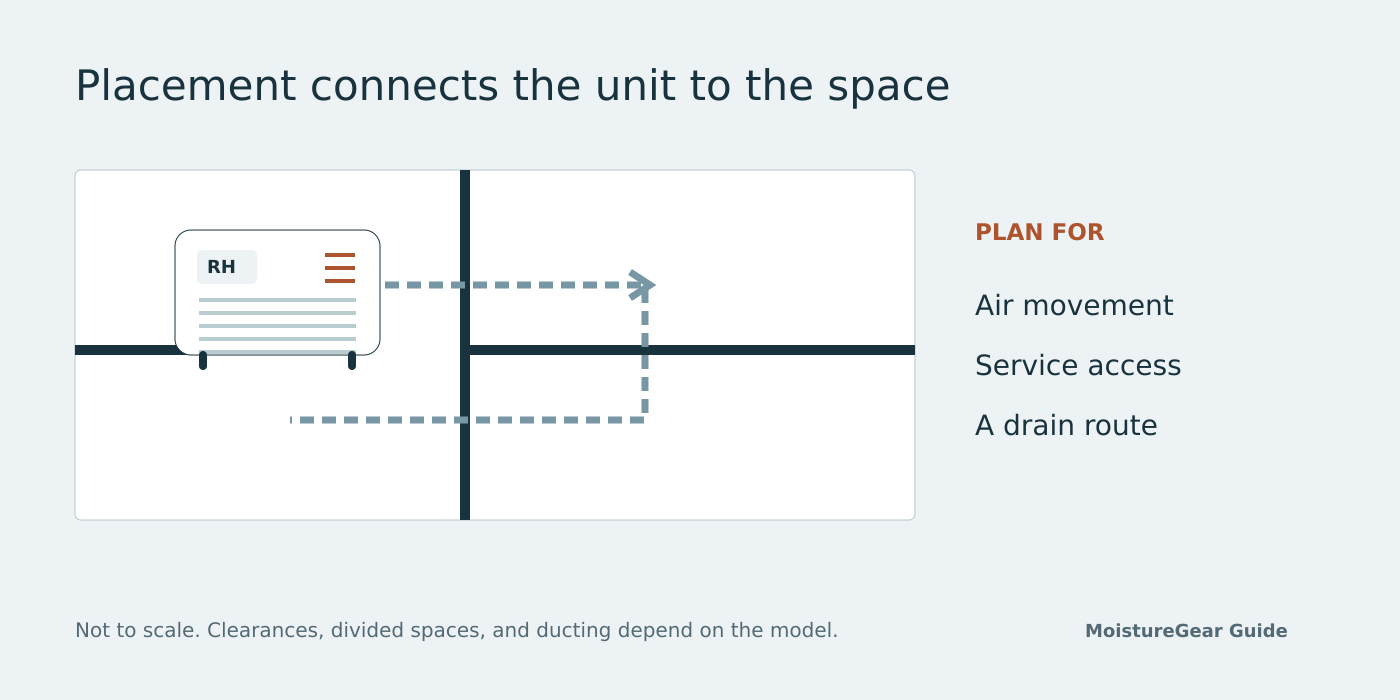
Read the airflow diagram for your appliance
Identify the inlet and outlet on the actual cabinet. Portables often discharge at the top, while other equipment has different arrangements. Filter access may be on the rear or side.
ENERGY STAR’s dehumidifier guidance explains why airflow and placement matter. Its general advice is a starting point; the equipment’s own instructions determine required space.
For example, the Danby DDR050BJP2WDB manual states minimum clearances of 16 inches around the air outlets and 8 inches on the other sides. Those values belong to that model, not to every appliance sold for a basement.
The Midea Cube model-specific guide also describes its air-space requirements and operating setup. The Cube’s handling arrangement means you should think beyond the footprint shown in a storage photograph.
Measure with the unit in its intended operating position. Leave additional practical room where you need to remove a filter, handle a bucket, inspect a connection, or lift part of the assembly. Minimum airflow clearance and comfortable service space are related but different.
Choose a stable floor surface
A portable should stand on a surface that meets the manufacturer's requirements and supports the appliance with its collected water. A level location also helps avoid unnecessary vibration and collection problems.
Check slopes in an older basement floor. The floor may pitch toward an existing drain, or an uneven section may make the cabinet rock. Do not assume that every visually flat area is stable under the appliance.
Carpeting can be unsuitable for a specific portable. Danby's manual expressly warns against placing the model above on carpet. Follow that instruction rather than choosing the spot that best hides the machine.
Avoid unstable furniture and improvised stacks used to increase drainage height. The ability to roll a portable does not mean it is safe on an elevated support. If a raised installation is needed, use an arrangement permitted for the equipment and properly designed for the load.
Keep water collection separate from outlets, cords, and devices. An unfinished basement is not a reason to disregard the ordinary separation between electricity and drainage.
Coordinate location with the water route
A gravity hose requires an appropriate lower receiving point and a continuous downward path. That may favor a location near a drain, but the location still needs useful air circulation.
Walk the complete hose route. Check thresholds, steps, shelving legs, and bends. A route that begins downhill can become unsuitable farther along, especially after furniture is moved.
An integrated pump may allow a better equipment location when the drain is above or farther away. Compare the documented lift and routing limits with your actual measurements. The highest point in the tubing can matter more than the final destination's height.
An external condensate pump introduces an intermediate reservoir. The appliance-to-reservoir path must drain as intended, while the pump's discharge follows a separate set of limits.
If there is no floor drain, start with our drain-destination guide. The gravity versus pump comparison explains why a location change and a drainage change often need to be planned together.
Five layouts and how to approach them
A single open unfinished room
Begin with a clear position within the connected air volume, away from storage that blocks the inlet. Favor an area where drainage can be inspected and the appliance will not collect unnecessary workshop dust.
You do not need to put the cabinet directly against the visibly damp wall. If water enters there, investigate the source. The dehumidifier's job is managing air moisture, not physically extracting water from a crack.
Use a meter in a representative area and another near the persistent problem if needed. If the far end remains elevated, inspect airflow obstructions and the room's moisture sources before assuming the machine belongs at the exact center.
A finished family room beside a utility area
Distance from seating may make the appliance easier to live with. A location on the utility side can be useful if the opening stays wide enough for air exchange and the equipment's own clearance remains intact.
If the door normally closes, do not evaluate performance only with it propped open for the trial. The intended arrangement needs to fit everyday use.
Place an independent meter in the family room. A dry reading in the utility area does not demonstrate that the television area receives enough treatment. Our quiet-basement guide helps balance sound with useful circulation.
A hallway serving bedrooms or offices
A hallway location may provide access to several rooms when their doors are open. It can also become a physical obstruction if the cabinet, cord, or hose intrudes into the path.
Consider room privacy and work routines. Doors closed for sleep, calls, or heating can isolate the spaces that need drying. A central hallway does not solve that condition by itself.
If the required doors must stay closed, ask about a designed distribution arrangement or separate suitable equipment. Do not assume a higher pint rating gives one portable the ability to treat every closed room.
A long basement divided by storage shelves
Open shelving and stored boxes can create effective barriers even without full-height walls. A dehumidifier beside the drain at one end may repeatedly treat local air while a distant bay remains elevated.
Look for a position that connects the main air paths without forcing tubing through traffic. Rearranging some storage may improve the setup more than buying another capacity class.
Keep the inlet away from dusty activities. Ordinary portable filters should not be treated as a replacement for source dust control or as permission to operate directly beside sanding or woodworking.
A dedicated permanent installation
Equipment designed for standalone or ducted use can provide more placement options, but those options depend on the exact product and installation.
A mechanical location needs clearance for filters, controls, drain components, and future service. Duct connections need to follow the permitted arrangement, and intake air must represent the space being controlled.
Ask the installer to explain the circulation path in plain language. If the machine sits behind a closed door, what moves room air to it and returns treated air? A good answer includes the intended system, not merely the cabinet's advertised airflow.
Should it sit close to the wettest spot?
Sometimes the troublesome area is a useful place to begin measurements. It is not automatically the best appliance location.
If the issue is condensation on cold surfaces, treatment needs to reduce the relevant air moisture and may require attention to the surfaces themselves. If the issue is active seepage, an appliance placed beside it does not repair the water entry.
University of Minnesota Extension emphasizes identifying basement moisture sources. That distinction is important when a visible problem tempts you to focus all equipment decisions on one wall.
Choose the location that treats the connected air while allowing you to monitor the vulnerable area. If one enclosed room is consistently wetter, it may need its own air-path solution rather than relocating the unit back and forth.
Avoid placing electrical equipment where it may be exposed to splashing, standing water, or the course of an active leak. Address those conditions before ordinary operation.
Internal doors and exterior openings need different treatment
Keep exterior windows and doors managed according to the moisture-control plan. In humid conditions, outside air can add moisture and enlarge the load while the machine runs.
Internal doors are about distribution. Opening an interior door may let the dehumidifier reach a room; closing it may intentionally separate an area you do not want to treat. Be explicit about which arrangement you are trying to achieve.
Do not block or alter required building ventilation, combustion-air provision, or a dedicated mechanical system because a generic guide says to close openings. Those systems need assessment in their own context.
For a basement receiving humid outdoor air in summer, the summer-moisture guide explains why opening windows can be counterproductive. The placement decision should work with the building’s intended ventilation rather than fight it.
Where to put the monitoring sensor
An independent humidity sensor helps you judge the room, not just the appliance's local conditions. Place it where it represents the area you want to control and follow the sensor's instructions.
Avoid the immediate warm discharge stream. A reading there can be influenced by the appliance's output and may not describe the air near furniture, stored items, or colder surfaces.
Also avoid placing it directly against a cold wall, beside a shower, above a dryer, or in direct sunlight unless the goal is specifically to investigate that localized condition. Label a problem-area measurement as such.
In a divided basement, compare two or more locations at similar times. You are looking for a pattern: whether all useful areas improve, whether one lags, and whether the difference follows door position or activity.
The basement hygrometer guide helps choose monitoring features. Data logging can be useful, but a carefully placed simple meter is more informative than a connected sensor in a misleading location.
Keep the maintenance path usable
Imagine a filter-cleaning visit before committing to the location. Can you see the controls, remove the filter, and reach the water connections without moving heavy shelving?
If bucket use is part of the plan, check how the container comes out and where you will carry it. The extraction direction matters. A cabinet can fit neatly under a table while its bucket does not.
If the appliance has a pump pickup or external reservoir, allow room for the maintenance prescribed by its manual. Concealing that part of the installation can make a simple inspection infrequent or neglected.
Store the manual and spare drain plugs where you can find them. If you change from pump to gravity or bucket operation, the unused outlet may need to be closed differently.
The best location is not merely one where the equipment fits today. It is one where maintaining the installed system remains straightforward.
Test a location before calling it final
Once the appliance is set up correctly, monitor the same representative areas under normal door positions and typical activities. Keep a short note of temperature, humidity, target, and water disposal.
Do not move the machine repeatedly during the first brief operating period without recording what changed. Otherwise it becomes difficult to tell whether weather, activity, or placement caused the result.
If the local reading improves but a distant room does not, look at air paths first. If all areas remain elevated, evaluate capacity, sources, operating temperature, and maintenance together. Our sizing guide provides that framework.
Inspect the drain during real discharge, not only before water appears. Check whether a person using the room can disturb the hose or cord. A technically working location can still be inconvenient if ordinary traffic keeps interfering with it.
For a permanent system, request commissioning that checks the occupied or vulnerable areas as well as the equipment. The cabinet's sensor cannot by itself prove that the whole intended basement is controlled.
A final location checklist
Before relying on the setup, answer four practical questions. Can useful room air reach the appliance? Can collected water leave by the intended route? Can the equipment operate safely on that surface and electrical supply? Can someone inspect and maintain it without dismantling the room?
If any answer is unclear, adjust the plan before decorating around the cabinet or concealing tubing. A small change now can avoid turning every future cleaning visit into a chore.
Keep a photograph and the location measurements with the model details. Those records are useful if you seek support, install shelving, or later convert the basement to another use. Placement is part of the moisture-control system, and changes to the room can change how well it works.
Selected sources
- ENERGY STAR: placement and drainage guidance
- Danby DDR050BJP2WDB manual and clearances
- Midea Cube setup and positioning instructions
- University of Minnesota Extension: moisture sources
About the author
Davis Murphy
Davis Murphy writes about dehumidifiers, indoor humidity, and home moisture control at MoistureGear Guide. His articles explain how to compare equipment, understand capacity ratings, and plan for drainage and maintenance. He focuses on clear, practical guidance to help readers choose a dehumidifier suited to their space and needs.