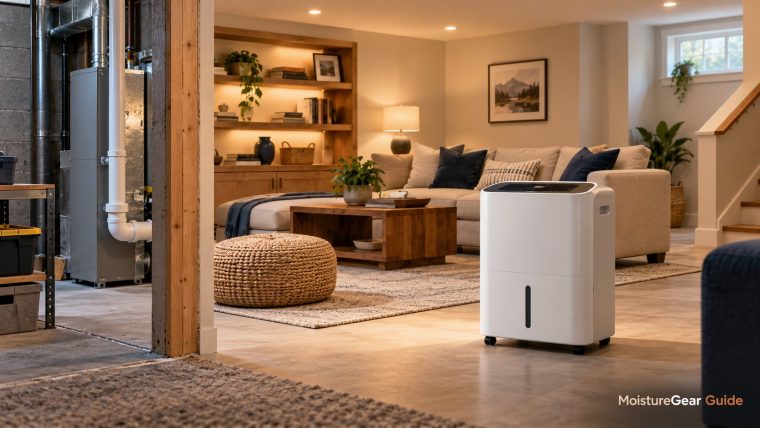
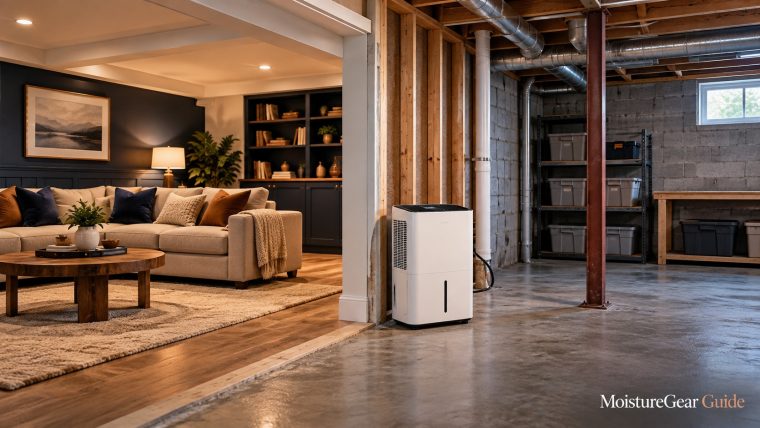
A quiet basement dehumidifier needs to suit the way you use the room, not just carry the smallest decibel claim on a shopping page. A steady fan can be acceptable beside storage shelves and distracting beside a microphone. A pump that runs occasionally may matter more during a film than a slightly different low-speed specification. The most useful purchase combines documented sound information with enough capacity, sensible placement, and an operating routine you can tolerate.
There is no independently measured “quietest” winner in this guide. We examine manufacturer specifications, point out missing test conditions, and explain how to build a shortlist for an office, television area, bedroom, or utility space. Our basement dehumidifier hub connects those choices with drainage and moisture-control planning.
Decide which sound problem you are trying to solve
Write down what the appliance would interrupt. Conversation, sleep, voice recording, and watching television are different uses. The distance to your chair and the room's background sound are also part of the experience.
A portable beside an office desk may transmit a continuous airflow sound into calls. A machine behind the television can mask quieter dialogue. A unit beneath a bedroom may be noticeable through the floor even if you rarely hear it downstairs.
Listen to the type of sound you already dislike if you own a dehumidifier. Is it a smooth rush of air, a low compressor hum, a vibration against the floor, or an occasional pumping sound? That distinction helps you avoid buying a new machine to solve a placement or maintenance issue.
Do not assume that the problem is the same at every fan speed. A lower setting may change airflow sound while leaving the compressor's character noticeable. A timing plan might help an office but fail if it lets the basement become persistently humid between work sessions.
The right question is what combination of equipment and room use will work. A universal ranking cannot answer that without comparable measurements and a definition of acceptable sound.
What a published dBA figure actually provides
Manufacturers sometimes state sound pressure in A-weighted decibels, commonly written dBA. The weighting is part of how the measurement represents sound across frequencies. It is not a complete description of the sound's character.
For a useful comparison, you need to know the operating mode, fan setting, distance, test environment, and whether the compressor and pump were included. A specification that omits those details may still describe the manufacturer's product, but it does not justify a precise cross-brand ranking.
Measurements taken close to a machine and farther away cannot be treated as the same test. Neither can a low-fan figure be compared fairly with another model's high-fan or unspecified figure.
Sound pressure and sound power are also different measurements. A table that mixes them creates a numerical comparison without a consistent basis. If a seller merely says “decibels,” ask what that number describes.
Avoid translating a brochure figure into a promise that you will not notice the appliance. Tonal hum, startup changes, vibration, and pumping can matter even when a single averaged reading looks appealing.
One useful example: documented figures for an exact Frigidaire model
The FHDP5033Y1 specification sheet, dated February 2026, lists 49 dBA at low fan and 51.5 dBA at high fan. It also identifies two fan speeds. Those are published manufacturer figures, not results from our testing.
That makes the FHDP5033Y1 a reasonable model to investigate if you want a portable with an identifiable sound specification. It does not prove that the model is quieter than every competitor.
The sheet does not explain the full measurement setup. We therefore use its figures to describe the model and its stated modes, rather than build a ranked list against products measured under unknown conditions.
Its integrated pump adds another operating event to consider. The fan specification should not be read as a separate guarantee about pumping sound or startup behavior. If your main concern is sleep or recording, ask the manufacturer about the modes relevant to that use and choose a seller with an appropriate return policy.
The exact model is important. Noise results for an older Frigidaire portable should not be transferred to this Y1 unit because the cabinets look related. If a marketplace offers a selectable family of models, verify which one the price and order identify.
How to read other candidates without inventing a ranking
Some products have a model-specific sound figure. Others provide a broad brand statement, a marketing adjective, or no useful published measurement. Those evidence levels should remain visible.
Danby's DDR050BJP2WDB product page includes a general dehumidifier sound answer in its FAQ. That broad statement is not enough to assign one exact value to this unit or rank it against the Frigidaire’s low setting.
Midea's MAD50PS1QWT-A Cube page documents its pump and smart features. Those features can be useful for ownership, but they do not establish a comparable sound result in the information used here.
AprilAire's E080 allows a different installation discussion. Equipment in a dedicated space with professionally planned airflow may be a better approach than placing a portable beside the sofa. That is an installation possibility, not a claim that the E080 has the lowest sound output.
| Evidence available | What you can reasonably infer | What you should not infer |
|---|---|---|
| Exact model, operating mode, full test conditions | A meaningful comparison with the same method | Guaranteed acceptability in every room |
| Exact model figure, incomplete conditions | Manufacturer’s stated sound for that model | A precise ranking against another brand |
| Brand-wide range or “quiet” description | A starting question for the supplier | Exact sound of the purchased SKU |
| No relevant measurement | Need for more information or a practical trial | Silence, exceptional quietness, or a made-up score |
A transparent shortlist is more useful than awarding a quietness rating from specifications that cannot be compared.
Three arrangements worth considering
A portable in the occupied room
This is the most straightforward arrangement when the basement is open and you can leave the appliance several useful steps from seating. Choose a model with suitable capacity, selectable fan operation, clear documentation, and a cabinet arrangement that allows safe placement.
The Frigidaire above is a candidate because it has published mode-specific figures, not because those figures prove an overall win. Other portable models may fit equally well if their documentation and purchase terms support your needs.
Keep the filter and air path clear. Position the unit where it will not touch furniture, a loose door, or another object that can rattle. Allow the specified inlet and outlet space even when the room looks tidier with the cabinet pushed into a corner.
The compromise is that you will hear equipment doing its work in the same room. If that is unacceptable during normal use, consider a different arrangement before expecting a minor change in advertised sound to solve everything.
A portable in an adjacent connected area
An adjoining utility or storage area can create distance while leaving the occupied room open to treatment. The idea works only if air can actually move between the areas.
A closed door defeats the arrangement when the dehumidifier samples and treats only its own room. A narrow opening or a distant corner can also limit how well the setup reaches the damp zone. Verify humidity in both areas rather than trusting the appliance's display.
A pump may allow a more favorable location for sound while still reaching a suitable drain. That benefit has to be weighed against the complete tubing route and service access. Read our pump-equipped basement guide when drainage is what limits your placement.
Choose this approach when your normal room layout already permits useful air exchange. Avoid turning it into an improvised closed enclosure with a grille added by guesswork.
Permanent equipment with planned air distribution
For a divided finished basement, professionally designed equipment placement may be more effective than repeatedly trying quieter-looking portables. A dedicated unit can be positioned and ducted according to its intended installation.
That plan should address air noise at the grilles, sound transmitted through ductwork, support and vibration, return paths, and access. Moving the compressor away does not make every other sound disappear.
Ask the installer where you will hear airflow during a quiet evening and whether the intended control location represents the occupied rooms. The system needs to manage both humidity and usability.
Our whole-house versus portable comparison explains when the installation investment makes sense. It is relevant even when the proposed permanent system serves only the basement, because the practical distinction is equipment arrangement and distribution.
Capacity and noise interact
An undersized dehumidifier may need long operating periods yet fail to reach the target. A machine that cannot manage the load does not become a good quiet choice simply because its fan has a gentle low setting.
A larger unit might reach the target more quickly in some circumstances, but that does not prove a lower average sound level or a guaranteed quiet schedule. Its airflow, compressor, control behavior, and actual moisture load still matter.
Use the basement sizing guide to establish a sensible capacity class first. Then compare sound information within the designs that plausibly fit the space.
If you plan to operate mainly on low fan, confirm that the equipment still controls the troublesome rooms. Lower fan speed can affect circulation and drying behavior. A local reading near the appliance cannot establish that a closed bedroom or distant storage area is also dry.
The useful trial is not only whether the sound feels softer. It is whether the combination of that mode, runtime, placement, and humidity control works during ordinary basement use.
Placement can improve or worsen what you hear
A stable floor helps avoid unnecessary vibration. Follow the surface requirements in the owner's manual. The Danby guide, for example, includes leveling and floor guidance relevant to operation and noise troubleshooting.
Do not balance equipment on a soft improvised pad, a wobbly stand, or furniture merely to move it away from the listener. Supports must keep the unit stable and respect its operating and drainage requirements.
Keep the cabinet from contacting shelving, wall trim, or loose storage items. A hose can also transmit or create a rattle if it is pulled tight against an object. Check the simple physical arrangement before concluding that the compressor itself is faulty.
Hard unfinished surfaces tend to make the character of machinery more noticeable than a furnished room, but adding fabric around the unit is not a solution if it blocks airflow or creates another damp surface. Deal with room acoustics away from the appliance's clearances.
Our basement placement guide balances sound, airflow, and access. The best-looking hidden spot is often less useful than a slightly more visible location that works.
Schedules can help, with a measurable limit
If your basement is an office used for a predictable work period, you might operate before or after calls. For a television area, an evening pause may be acceptable if the room remains controlled.
Treat that as an experiment, not a universal recommendation. Record humidity during the pause and again when you restart. Check the coldest vulnerable surfaces and any room farther from the appliance.
A schedule that avoids sound by allowing humidity to remain high is not succeeding. Similarly, setting the target unnecessarily low before a quiet period may create extra operation without a clear benefit.
Use the equipment's intended controls. Do not repeatedly interrupt power with a generic switching device unless the manufacturer permits that arrangement. Compressor restart rules, connected settings, and pump operation can be model-specific.
The electricity-cost guide can help estimate the effect of operating hours, but hours alone do not establish total energy use. A quieter routine needs to remain a functional moisture-control routine.
Pumps deserve separate attention
Pump discharge can be intermittent rather than a steady background sound. That may make it more noticeable in a quiet room even if it lasts briefly.
If gravity drainage is feasible, it avoids a pump motor in that arrangement. It does not silence the fan and compressor, and the receiving drain can still make water noises.
An external condensate pump gives a different placement and service possibility, but it adds equipment and must be compatible with the dehumidifier and discharge route. Do not promise a quieter result without assessing where that pump will operate.
For a pump-equipped portable, check the pickup, tubing, and required bucket position according to the manual. An abnormal sound accompanying poor drainage is a maintenance or service question, not simply a normal inconvenience to ignore.
A specific owner's guide may describe sounds expected during initial pumping. That information is useful only for the matching product. A reassuring comment in a review of another model is not a diagnosis for yours.
A simple listening and humidity trial after delivery
Before making furniture changes, set up the appliance in its intended location and observe ordinary operating modes. Listen from the chair, desk, or bed that motivated the purchase, not only while standing over the cabinet.
Make note of low and high fan, compressor operation, transitions, and any pump cycle you can observe. Keep the same room arrangement while comparing. A phone recording can help document a rattle for support, but an uncalibrated phone reading is not a laboratory sound test.
At the same time, log humidity in representative areas. The quieter mode should still manage the room. Give the appliance the manufacturer's recommended initial operating period before judging steady-state use.
If the sound is objectionable, first check the floor, bucket fit, clearances, and nearby contact points. If it remains unsuitable for the room, use the seller's stated process within the permitted return period rather than building an unauthorized muffling enclosure.
A practical trial also exposes problems no brochure can show: a display light at night, an inconvenient beep, hose interference with the door, or controls that family members struggle to reach. Those details are legitimate reasons to choose a different arrangement.
When a new noise needs support
A persistent metallic rattle, grinding sound, electrical smell, visible damage, or sudden change in operation should be assessed according to the manufacturer's safety and service instructions. Do not open sealed covers or change internal mounting parts to experiment with quietness.
For a portable, safe user checks generally focus on external placement, the filter, bucket seating, and unobstructed airflow. The manual defines what you are allowed to inspect or clean.
If the cabinet vibrates only when touching a shelf, moving the shelf away may solve the symptom. If the noise continues on the prescribed stable surface with no contact, describe it to support with the exact model and operating mode.
Retain a short account of when the sound began and whether humidity control or drainage changed at the same time. That is more useful than telling a technician only that the machine is loud.
Check the purchasing terms for a sound-sensitive room
When you cannot obtain a comparable acoustic test, a practical room trial becomes especially valuable. Read the seller's return terms before ordering, including the permitted condition of the product, timing, and responsibility for return transport. Those details can affect whether a trial is realistic.
Confirm that the offer identifies the exact model whose specifications you reviewed. A selectable product family may associate one photograph or a collection of reviews with several different appliances.
For an installed system, agree on the intended occupied-room outcome and commissioning process before work begins. Ask how concerns about vibration or grille sound would be assessed. A clear installation scope is more useful than a broad verbal promise that the equipment is quiet.
Choosing for the room you actually have
For an open storage basement, prioritize useful capacity, drainage, and a tolerable ordinary sound. There may be no reason to pay for an elaborate installation merely to make a seldom-occupied area quieter.
For an office or recreation room, investigate mode-specific specifications and placement before purchase. The Frigidaire FHDP5033Y1 is one documented candidate, but it still needs a practical room assessment.
For regularly closed finished rooms or a particularly sound-sensitive space, ask about planned air distribution with equipment outside the main occupied area. The finished versus unfinished basement guide explains why layout changes that decision.
A good quietness choice is transparent about what is known. Published numbers, installation planning, and an honest trial can support a purchase. Unsupported claims of silence cannot.
Selected sources
- Frigidaire FHDP5033Y1 sound and airflow specifications
- Danby DDR050BJP2WDB manual
- Midea Cube MAD50PS1QWT-A features
- AprilAire E080 installation category and product information
- ENERGY STAR: selecting and positioning dehumidifiers

About the author
Davis Murphy
Davis Murphy writes about dehumidifiers, indoor humidity, and home moisture control at MoistureGear Guide. His articles explain how to compare equipment, understand capacity ratings, and plan for drainage and maintenance. He focuses on clear, practical guidance to help readers choose a dehumidifier suited to their space and needs.