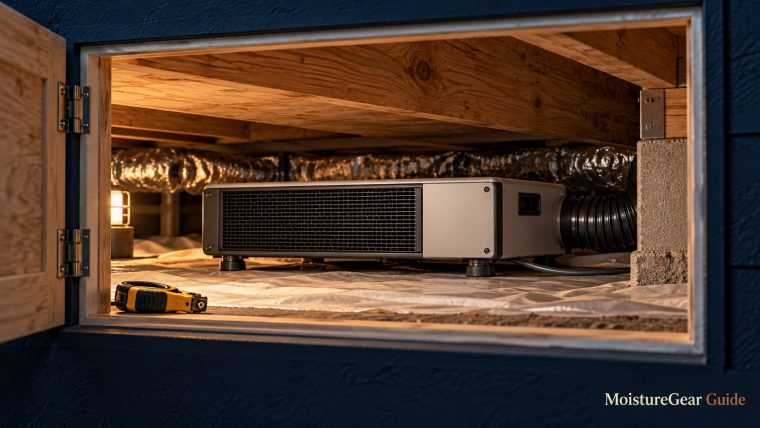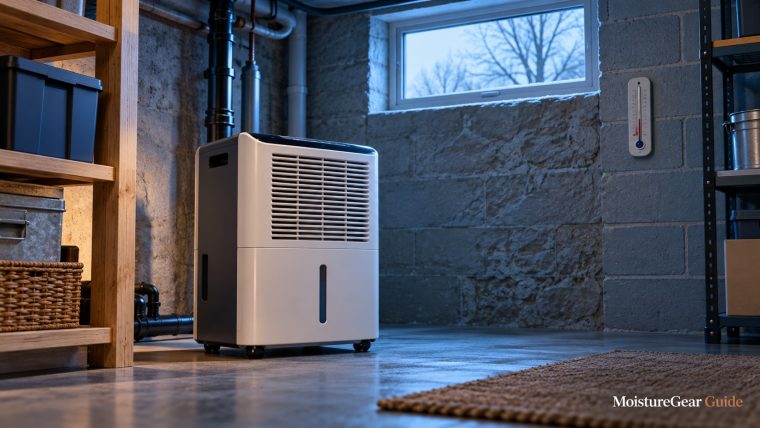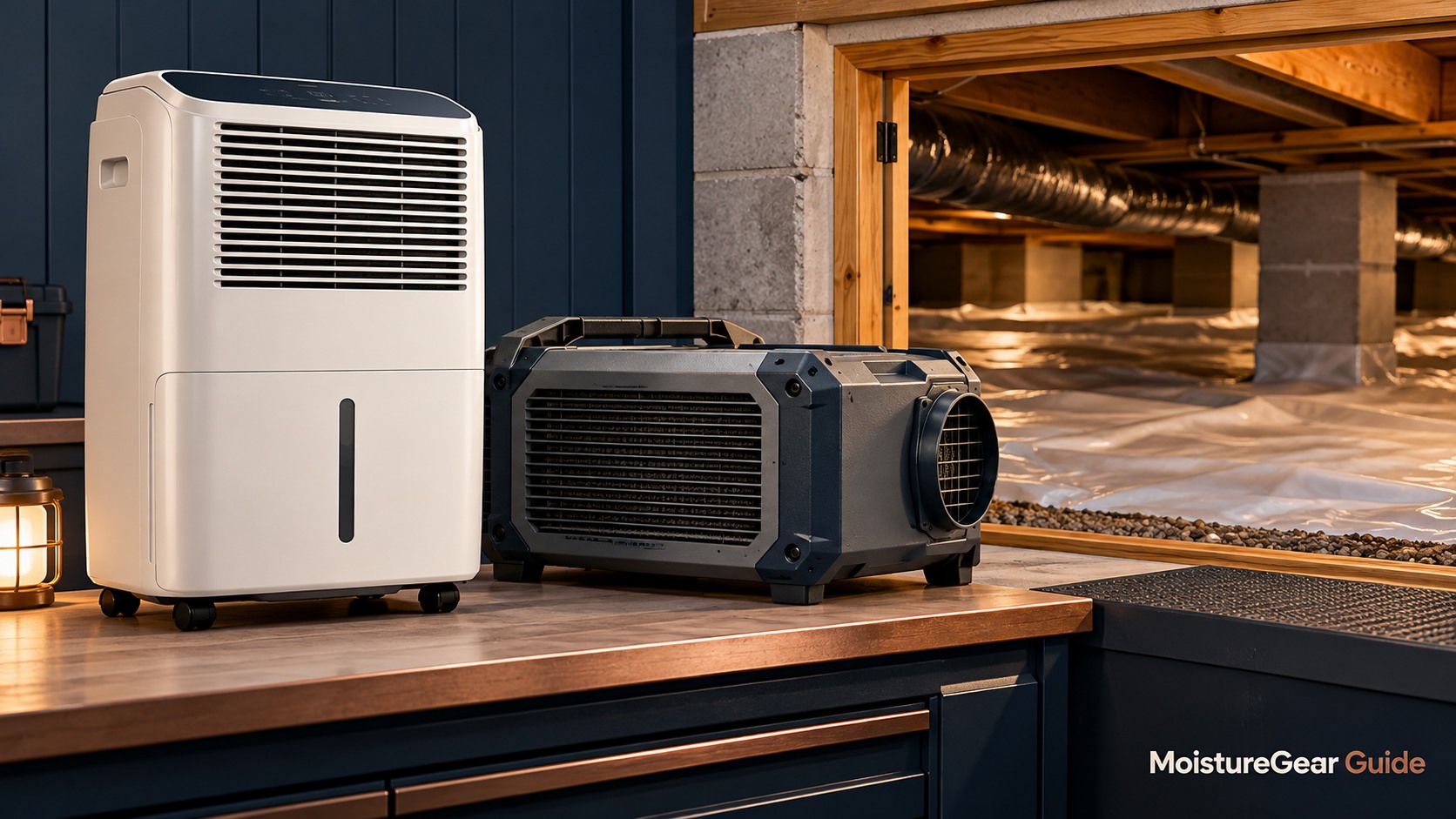
The decision behind “can you use a regular dehumidifier in a crawl space” comes down to the appliance’s approved application, temperature limits, drainage, and access. A portable room unit may be a workable choice in a suitably protected, accessible space when its manual permits the conditions. It is a poor choice if installation depends on ignoring those limits or repeatedly crawling under the home to empty a bucket.
The distinction is practical rather than purely a label. Equipment marketed for crawl spaces often offers a low cabinet and permanent drainage, while a room appliance may prioritize easy movement and a removable tank. Neither description proves that a particular model suits your home. Our crawl-space equipment hub connects the sizing, placement, and specialist buying guides.
When a room dehumidifier may make sense
A portable unit is worth evaluating when the space is accessible, the environment falls within its documented operating limits, and the appliance can remain upright with suitable clearance. There should be a safe electrical supply and a drain arrangement that does not depend on frequent bucket handling.
It can also be a reasonable existing-equipment assessment. If you already own a suitable machine, you do not have to assume it is useless simply because the product name does not say “crawl space.” Check the manual, model details, condition, and recall status before considering a trial installation.
The useful test is whether the complete arrangement works. Can the filter be reached? Can the outlet drain continuously through a permitted configuration? Does the equipment fit without touching a beam or obstructing the inlet? Can independent readings show that the intended space is controlled?
If the answer to those questions is uncertain, investigate before operating the unit unattended. A lower equipment cost is valuable only when the installation and maintenance remain appropriate.
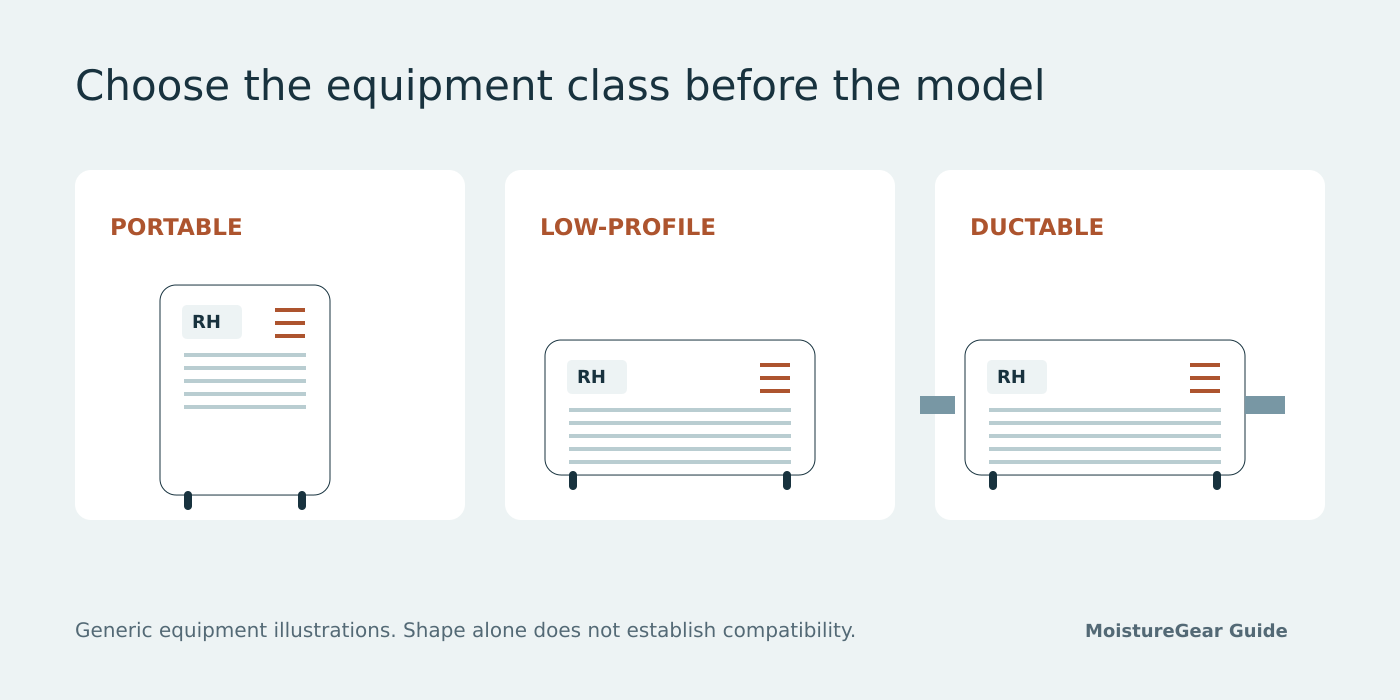
The differences that matter
| Buying consideration | Portable room equipment: what to check | Crawl-space equipment: what to check |
|---|---|---|
| Cabinet shape | Height, handles, wheels, and clearance at the inlet/outlet | Low cabinet dimensions plus supports and service envelope |
| Water disposal | Bucket access, approved continuous outlet, or pump mode | Gravity configuration, integral pump, or external pump kit |
| Temperature | Actual allowed range for the model | Actual allowed range and any cooler-condition performance data |
| Control | Humidistat behavior and restart instructions | Built-in control, approved remote sensing, or supported controller |
| Maintenance | Filter and bucket removal space | Filter side, drain access, and authorized service route |
| Capacity | Published test conditions behind the pint figure | Published test conditions behind the pint figure |
| Support | Model-specific warranty and service process | Model-specific warranty and service process |
This table identifies questions, not universal advantages. A portable appliance can have a pump, and a specialist cabinet can use gravity drainage. Compare the actual equipment rather than attributing every feature to a category.
Read the intended-use instructions first
Look for the permitted environment, electrical requirements, operating orientation, clearances, and water-disposal instructions. “Indoor use” is not a complete answer to whether the particular crawl-space conditions are suitable. A protected enclosed space and an area with persistent water entry are not the same application.
If the manual does not address the intended arrangement clearly, ask the manufacturer using the exact model number. Describe the crawl-space temperature range, humidity, drainage route, access, and risk of water exposure. An answer tied to that situation is more useful than a retailer’s general assurance that the appliance is powerful.
GE’s operating-condition guidance illustrates the importance of model-specific temperature limitations and adequate circulation. Treat it as guidance for the relevant GE equipment, not a universal operating range for every dehumidifier.
Keep the manual with the purchase records. If the unit is old or borrowed, obtain the correct manual rather than copying instructions from a similar current model. Equipment that shares a brand name can have different controls, drainage modes, and limits.
Temperature may be the deciding factor
Many crawl spaces are cooler than the conditions used for a warm-capacity headline. A room appliance that works well in a living area may behave differently below the home. Frost control can affect operation, and a permitted low temperature does not guarantee unchanged water removal.
ENERGY STAR’s buying guidance advises choosing equipment specified for lower temperatures when the space is typically below 65°F. That is a screening question, not a statement that every model stops working at the same temperature.
Check actual temperatures across the season when moisture control is needed. A warm measurement near an appliance or during one summer afternoon may not represent the coolest operating periods. A monitor that records both temperature and humidity gives you a more useful picture.
If cool conditions dominate, compare equipment using documented performance and operating limits. Our cold-basement dehumidifier guide addresses this issue. Do not improvise heating or disable defrost protection to make a room unit operate outside its instructions.
Bucket emptying is usually the wrong ownership plan
A portable tank can be convenient in a room where it is easy to reach. In a crawl space, repeated trips to empty it may be difficult or impractical. When the tank fills, the appliance’s normal shutoff can stop dehumidification even though the space still needs control.
The problem is not the existence of a bucket; it is relying on access that you will not realistically maintain. Consider how often the arrangement might need attention during humid periods, who would do it, and whether the route can be used safely while carrying water.
A supported continuous-drain mode can change the decision. Check the required outlet, hose, slope, and bucket position in the manual. Some equipment requires a tank or fitting to remain properly installed even when using another drainage mode. Do not bypass sensors or modify the case to avoid a full-bucket response.
A specialist unit with permanent drainage may be a better ownership choice where bucket access is unacceptable. That benefit should be weighed against the complete cost, not treated as proof that all room units are unsuitable.
Continuous drainage still requires a real plan
A hose outlet does not make water disposal automatic in every location. Gravity drainage needs the route specified by the appliance instructions, and a pump needs a compatible discharge arrangement. An elevated termination can rule out a gravity-only installation even when the destination is nearby.
Measure the path and settle the approved destination before placing equipment. Keep the line accessible where practical and avoid creating an obstruction along the crawl route. A kinked or displaced hose can defeat a good equipment choice.
If you add an external condensate pump, evaluate its inlet arrangement, power, controls, lift, and service access. The pump should be compatible with the dehumidifier’s gravity outlet and the full installation. It is not enough that water appears to reach the reservoir during a brief test.
Our gravity-versus-pump guide and condensate-pump buying guide explain those decisions. Keep the appliance manual and pump instructions together so the installed system satisfies both.
A taller room cabinet can create access problems
Measure the hatch and the route to the intended position. A room appliance’s handles, wheels, or tall case may matter even if its published width looks small enough. There may be a tight turn immediately inside the opening that prevents safe movement.
At the final location, allow room for the required air path and routine maintenance. A machine tucked beneath a beam may fit physically but leave no space to remove the tank or filter. Consider authorized service access and eventual removal as well.
Do not place the machine on its side to fit a low space unless the manufacturer expressly allows the operating orientation. Transport instructions also need to be followed. A cardboard cabinet mock-up can assist planning but cannot establish that an appliance can safely be handled the same way.
If cabinet fit is the limiting issue, our low-profile crawl-space shortlist compares compact designs. The shorter machine may provide a more workable installation even when a room unit would have sufficient published capacity.
Compare pint ratings fairly
A room appliance advertised as fifty pints and a crawl-space machine advertised as fifty-three pints may not have been rated at the same conditions. ENERGY STAR explains that portable testing uses a cooler temperature than older warm-condition ratings.
Read the temperature and humidity associated with each number. A saturation figure from a crawl-space listing should not be set against a cooler-standard figure from a room appliance and interpreted as a direct advantage. Model names and large package graphics can obscure the underlying comparison.
Sizing also depends on moisture sources, enclosure, and circulation between sections. An appliance can meet a nominal area claim yet struggle when humid outdoor air enters continuously or when a separate bay receives little dry air.
Use our crawl-space sizing guide to build the site description before choosing by capacity. If the existing portable unit controls the environment under permitted conditions, a category label alone does not justify replacing it.
Specialist equipment does not repair water entry
Replacing a portable appliance with a permanent unit will not repair a torn ground cover, plumbing leak, or exterior drainage defect. These can contribute moisture regardless of the cabinet used. A higher extraction rating should not distract from the source investigation.
PNNL’s water-management guide separates bulk-water work from the enclosure and humidity-control plan. That is a useful distinction when considering an upgrade. Assess the source and then size for the conditions expected after the work.
The appliance also does not establish completed mold cleanup or structural soundness. A favorable RH reading can coexist with materials that need assessment. Treat those concerns as separate work rather than assuming a more expensive dehumidifier resolves them automatically.
If the crawl space contains standing water, suspected contaminated water, exposed wiring, or damaged structural components, arrange professional help. Equipment selection can resume once the conditions are appropriately addressed.
Check older equipment for recalls and condition
Before moving an older room appliance into an out-of-sight area, identify its exact model and date information. Check current CPSC recalls and the manufacturer’s notices. Recall status belongs to the specific equipment, not an assumption about a whole brand or product category.
CPSC’s Gree dehumidifier warning illustrates why this matters for older machines. If your unit is affected by a recall, follow the recall instructions rather than treating previous trouble-free operation as reassurance.
Inspect the accessible cord, plug, cabinet, and drain components without opening the appliance. Damage, overheating signs, unusual smells, or electrical problems call for appropriate service or discontinuation of use, not an improvised repair.
A cheap used appliance is not automatically good value once its condition, missing manual, or uncertain service position is considered. The same model-specific diligence applies to secondhand specialist equipment.
Compare total ownership rather than category prices
A portable machine may cost less to buy, but the complete arrangement may still require a pump, supports, tubing, monitoring, and installation work. Specialist equipment may offer a more convenient cabinet and drain arrangement, but that does not guarantee a lower lifetime cost.
Do not assume that either category lasts a particular number of years. Published warranties, online reviews, and cabinet material are not independent reliability studies. Compare the actual support channel, component coverage, freight responsibility, and work required to remove the unit for service.
Running cost also needs real assumptions. Appliance size, electrical rating, efficiency, moisture demand, and operating time interact. A bigger machine may complete some tasks sooner, but a universal energy-savings claim requires evidence that a simple product comparison does not provide.
Our electricity-cost guide provides a transparent calculation method. Use estimates to compare scenarios, then revise them with operating data rather than presenting a guessed monthly cost as a measured result.
A sensible existing-unit assessment
If your portable appliance appears suitable, begin with a documented installation rather than an unstructured experiment. Confirm the permitted application, operating conditions, access, and drain plan. Follow the manual’s transport and startup instructions.
Set a reasonable target consistent with the home’s moisture-control plan and keep it steady while observing a useful trend. Use independent sensors away from the immediate discharge, and compare a distant section with the equipment area. Record temperature, weather, and the drainage behavior.
If conditions remain unsatisfactory, investigate why. The cause may be capacity, blocked circulation, water entry, temperature, a dirty filter, or drainage interruption. Simply deciding that the machine is “only a regular dehumidifier” provides no useful diagnosis.
Do not bypass shutoffs, extend wiring improperly, or operate outside the allowed temperature range to keep the assessment going. If the documented arrangement cannot meet the site’s needs, use the observations to choose a more appropriate system.
When the specialist purchase becomes easier to justify
A low cabinet, dependable permanent drainage, compatible remote control, and accessible service arrangement can be valuable when reaching the crawl space is difficult. These features may justify specialist equipment even where a room appliance could remove moisture from the air.
An upgrade also makes sense when the existing unit’s documented performance or operating conditions are unsuitable, or when the layout needs an approved distribution arrangement. Our commercial-versus-residential comparison separates useful equipment features from category marketing.
For an accessible, protected crawl space, keep a suitable portable appliance on the shortlist if its complete installation works. For a difficult permanent location, compare low cabinets and drainage options through the crawl-space buying guide.
The decision should leave you with equipment that operates within its instructions, can be maintained, and controls the intended space. That is more meaningful than whether the listing describes the machine as ordinary, commercial, or professional.
Selected sources
- ENERGY STAR: Dehumidifier buying guidance
- ENERGY STAR: Testing and capacity
- GE: Ideal operating conditions
- PNNL: Crawl-space water management
- CPSC: Gree dehumidifier warning

About the author
Davis Murphy
Davis Murphy writes about dehumidifiers, indoor humidity, and home moisture control at MoistureGear Guide. His articles explain how to compare equipment, understand capacity ratings, and plan for drainage and maintenance. He focuses on clear, practical guidance to help readers choose a dehumidifier suited to their space and needs.