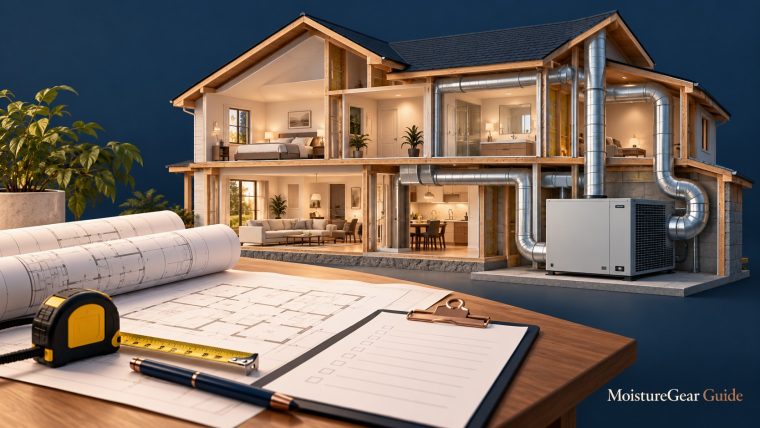
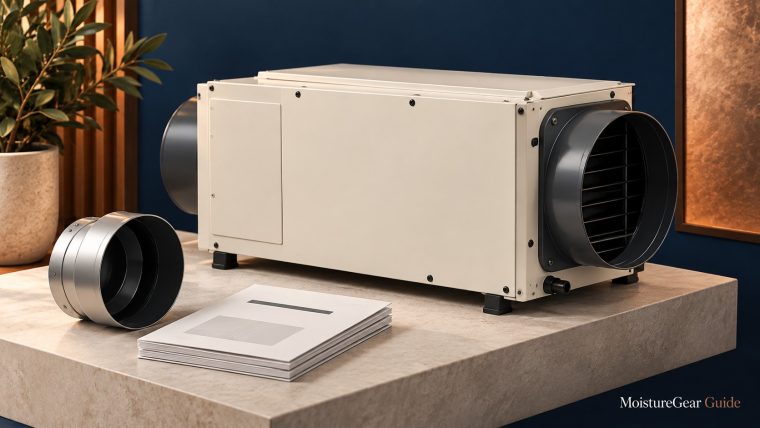
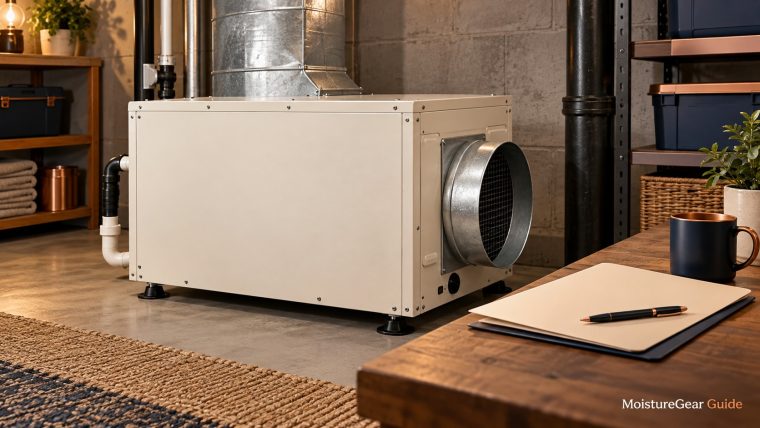
An AprilAire vs Santa Fe dehumidifier comparison should identify the exact models and product generations before comparing capacity or cost. AprilAire's E080 and E100 families are permanent options with built-in controls, while Santa Fe's Ultra98 and Ultra120 are whole-house ventilating models that require an external control. Either can belong in a well-planned project; the better fit depends on the moisture load, duct arrangement, ventilation design, and support available for the installation.
This research comparison uses current manufacturer specifications checked in October 2026, including Santa Fe's R454B documents and current non-W AprilAire sheets. It does not present laboratory tests, independent sound measurements, or failure-rate findings. The purpose is to make the model and installation tradeoffs clear enough for a useful quote comparison.
The products being compared
AprilAire's E080 and E100 are different capacity tiers with a similar nominal cabinet footprint. The W versions add connected controls, and other suffixes can change the supplied configuration.
Santa Fe's Ultra98 and Ultra120 are dedicated whole-house ventilating models. They provide connections and controls that can support an outdoor-air strategy when properly designed. They also have older R410A documentation still available alongside current R454B material.
The “98” and “120” model names should not be treated as guaranteed daily water-removal values. Current product data differs from some older figures circulated online.
We focus on those models because their documentation supports a meaningful permanent-installation discussion. Santa Fe also sells other product families for different applications; a brand-wide comparison that combines them would conceal the installation differences.
The whole-house hub provides the wider context, while the whole-house buying guide helps assemble an application-based shortlist.
Capacity at matching reference conditions
| Current documented model | At 80°F/60% RH | At 73°F/60% RH | Document context |
|---|---|---|---|
| AprilAire E080, non-W | 80 pints/day | 65 pints/day | October 2025 sheet |
| AprilAire E100, non-W | 100 pints/day | 85 pints/day | July 2025 sheet |
| Santa Fe Ultra98 | 100 pints/day | 71.4 pints/day | Current page and R454B documentation |
| Santa Fe Ultra120 | 118 pints/day | 88 pints/day | Current R454B data sheet |
The AprilAire E080 sheet, AprilAire E100 sheet, Santa Fe Ultra98 page, and Ultra120 R454B sheet provide the listed references.
These figures allow comparison at the same temperature and RH, but they do not describe performance at every pressure, temperature, and target setting. A contractor must still assess the installed system.
Why the warmer rating can change your first impression
At one warm-condition reference point, the E100 and current Ultra98 show the same capacity. At the cooler point in the table, their published figures differ.
That is useful information for a house normally operating closer to the cooler reference temperature. It also shows why comparing only the largest product-page figure can hide relevant behavior.
The Ultra120's larger warm-condition capacity is another example. Its cooler published figure is much closer to the E100's than the warm figures alone might suggest. That does not make the products interchangeable; it makes the rating conditions important.
Do not convert those differences into a claim that one brand will always dry a home faster. Available removal in the completed installation depends on inlet conditions, airflow, humidity objective, and the moisture entering the building.
Use the whole-house sizing guide to ask which operating points matter for your project. Model names and maximum floor-area claims are less useful than a documented load and performance assessment.
Controls: a meaningful package difference
The AprilAire models in the comparison have built-in humidity controls. The current Santa Fe Ultra98 and Ultra120 product descriptions identify an external control requirement.
That changes the purchasing checklist. A Santa Fe equipment-only price may exclude the wall control and installation scope needed for the intended system. Ask which control is included and whether it handles the planned ventilation function.
For AprilAire, distinguish the standard built-in control from a W-model connected configuration or any separate controller chosen by the installer. A Wi-Fi feature is useful only when the specific supplied product includes it and the installation location has suitable connectivity.
The actual sensing location matters for both brands. A mechanical-room cabinet may receive different air from the occupied area. The installer must choose a control strategy that matches the treatment objective.
Ask the same question of every proposal: which air or room will determine a humidity call, and how will that setting represent the served spaces?
Ventilation capability needs a design, not just a connection
Santa Fe's Ultra series is intended to support whole-house moisture control with an optional fresh-air path. That can be useful when the project includes ventilation, but outdoor air can add a moisture load under humid conditions.
AprilAire documentation also describes ventilation options for relevant configurations. It would be misleading to say the brand simply lacks a ventilation role. The exact model, accessories, controls, and installation design determine what is supported.
Ask the contractor how ventilation demand was established, which damper and control are specified, and how the dehumidifier is sized for that completed arrangement. Do not add an outdoor-air duct after sizing the equipment for a different load.
A ventilating dehumidifier is not permission to ignore the building's other air-quality and pressure requirements. Ventilation rates and local compliance belong in the professional design.
The DOE humidity-control research provides useful context for why moisture control can remain necessary even when the cooling load is modest.
Filters differ, but the rating is not the whole result
Current AprilAire E080 and E100 specifications identify a washable MERV 8 filter. Santa Fe's Ultra98 and Ultra120 identify MERV 13 media.
That is a documented package distinction. It may matter to a buyer who wants the specified filtration arrangement, but it should not be translated into an unsupported claim that one dehumidifier produces universally healthier air.
A filter treats air passing through it, and the actual circulation path matters. A higher filter rating does not solve insufficient return air from a remote room or establish a measured reduction in symptoms.
Filter care also differs by product. A washable filter and a replaceable media filter should be maintained according to their own instructions. Do not assume the Santa Fe media should be washed like an AprilAire filter.
Avoid substituting a more restrictive filter into the AprilAire cabinet simply to reproduce a rating from a different machine. The filter and blower are part of the approved system.
Airflow: compare pressure points and the intended layout
The models have different blower data. For a ducted project, compare available airflow at the design resistance rather than only at zero external static pressure.
Filters, return and supply grilles, duct length, bends, and dampers all influence resistance. A published CFM value without its pressure condition cannot tell you whether a proposed route is suitable.
Santa Fe's current product information gives several pressure points, and AprilAire's current sheets do the same. Those data should inform the contractor's duct selection and commissioning.
Different permitted HVAC connection layouts can also require different fan and damper behavior. Do not assume an AprilAire connection diagram applies unchanged to a Santa Fe unit or vice versa.
The current Santa Fe Ultra98/Ultra120 manual is the relevant model-specific reference. Our ducted versus standalone guide helps organize the layout questions without giving generic wiring instructions.
Installation size includes access and accessories
The AprilAire pair's nominal cabinet size can be attractive in constrained installations. The Santa Fe units have different cabinet and connection envelopes.
Measure the actual supplied model with collars, supports, ducts, drainage, and filter access in mind. Some product pages distinguish dimensions with and without collars; labels can be confusing when several drawings or revisions are present.
A fitting cabinet may still be hard to service. The filter needs to leave through an accessible route, panels need working space, and future replacement should be possible without dismantling permanent structures.
The transport route also matters. A loft or crawl-space opening may restrict the model before final-location dimensions become relevant. Installation quotes should acknowledge difficult handling rather than assuming the product will simply fit.
Ask for the matching dimension drawing and a description of the service envelope. Avoid choosing a brand based on a single simplified length or height.
Drainage is usually a separate planning decision
Permanent central units need a condensate route. For the compared AprilAire and Santa Fe configurations, an accessory pump may be necessary when a suitable gravity arrangement is unavailable; a built-in pump should not be assumed from the model name.
Compare the complete route, including the destination, tubing or pipe, power, and protection. A convenient nearby drain is useful only when the connection is appropriate for the installation.
If the machine is placed above a finished surface, ask how leakage will be detected and what protective action occurs. Protective hardware needs a planned function and commissioning, not merely an extra line on the quote.
An accessible external pump can be practical, but it adds another component to inspect and support. Its lift and flow capability must match the route.
The gravity versus pump article explains these choices. A drain design should remain sound whichever brand wins the equipment comparison.
Noise comparisons require restraint
Santa Fe publishes sound information for its models, and AprilAire sheets also contain sound figures. Those values are useful references only when the measurement circumstances are understood.
A comparison should not combine a ducted rating with a different measurement distance or an unspecified room condition and present the result as a definitive household ranking.
The experienced sound depends on location, mounting, room barriers, duct transmission, and airflow through grilles. A system next to a bedroom has different design priorities from one in an unfinished mechanical area.
Ask the installer about the complete acoustic arrangement and whether a relevant installed demonstration is available. Avoid enclosing the equipment in a way that blocks airflow or maintenance.
This guide does not call one brand independently tested quieter. It identifies noise as a site-specific factor that the final proposal should address.
Energy-factor numbers need the correct label
Manufacturers may publish efficiency data at different inlet conditions. ENERGY STAR uses integrated energy factor for certification, which is a defined metric rather than a generic synonym for every energy-factor value on a sheet.
Match the test condition and metric before using an efficiency difference to justify a purchase. Do not silently convert pints per kWh and liters per kWh without identifying what is being compared.
For household budgeting, runtime and the rest of the installation still matter. A central blower or ventilation strategy can add energy use beyond the dehumidifier's operation.
Use the electricity-cost guide for an explicit ownership estimate. It does not promise that one brand reduces bills by a fixed amount.
ENERGY STAR’s product guidance supports correctly sized and installed equipment. Good efficiency documentation is valuable, but it cannot rescue an unsuitable load assessment or restricted duct path.
Santa Fe warranty terms need more than the headline
The current Ultra98/Ultra120 manual contains a warranty effective January 1, 2024, describing five-year product-defect coverage and six-year component-defect coverage under its terms.
It identifies the original purchaser buying from the manufacturer or an authorized reseller and describes exclusions that include costs such as transportation and repair labor. That is not the same as six years with every service expense paid.
Read the applicable certificate for the model and purchase date and ask the manufacturer to confirm the seller route. Keep the invoice and product identification.
If the installer supplies the equipment, ask about labor coverage separately. If you buy it yourself, confirm the installer’s support policy and the warranty process before shipment.
The warranty guide explains why eligibility and service costs deserve their own comparison column.
AprilAire warranty information also needs matching
Current W-model promotional pages and older specification or warranty documents can use different descriptions. The right response is to obtain the terms governing the supplied unit, not to combine favorable phrases from several generations.
Ask for model, serial or production context where available, purchase-date terms, and any installation requirements. Confirm whether the purchase route qualifies.
A manufacturer's equipment warranty and a contractor's installation warranty are distinct. A replacement machine might qualify while the costs of removing and reinstalling it remain a separate question.
Keep written answers with the quote and invoice. A seller's assurance is easier to evaluate when it identifies a governing document.
This comparison avoids guaranteeing warranty coverage for any Amazon seller. Search links are simply a way to locate offers that still need verification.
Compare the installed packages
Have each proposal price the same served spaces, humidity objective, ventilation role, and level of follow-up. Then compare the equipment and installation components.
For Santa Fe, identify the selected external controller and required accessories. For AprilAire, identify the exact suffix and any separate controls. For both, name drainage, mounting, electrical work, ducts, and commissioning.
A lower cabinet price can be a genuine advantage if the completed supported installation is comparable. A higher total may also include meaningful design and service work. The itemized scope lets you judge that difference.
Use the whole-house cost guide to make the budget visible. Do not compare an equipment-only offer with a contractor’s complete central project as if both purchased the same outcome.
Local support should be verified model by model. Familiarity with a brand does not prove willingness to service a particular owner-supplied unit.
New construction and retrofit projects have different priorities
In a new build, settle the ventilation and humidity-control plan while duct routes and service access can still be coordinated. Choosing the equipment after those spaces are closed may create avoidable compromises.
In a retrofit, identify which existing constraints are real: finished surfaces, hatch dimensions, drain elevation, room return paths, or a central system that cannot support the proposed connection. A different layout can sometimes matter more than a different brand.
Ask both proposals to use the same final building assumptions. One contractor should not size for planned enclosure improvements while another sizes for the house as it stands, unless that difference is explicitly explained. Matching those assumptions makes both equipment and installation comparisons more meaningful.
Make the choice around the completed system
AprilAire may fit a proposal that uses its built-in control and a capacity tier supported by current performance data. A W configuration may be attractive where connected access is valuable.
Santa Fe Ultra models may fit a project that makes deliberate use of external controls, the specified filtration, and an appropriate ventilation arrangement. Include those features and their costs in the scope.
In either case, the performance table, duct design, condensate plan, and support process should agree with the actual unit being purchased. Model-generation conflicts should be resolved before payment.
Use the E080 review and E100 review to investigate those options further. The final recommendation should explain why one documented model and installation fit your house, with the remaining purchase checks clearly resolved.
Selected sources
- AprilAire current E080 manufacturer specifications
- AprilAire current E100 manufacturer specifications
- Santa Fe Ultra98 current product information
- Santa Fe Ultra120 R454B data sheet
- Santa Fe Ultra98/Ultra120 current manual and warranty
About the author
Davis Murphy
Davis Murphy writes about dehumidifiers, indoor humidity, and home moisture control at MoistureGear Guide. His articles explain how to compare equipment, understand capacity ratings, and plan for drainage and maintenance. He focuses on clear, practical guidance to help readers choose a dehumidifier suited to their space and needs.